


Molecular subgroups of adult medulloblastoma: a long-term single-institution study
- PMID: 27106407
- PMCID: PMC4896550
- DOI: 10.1093/neuonc/now050
Molecular subgroups of adult medulloblastoma: a long-term single-institution study
Abstract
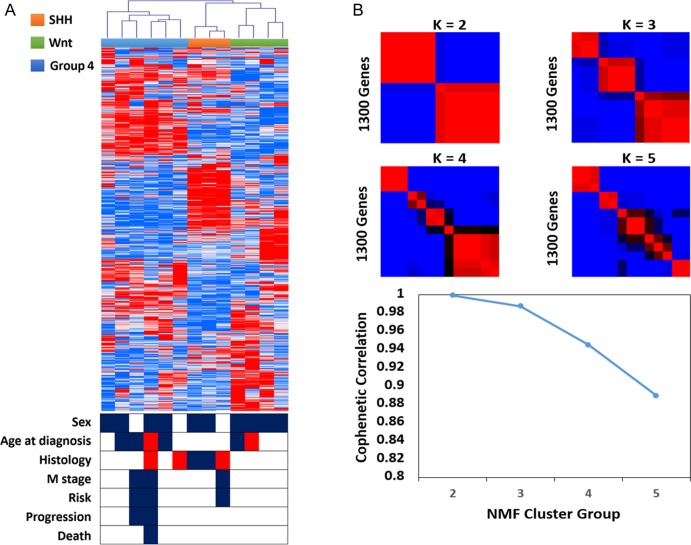
Background: Recent transcriptomic approaches have demonstrated that there are at least 4 distinct subgroups in medulloblastoma (MB); however, survival studies of molecular subgroups in adult MB have been inconclusive because of small sample sizes. The aim of this study is to investigate the molecular subgroups in adult MB and identify their clinical and prognostic implications in a large, single-institution cohort.
Methods: We determined gene expression profiles for 13 primary adult MBs. Bioinformatics tools were used to establish distinct molecular subgroups based on the most informative genes in the dataset. Immunohistochemistry with subgroup-specific antibodies was then used for validation within an independent cohort of 201 formalin-fixed MB tumors, in conjunction with a systematic analysis of clinical and histological characteristics.
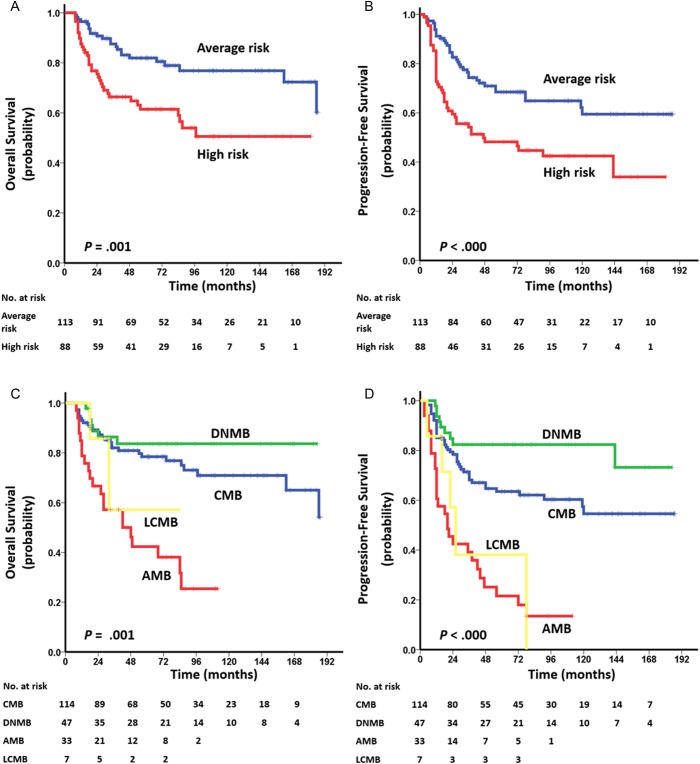
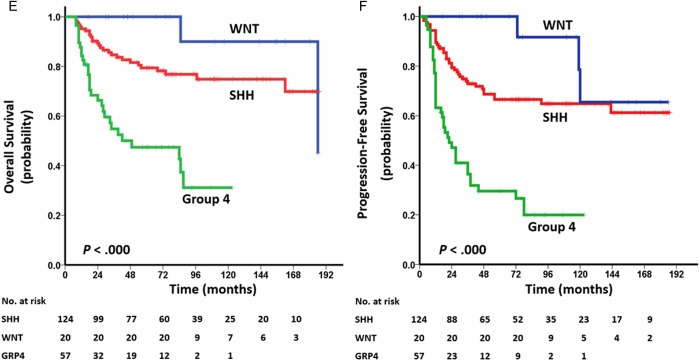
Results: Three distinct molecular variants of adult MB were identified: the SHH, WNT, and group 4 subgroups. Validation of these subgroups in the 201-tumor cohort by immunohistochemistry identified significant differences in subgroup-specific demographics, histology, and metastatic status. The SHH subgroup accounted for the majority of the tumors (62%), followed by the group 4 subgroup (28%) and the WNT subgroup (10%). Group 4 tumors had significantly worse progression-free and overall survival compared with tumors of the other molecular subtypes.
Conclusions: We have identified 3 subgroups of adult MB, characterized by distinct expression profiles, clinical features, pathological features, and prognosis. Clinical variables incorporated with molecular subgroup are more significantly informative for predicting adult patient outcome.
Keywords: adult medulloblastoma; histology; molecular subgroup; prognosis; survival.
© The Author(s) 2016. Published by Oxford University Press on behalf of the Society for Neuro-Oncology. All rights reserved. For permissions, please e-mail: journals.permissions@oup.com.
Figures
Comment in
-
Medulloblastoma in adults: they're not just big kids.Neuro Oncol. 2016 Jul;18(7):895-7. doi: 10.1093/neuonc/now110. Neuro Oncol. 2016. PMID: 27271088 Free PMC article. No abstract available.
References
-
- Giordana MT, Schiffer P, Lanotte M et al. . Epidemiology of adult medulloblastoma. Int J Cancer. 1999;80(5):689–692. - PubMed
-
- Polkinghorn WR, Tarbell NJ. Medulloblastoma: tumorigenesis, current clinical paradigm, and efforts to improve risk stratification. Nat Clin Pract Oncol. 2007;4(5):295–304. - PubMed
-
- Packer RJ, Gajjar A, Vezina G et al. . Phase III study of craniospinal radiation therapy followed by adjuvant chemotherapy for newly diagnosed average-risk medulloblastoma. J Clin Oncol. 2006;24(25):4202–4208. - PubMed
-
- Taylor RE, Bailey CC, Robinson K et al. . Results of a randomized study of preradiation chemotherapy versus radiotherapy alone for nonmetastatic medulloblastoma: the International Society of Paediatric Oncology/United Kingdom Children's Cancer Study Group PNET-3 Study. J Clin Oncol. 2003;21(8):1581–1591. - PubMed
-
- Gajjar A, Chintagumpala M, Ashley D et al. . Risk-adapted craniospinal radiotherapy followed by high-dose chemotherapy and stem-cell rescue in children with newly diagnosed medulloblastoma (St Jude Medulloblastoma-96): long-term results from a prospective, multicentre trial. Lancet Oncol. 2006;7(10):813–820. - PubMed
Publication types
MeSH terms
Substances
Grants and funding
LinkOut - more resources
Full Text Sources
Other Literature Sources
Molecular Biology Databases
Miscellaneous
