


Contemporary Profile of Seizures in Neonates: A Prospective Cohort Study
- PMID: 27106855
- PMCID: PMC4925241
- DOI: 10.1016/j.jpeds.2016.03.035
Contemporary Profile of Seizures in Neonates: A Prospective Cohort Study
Abstract
Objective: To determine the contemporary etiology, burden, and short-term outcomes of seizures in neonates monitored with continuous video-electroencephalogram (cEEG).
Study design: We prospectively collected data from 426 consecutive neonates (56% male, 88% term) ≤44 weeks' postmenstrual age with clinically suspected seizures and/or electrographic seizures. Subjects were assessed between January 2013 and April 2015 at 7 US tertiary care pediatric centers following the guidelines of the American Clinical Neurophysiology Society for cEEG for at-risk neonates. Seizure etiology, burden, management, and outcome were determined by chart review by the use of a case report form designed at study onset.
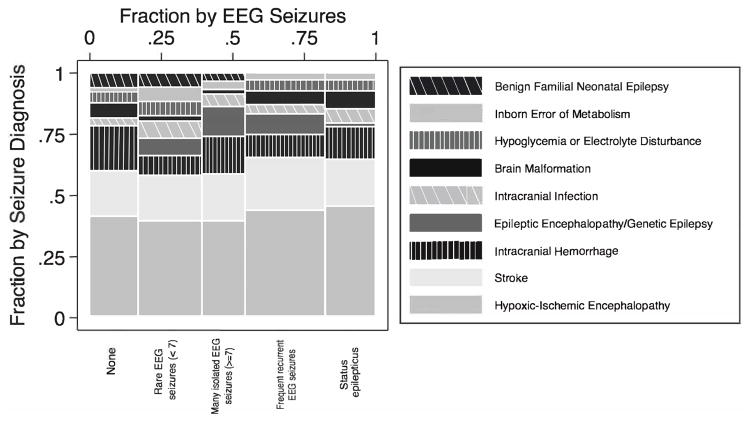
Results: The most common seizure etiologies were hypoxic-ischemic encephalopathy (38%), ischemic stroke (18%), and intracranial hemorrhage (11%). Seizure burden was high, with 59% having ≥7 electrographic seizures and 16% having status epilepticus; 52% received ≥2 antiseizure medications. During the neonatal admission, 17% died; 49% of survivors had abnormal neurologic examination at hospital discharge. In an adjusted analysis, high seizure burden was a significant risk factor for mortality, length of hospital stay, and abnormal neurological examination at discharge.
Conclusions: In this large contemporary profile of consecutively enrolled newborns with seizures treated at centers that use cEEG per the guidelines of the American Clinical Neurophysiology Society, about one-half had high seizure burden, received ≥2 antiseizure medications, and/or died or had abnormal examination at discharge. Greater seizure burden was associated with increased morbidity and mortality. These findings underscore the importance of accurate determination of neonatal seizure frequency and etiology and a potential for improved outcome if seizure burden is reduced.
Keywords: EEG; critical care; electroencephalogram; epilepsy; hypoxic-ischemic encephalopathy; infant; neonatal encephalopathy; neonatal seizures; neurocritical care.
Copyright © 2016 Elsevier Inc. All rights reserved.
Conflict of interest statement
The authors declare no conflicts of interest.
Figures
References
-
- Uria-Avellanal C, Marlow N, Rennie JM. Outcome following neonatal seizures. Semin Fetal Neonatal Med. 2013;18:224–32. - PubMed
-
- Ronen GM, Buckley D, Penney S, Streiner DL. Long-term prognosis in children with neonatal seizures: a population-based study. Neurology. 2007;69:1816–22. - PubMed
-
- Clancy RR, Legido A, Lewis D. Occult neonatal seizures. Epilepsia. 1988;29:256–61. - PubMed
-
- Biagioni E, Ferrari F, Boldrini A, Roversi MF, Cioni G. Electroclinical correlation in neonatal seizures. Eur J Paediatr Neurol. 1998;2:117–25. - PubMed
-
- Painter MJ, Scher MS, Stein AD, Armatti S, Wang Z, Gardiner JC, et al. Phenobarbital compared with phenytoin for the treatment of neonatal seizures. N Engl J Med. 1999;341:485–9. - PubMed
Publication types
MeSH terms
Substances
Grants and funding
LinkOut - more resources
Full Text Sources
Other Literature Sources
Medical
Miscellaneous
