


Public preferences for electronic health data storage, access, and sharing - evidence from a pan-European survey
- PMID: 27107445
- PMCID: PMC5070520
- DOI: 10.1093/jamia/ocw012
Public preferences for electronic health data storage, access, and sharing - evidence from a pan-European survey
Abstract
Objective: To assess the public's preferences regarding potential privacy threats from devices or services storing health-related personal data.
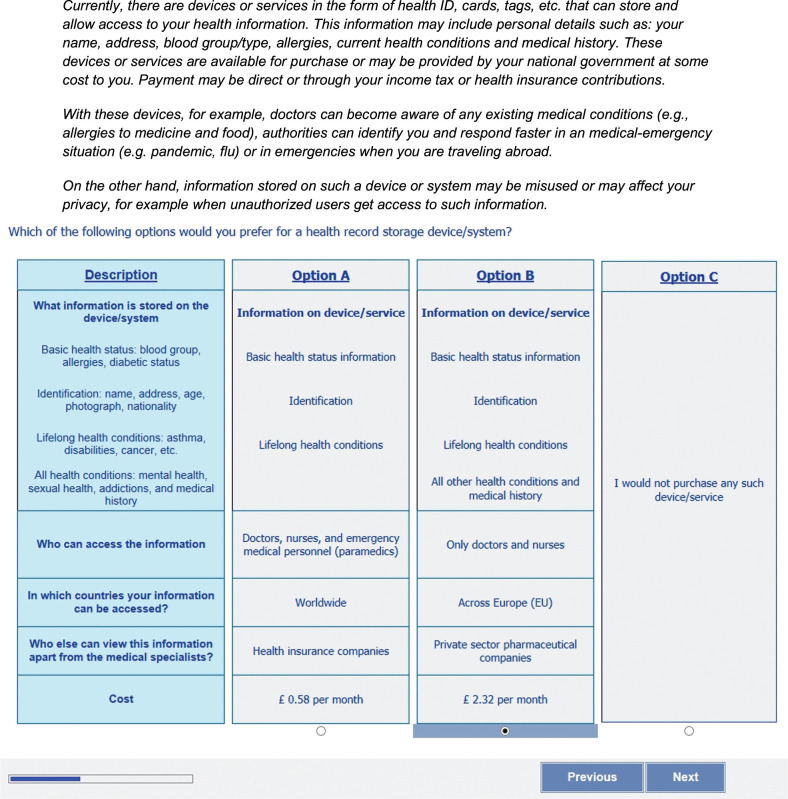
Materials and methods: A pan-European survey based on a stated-preference experiment for assessing preferences for electronic health data storage, access, and sharing.
Results: We obtained 20 882 survey responses (94 606 preferences) from 27 EU member countries. Respondents recognized the benefits of storing electronic health information, with 75.5%, 63.9%, and 58.9% agreeing that storage was important for improving treatment quality, preventing epidemics, and reducing delays, respectively. Concerns about different levels of access by third parties were expressed by 48.9% to 60.6% of respondents.On average, compared to devices or systems that only store basic health status information, respondents preferred devices that also store identification data (coefficient/relative preference 95% CI = 0.04 [0.00-0.08], P = 0.034) and information on lifelong health conditions (coefficient = 0.13 [0.08 to 0.18], P < 0.001), but there was no evidence of this for devices with information on sensitive health conditions such as mental and sexual health and addictions (coefficient = -0.03 [-0.09 to 0.02], P = 0.24). Respondents were averse to their immediate family (coefficient = -0.05 [-0.05 to -0.01], P = 0.011) and home care nurses (coefficient = -0.06 [-0.11 to -0.02], P = 0.004) viewing this data, and strongly averse to health insurance companies (coefficient = -0.43 [-0.52 to 0.34], P < 0.001), private sector pharmaceutical companies (coefficient = -0.82 [-0.99 to -0.64], P < 0.001), and academic researchers (coefficient = -0.53 [-0.66 to -0.40], P < 0.001) viewing the data.
Conclusions: Storing more detailed electronic health data was generally preferred, but respondents were averse to wider access to and sharing of this information. When developing frameworks for the use of electronic health data, policy makers should consider approaches that both highlight the benefits to the individual and minimize the perception of privacy risks.
Keywords: Health records; attitudes; data privacy; personal data; public preferences; stated preference.
© The Author 2016. Published by Oxford University Press on behalf of the American Medical Informatics Association.
Figures
References
-
- Adler-Milstein J Jha AK . No evidence found that hospitals are using new electronic health records to increase Medicare reimbursements . Health Affairs. 2014. ; 33 ( 7 ): 1271 – 1277 . - PubMed
-
- Ioannidis JP . Are mortality differences detected by administrative data reliable and actionable? JAMA. 2013. ; 309 ( 13 ): 1410 – 1411 . - PubMed
-
- Robinson N Potoglou D Kim CW et al. . Security at what cost? Quantifying people's trade-offs across liberty, privacy, and security. 2010. http://www.rand.org/pubs/technical_reports/TR664.html . Accessed July 25, 2014 .
-
- National Information Board . Personalised Health and Care 2020. 2014 .
Publication types
MeSH terms
LinkOut - more resources
Full Text Sources
Other Literature Sources
