Review
. 2016 Apr 23:17:44.
doi: 10.1186/s12931-016-0358-z.

Regeneration of the lung: Lung stem cells and the development of lung mimicking devices

Affiliations
Review

Regeneration of the lung: Lung stem cells and the development of lung mimicking devices

Kim A A Schilders et al. Respir Res. .

Abstract

Inspired by the increasing burden of lung associated diseases in society and an growing demand to accommodate patients, great efforts by the scientific community produce an increasing stream of data that are focused on delineating the basic principles of lung development and growth, as well as understanding the biomechanical properties to build artificial lung devices. In addition, the continuing efforts to better define the disease origin, progression and pathology by basic scientists and clinicians contributes to insights in the basic principles of lung biology. However, the use of different model systems, experimental approaches and readout systems may generate somewhat conflicting or contradictory results. In an effort to summarize the latest developments in the lung epithelial stem cell biology, we provide an overview of the current status of the field. We first describe the different stem cells, or progenitor cells, residing in the homeostatic lung. Next, we focus on the plasticity of the different cell types upon several injury-induced activation or repair models, and highlight the regenerative capacity of lung cells. Lastly, we summarize the generation of lung mimics, such as air-liquid interface cultures, organoids and lung on a chip, that are required to test emerging hypotheses. Moreover, the increasing collaboration between distinct specializations will contribute to the eventual development of an artificial lung device capable of assisting reduced lung function and capacity in human patients.

Keywords: Lung; Lung mimics; Regeneration; Stem cells; Tissue engineering.


Figures
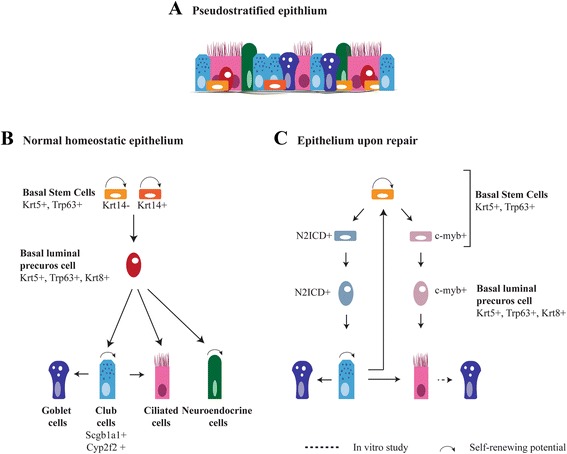
Fig. 1
Fig. 1
Regeneration of pseudostratified airway epithelium of the lung. a The airways are lined by a pseudostratified epithelium consisting of secretory cells (goblet and club cells), ciliated cells, neuroendocrine cells and basal cells. Goblet cells are abundant in the human epithelium, but are rare in mice. b The relationship between the different epithelial cells during normal homeostasis. The basal cells are progenitor cells of the pseudostratified epithelium which are heterogeneous for the expression of Krt14. The basal cell becomes a Krt8 positive luminal precursor cell before further differentiation. A basal cell differentiate into secretory cells and neuroendocrine cells under homeostatic conditions. Neuroendocrine cells are also capable to self-renew [162]. Scgb1a1+ secretory cells are a self-renewing population and can give rise to ciliated cells. In homeostatic epithelium, there is a very low turnover of cells. It is likely that the dividing secretory cell population is sufficient to regenerate ciliated cells in homeostatic condition. However, their generation from basal cells is not excluded. Upon allergen exposure, secretory cells are the main source of goblet cells [163], but it is unknown whether basal cells can directly differentiate into goblet cells. (C). Upon depletion of luminal cells by SO2exposure, basal cells proliferate and subdivide into two populations, N2ICD and c-myb positive, respectively, differentiating into secretory and ciliated cells. After the loss of basal cells, secretory cells (de)differentiate into functional progenitor basal stem cells. In a normal pseudostratified epithelium, only a few scattered goblet cells are present. Increases in goblet cells are observed upon immune stimuli and in diseases like COPD. Lineage tracing studies show that goblet cells can arise from Scgb1a1+ secretory cells and recently a trans-differentiation of foxj1+ ciliated cells to goblet cells was observed upon smoke exposure in culture
Fig. 2
Fig. 2
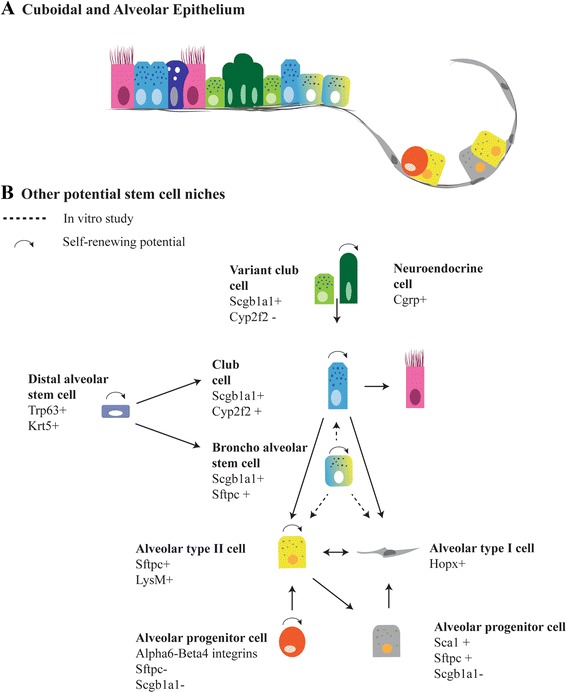
Regeneration of distal and alveolar airway epithelium after injury. a The small airways lack basal cells and consist of cuboidal epithelium, containing secretory and ciliated cells, as well as clusters of neuroendocrine cells. The cuboidal epithelium passes into a broncho-alveolar duct junction which is the niche of broncho-alveolar stem cells. The alveolar epithelium consists of alveolar type I, type II cells and alveolar progenitor cells. b Variant club cells (Cyp2f2) are a variant of secretory cells that survive naphtalene injury and give rise to cyp2f2+ club cells. Lineage tracing of Cgrp+ cells showed that after depletion of club cells by naphtalene injury neuroendocrine cells contribute to the regeneration of these cells. At the broncho-alveolar duct junction, broncho-alveolar stem cells were isolated and shown to differentiate into bronchiolar and alveolar lineages in culture (dashed lines). Scgb1a1+ cells have the potential to form alveolar type I and type II cells after bleomycin injury, but not after hyperoxia-induced injury (dashed line). AT-II cells can self-renew and differentiate to AT-I cells. After pneumonectomy, a contribution of AT-I cells to regenerate AT-II cells was observed. An alveolar progenitor cell expressing α6-β4 integrins can regenerate AT-II cells after injury. Yet another cell type was identified expressing Sca1+ arising from AT-II cells and regenerating AT-I cells. Distal alveolar stem cells appear after severe injury and give rise to secretory and alveolar cells
Fig. 3
Fig. 3
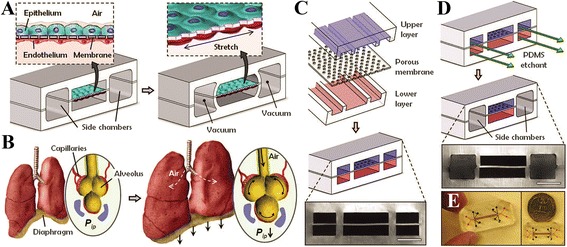
Example of a human breathing lung-on-a-chip microdevice. Lung-on-a-chip microfluidic device with compartmentalized microchannels to mimic a breathing lung (From Huh et al., “Reconstituting organ-level lung functions on a chip”, Science 2010; 328:1662–8. Reprinted with permission from the AAAS [100]). See original reference for detailed description of the figure. In brief, (a) indicates the creation of mechanical breathing movements causing mechanical stretch of the membrane, (b) shows the physiology of the normal breathing human lung, (c) and (d) show the assembly and etching of the microdevice, and (e) visualizes the actual size of the device

References

    1. Beers MF, Morrisey EE. The three R's of lung health and disease: repair, remodeling, and regeneration. J Clin Investig. 2011;121:2065–73. doi: 10.1172/JCI45961. - DOI - PMC - PubMed
    1. Volckaert T, De Langhe S. Lung epithelial stem cells and their niches: Fgf10 takes center stage. Fibrogenesis Tissue Repair. 2014;7:8. doi: 10.1186/1755-1536-7-8. - DOI - PMC - PubMed
    1. Kotton DN, Morrisey EE. Lung regeneration: mechanisms, applications and emerging stem cell populations. Nat Med. 2014;20:822–32. doi: 10.1038/nm.3642. - DOI - PMC - PubMed
    1. Hogan BLM, Barkauskas CE, Chapman HA, Epstein JA, Jain R, Hsia CCW, Niklason L, Calle E, Le A, Randell SH, et al. Repair and Regeneration of the Respiratory System: Complexity, Plasticity, and Mechanisms of Lung Stem Cell Function. Cell Stem Cell. 2014;15:123–38. doi: 10.1016/j.stem.2014.07.012. - DOI - PMC - PubMed
    1. Lin C, Yao E, Chuang PT. A conserved MST1/2-YAP axis mediates Hippo signaling during lung growth. Dev Biol. 2015;403:101–13. doi: 10.1016/j.ydbio.2015.04.014. - DOI - PMC - PubMed

Publication types