


Depressive symptoms in older long-term colorectal cancer survivors: a population-based analysis using the SEER-Medicare healthcare outcomes survey
- PMID: 27108264
- PMCID: PMC7064812
- DOI: 10.1007/s00520-016-3227-x
Depressive symptoms in older long-term colorectal cancer survivors: a population-based analysis using the SEER-Medicare healthcare outcomes survey
Abstract
Purpose: Colorectal cancer survivorship has improved significantly over the last 20 years; however, few studies have evaluated depression among older colorectal cancer survivors, especially using a population-based sample. The aim of this study was to identify correlates for positive depression screen among colorectal cancer survivors who underwent potentially curative surgery.
Methods: Using the 1998-2007 Surveillance, Epidemiology, and End-Result registry and the Medicare Health Outcome Survey linked dataset, we identified patients over 65 with pathology confirmed and resected colorectal cancer enrolled in Medicare. Using univariate and multiple variable analyses, we identified characteristics of patients with and without positive depression screen.
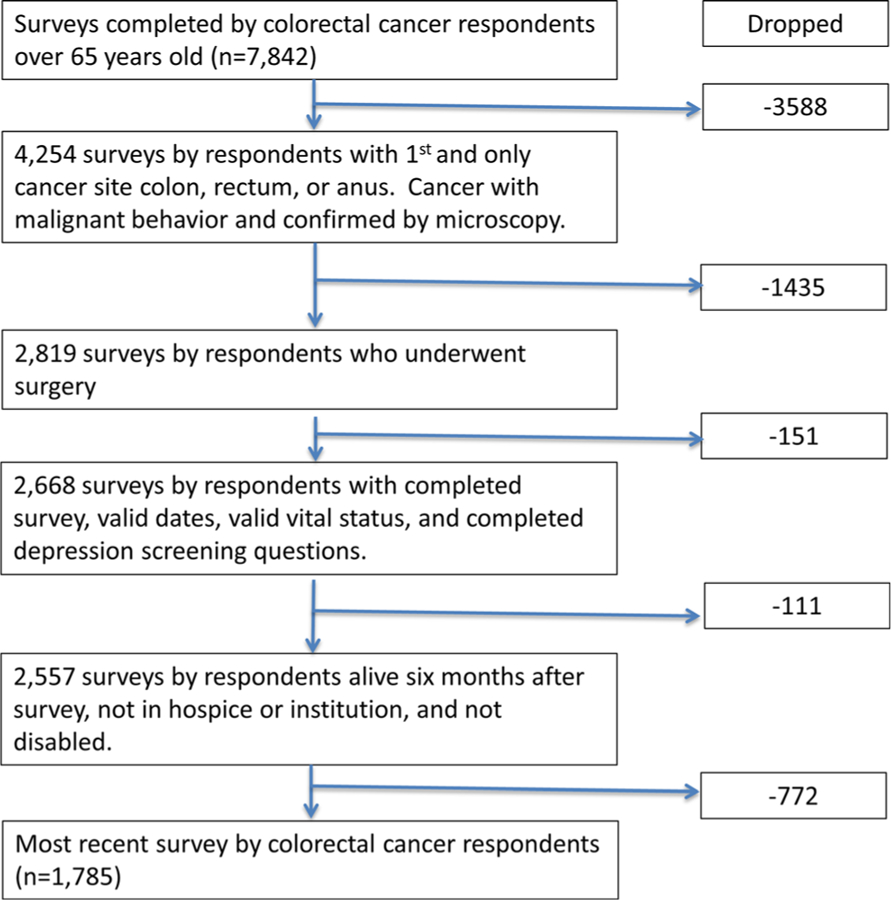
Results: Resected colorectal cancer patients (1785) (median age 77, 50.8 % female) were identified in the dataset with 278 (15.6 %) screening positive for symptoms of depression. Median time from diagnosis to survey was 62 months. On univariate analysis, larger tumor size, advanced cancer stage, and extent of resection were not correlates of depressive symptoms (all p > 0.05). After adjusting for confounders, income less than US$30,000 per year (OR 1.50, 1.02-2.22, 95 % CI, p = 0.042), non-white race (OR 1.51, 1.05-2.17, 95 % CI, p = 0.027), two or more comorbidities (OR 1.78, 1.25-2.52, 95 % CI, p = 0.001), and impairment in activities of daily living (OR 5.28, 3.67-7.60, 95 % CI, p < 0.001) were identified as independent correlates of depressive symptoms in colorectal cancer survivors.
Conclusions: In the current study, socioeconomic status and features of physical health rather than tumor characteristics were associated with symptoms of depression among long-term colorectal cancer survivors.
Keywords: Cancer survivor; Colorectal cancer; Depression; Elderly; Quality of life; Surgery.
Conflict of interest statement
Figures
References
-
- SEER. SEER Stat Fact Sheets: colon and rectum cancer. Natl Cancer Inst 2015. http://perma.cc/HXD2-SDSK.
-
- Siegel R, Jemal A. Colorectal cancer facts and figures 2011–2013. Am Cancer Soc 2013:1–27.
-
- Levin B, DA L, McFarland B, RA S, D B, KS A, et al. (2008) Screening and surveillance for the early detection of colorectal cancer and adenomatous polyps, 2008: a joint guideline from the American Cancer Society, the US multi-society task force on colorectal cancer, and the American College of Radiology. CA Cancer J Clin 58:130–160. doi: 10.3322/CA.2007.0018 - DOI - PubMed
MeSH terms
Grants and funding
LinkOut - more resources
Full Text Sources
Other Literature Sources
Medical
