


Sleep Problems in Childhood and Borderline Personality Disorder Symptoms in Early Adolescence
- PMID: 27108717
- PMCID: PMC5219009
- DOI: 10.1007/s10802-016-0158-4
Sleep Problems in Childhood and Borderline Personality Disorder Symptoms in Early Adolescence
Abstract
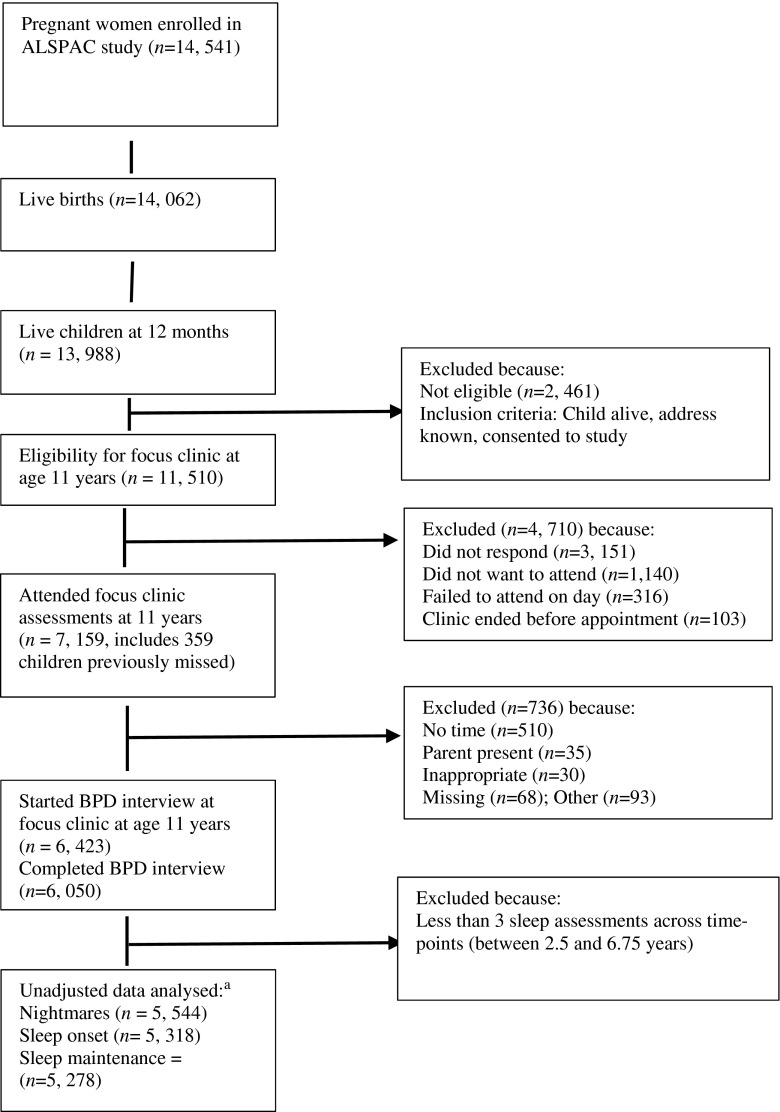
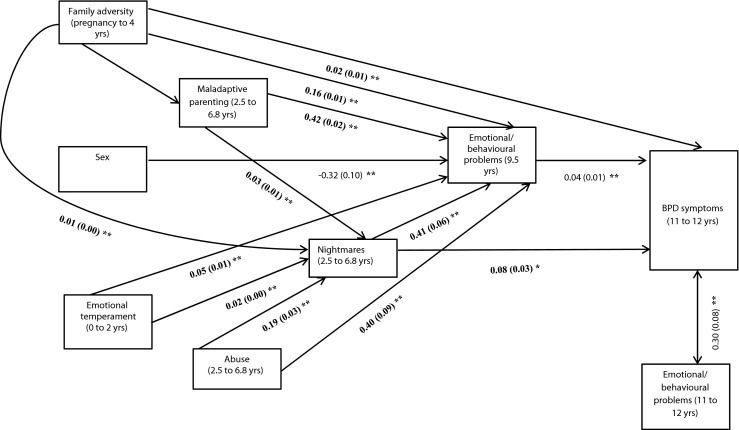
Sleep disorders, such as insomnia and nightmares, are commonly associated with Borderline Personality Disorder (BPD) in adulthood. Whether nightmares and sleep-onset and maintenance problems predate BPD symptoms earlier in development is unknown. We addressed this gap in the literature using data from the Avon Longitudinal Study of Parents and Children (ALSPAC). Participants included 6050 adolescents (51.4 % female) who completed the UK Childhood Interview for DSM-IV BPD at 11 to 12 years of age. Nightmares and sleep onset and maintenance problems were prospectively assessed via mother report when children were 2.5, 3.5, 4.8 and 6.8 years of age. Psychopathological (i.e., emotional temperament; psychiatric diagnoses; and emotional and behavioural problems) and psychosocial (i.e., abuse, maladaptive parenting, and family adversity) confounders were assessed via mother report. In logistic regressions, persistent nightmares (i.e., regular nightmares at 3 or more time-points) were significantly associated with BPD symptoms following adjustment for sleep onset and maintenance problems and all confounders (Adjusted Odds Ratio = 1.62; 95 % Confidence Interval = 1.12 to 2.32). Persistent sleep onset and maintenance problems were not significantly associated with BPD symptoms. In path analysis controlling for all associations between confounders, persistent nightmares independently predicted BPD symptoms (Probit co-efficient [β] = 0.08, p = 0.013). Emotional and behavioural problems significantly mediated the association between nightmares and BPD (β =0.016, p < 0.001), while nightmares significantly mediated associations between emotional temperament (β = 0.001, p = 0.018), abuse (β = 0.015, p = 0.018), maladaptive parenting (β = 0.002, p = 0.021) and subsequent BPD. These findings tentatively support that childhood nightmares may potentially increase the risk of BPD symptoms in early adolescence via a number of aetiological pathways. If replicated, the current findings could have important implications for early intervention, and assist clinicians in the identification of children at risk of developing BPD.
Keywords: ALSPAC; Adolescence; BPD; Borderline personality disorder; Childhood; Nightmares; Sleep.
Conflict of interest statement
S.T.L., C.W, N.K.Y.T & D.W report no conflict of interest.
Figures
References
-
- Allison PD. Comparing logit and probit coefficients across groups. Sociological Methods & Research. 1999;28:186–208. doi: 10.1177/0049124199028002003. - DOI
-
- Bollen KA, Stine R. Direct and indirect effects: classical and bootstrap estimates of variability. Sociological Methodology. 1990;20:15–140. doi: 10.2307/271084. - DOI
-
- Bornovalova MA, Hicks BM, Iacono WG, McGue M. Longitudinal twin study of borderline personality disorder traits and substance use in adolescence: developmental change, reciprocal effects, and genetic and environmental influences. Personality Disorders: Theory, Research, and Treatment. 2013;4:23–32. doi: 10.1037/a0027178. - DOI - PMC - PubMed
Publication types
MeSH terms
Grants and funding
LinkOut - more resources
Full Text Sources
Other Literature Sources
Medical
Miscellaneous
