


Annual incidence rates of hip symptoms and three hip OA outcomes from a U.S. population-based cohort study: the Johnston County Osteoarthritis Project
- PMID: 27109873
- PMCID: PMC5466003
- DOI: 10.1016/j.joca.2016.04.012
Annual incidence rates of hip symptoms and three hip OA outcomes from a U.S. population-based cohort study: the Johnston County Osteoarthritis Project
Abstract
Objective: Estimate annual incidence rates (IRs) of hip symptoms and three osteoarthritis (OA) outcomes (radiographic, symptomatic, and severe radiographic) overall and by race, sociodemographic characteristics, and hip OA risk factors.
Design: Analyze baseline (1991-1997) and first follow-up (1999-2003) data (n = 1446) from the Johnston County Osteoarthritis Project, a population-based, prospective study of adults ≥45 years in North Carolina. Hip symptoms were pain, aching, and/or stiffness on most days, or groin pain. Radiographic and severe radiographic OA were Kellgren-Lawrence (KL) grades ≥2 and ≥3, respectively. Symptomatic OA was radiographic OA with symptoms in the same hip. Sociodemographics were age, gender, race, highest attained education, and annual household income. Hip OA risk factors were self-reported body mass index (BMI) at age 18 years, clinically measured BMI at baseline, and history of hip injury.
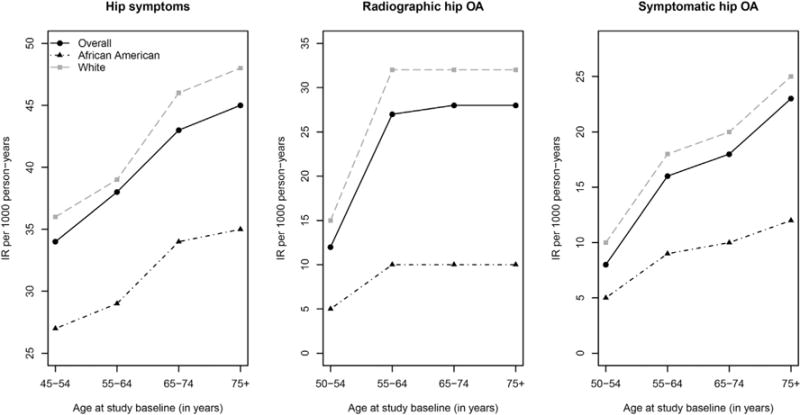
Results: Annual IRs (median = 5.5 years follow-up) were 37, 23, 13, and 2.9 per 1000 person-years for hip symptoms, and radiographic, symptomatic, and severe radiographic hip OA, respectively. We found low IRs of radiographic and symptomatic hip OA among African Americans and high IRs of hip symptoms among the obese and the very poor. Across outcomes, IRs were highest for those with hip injury.
Conclusion: No prior studies have reported IRs of hip symptoms; IRs of radiographic and severe radiographic hip OA were similar to, and the IR of symptomatic hip OA was higher than, previous estimates. Prevention efforts should target low socioeconomic status (SES) populations and obese adults; interventions for hip OA and hip symptoms are imperative for those with hip injuries.
Keywords: Hip osteoarthritis; Hip symptoms; Incidence rates; Race; Socioeconomic status.
Published by Elsevier Ltd.
Figures
References
-
- Katz JN, Losina E, Barrett J, Phillips CB, Mahomed NN, Lew RA, et al. Association between hospital and surgeon procedure volume and outcomes of total hip replacement in the United States medicare population. J Bone Joint Surg Am. 2001;83-A:1622–9. - PubMed
-
- Kurtz S, Ong K, Lau E, Mowat F, Halpern M. Projections of primary and revision hip and knee arthroplasty in the United States from 2005 to 2030. J Bone Joint Surg Am. 2007;89:780–5. - PubMed
MeSH terms
Grants and funding
LinkOut - more resources
Full Text Sources
Other Literature Sources
