


Appointment reminder systems are effective but not optimal: results of a systematic review and evidence synthesis employing realist principles
- PMID: 27110102
- PMCID: PMC4831598
- DOI: 10.2147/PPA.S93046
Appointment reminder systems are effective but not optimal: results of a systematic review and evidence synthesis employing realist principles
Abstract
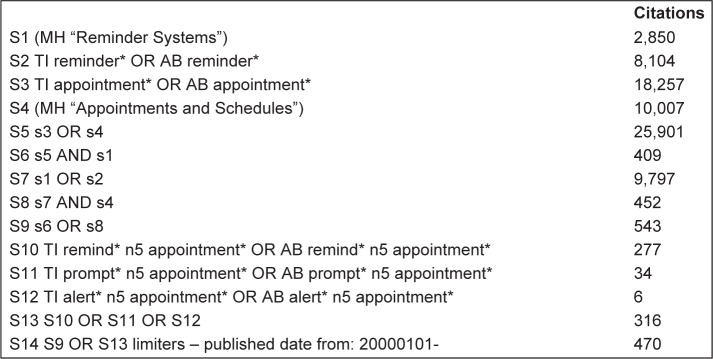
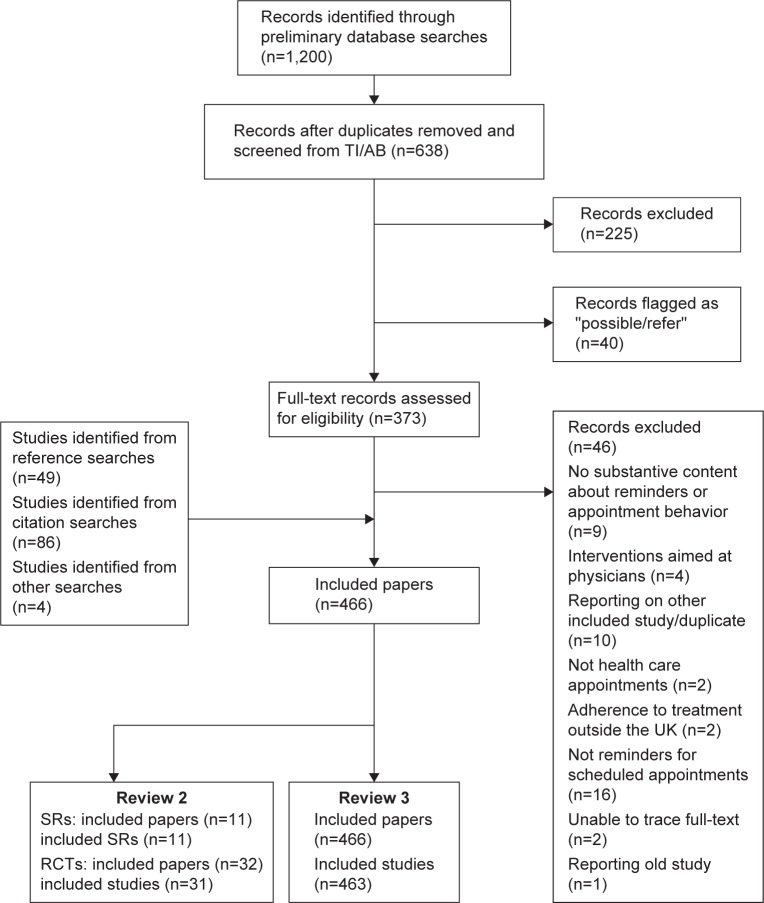
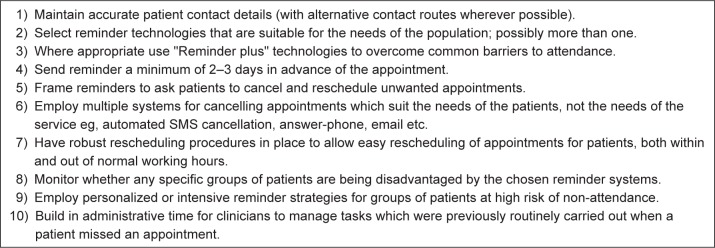
Missed appointments are an avoidable cost and resource inefficiency which impact upon the health of the patient and treatment outcomes. Health care services are increasingly utilizing reminder systems to manage these negative effects. This study explores the effectiveness of reminder systems for promoting attendance, cancellations, and rescheduling of appointments across all health care settings and for particular patient groups and the contextual factors which indicate that reminders are being employed sub-optimally. We used three inter-related reviews of quantitative and qualitative evidence. Firstly, using pre-existing models and theories, we developed a conceptual framework to inform our understanding of the contexts and mechanisms which influence reminder effectiveness. Secondly, we performed a review following Centre for Reviews and Dissemination guidelines to investigate the effectiveness of different methods of reminding patients to attend health service appointments. Finally, to supplement the effectiveness information, we completed a review informed by realist principles to identify factors likely to influence non-attendance behaviors and the effectiveness of reminders. We found consistent evidence that all types of reminder systems are effective at improving appointment attendance across a range of health care settings and patient populations. Reminder systems may also increase cancellation and rescheduling of unwanted appointments. "Reminder plus", which provides additional information beyond the reminder function may be more effective than simple reminders (ie, date, time, place) at reducing non-attendance at appointments in particular circumstances. We identified six areas of inefficiency which indicate that reminder systems are being used sub-optimally. Unless otherwise indicated, all patients should receive a reminder to facilitate attendance at their health care appointment. The choice of reminder system should be tailored to the individual service. To optimize appointment and reminder systems, health care services need supportive administrative processes to enhance attendance, cancellation, rescheduling, and re-allocation of appointments to other patients.
Keywords: TURNUP; attendance; cancellation; rescheduling.
Figures
References
-
- Ulmer T, Troxler C. The economic cost of missed appointments and the open access system. 2006. [Accessed December 20, 2013]. Available from: http://citeseerx.ist.psu.edu/viewdoc/download?doi=10.1.1.513.1864&rep=re....
-
- Mandirola H, Guillen S, Laguzzi P.IT technologies to reduce the rate of missed appointments in the outpatients 24th International Conference of the European Federation for Medical Informatics Quality of Life through Quality of Information; 2012Available from: http://person.hst.aau.dk/ska/mie2012/CD/Interface_MIE2012/MIE_2012_Conte...Accessed October 20, 2015
-
- Nour El-Din MM, Al-Shakhs FN, Al-Oudah SS. Missed appointments at a university hospital in eastern Saudi Arabia: Magnitude and association factors. J Egypt Public Health Assoc. 2008;83(5–6):415–433. - PubMed
-
- Taylor NF, Bottrell J, Lawler K, et al. Mobile telephone short message service reminders can reduce nonattendance in physical therapy outpatient clinics: A randomized controlled trial. Arch Phys Med Rehabil. 2012;93(1):21–26. - PubMed
-
- Quarterly hospital activity – published data. Department of Health; 2012. [Accessed October 20, 2015]. Available from: http://transparency.dh.gov.uk/?p=19701.
Publication types
Grants and funding
LinkOut - more resources
Full Text Sources
Other Literature Sources
