Review
. 2015 Fall-Winter;12(3-4):299-319.
doi: 10.1900/RDS.2015.12.299. Epub 2016 Feb 10.

Complex Genetics of Type 2 Diabetes and Effect Size: What have We Learned from Isolated Populations?

Affiliations
Review

Complex Genetics of Type 2 Diabetes and Effect Size: What have We Learned from Isolated Populations?

Anup K Nair et al. Rev Diabet Stud. 2015 Fall-Winter.

Abstract

Genetic studies in large outbred populations have documented a complex, highly polygenic basis for type 2 diabetes (T2D). Most of the variants currently known to be associated with T2D risk have been identified in large studies that included tens of thousands of individuals who are representative of a single major ethnic group such as European, Asian, or African. However, most of these variants have only modest effects on the risk for T2D; identification of definitive 'causal variant' or 'causative loci' is typically lacking. Studies in isolated populations offer several advantages over outbred populations despite being, on average, much smaller in sample size. For example, reduced genetic variability, enrichment of rare variants, and a more uniform environment and lifestyle, which are hallmarks of isolated populations, can reduce the complexity of identifying disease-associated genes. To date, studies in isolated populations have provided valuable insight into the genetic basis of T2D by providing both a deeper understanding of previously identified T2D-associated variants (e.g. demonstrating that variants in KCNQ1 have a strong parent-of-origin effect) or providing novel variants (e.g. ABCC8 in Pima Indians, TBC1D4 in the Greenlandic population, HNF1A in Canadian Oji-Cree). This review summarizes advancements in genetic studies of T2D in outbred and isolated populations, and provides information on whether the difference in the prevalence of T2D in different populations (Pima Indians vs. non-Hispanic Whites and non-Hispanic Whites vs. non-Hispanic Blacks) can be explained by the difference in risk allele frequencies of established T2D variants.


Conflict of interest statement

The authors report no conflict of interests.

Figures
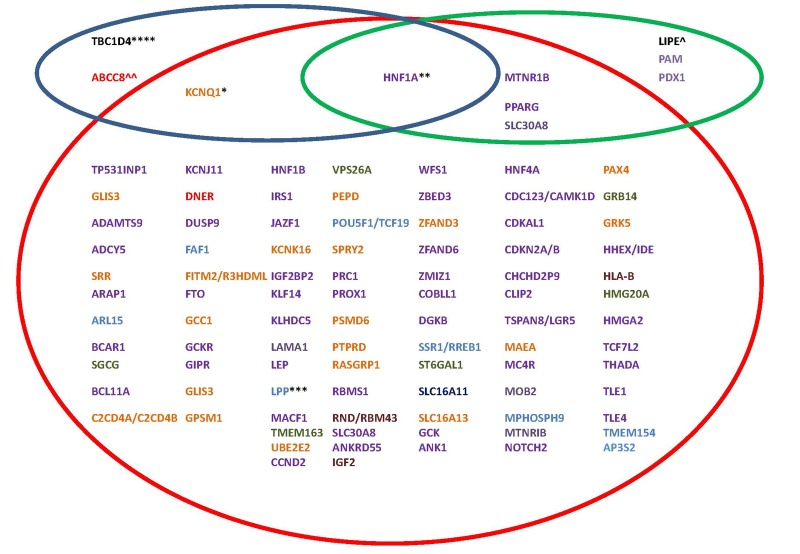
Figure 1
Figure 1. Loci that harbor variants associated with type 2 diabetes [10, 47, 68, 87, 135, 138, 145, 147]
Red circle: Loci harboring common variants with small effect size (OR < 1.5) primarily identified by GWASs. Green circle: Loci harboring low frequency variants with large effect size (OR > 1.8). Blue circle: Loci harboring common variants with large effect size (OR > 1.8). Also indicated are the populations in which the loci were initially detected: Caucasian European, East Asian, South Asian, African American, Pima Indians, Mexican, trans-ancestry meta-analysis (see color code). * Variants in KCNQ1 were first identified in Japanese; subsequently a strong parent-of-origin effect for KCNQ1 variants has been independently shown in family studies of Icelandic and Pima Indian populations. In Pima Indians, one of the KCNQ1 variants explained ~4% of the observed variance in T2D (OR > 1.9). ** A common variant (G319S) in HNF4A has been identified in the Oji-Cree population with an OR of 4.00 when comparing homozygous individuals for either allele. Rare variants in HNF4A have been identified in a Mexican population which increases T2D risk 5-fold. *** Variants in LPP were initially identified by a trans-ancestry meta-analysis; however studies in Pima Indians identified an independent variant associated with T2D. **** A Greenlandic study identified a common nonsense variant in TBC1D4 which increases T2D risk by ~10 fold. ^ A rare nonsense variant in LIPE was identified in the Old Order Amish which substantially increases risk for T2D (OR = 1.8). ^^ A common (3% of the population) missense variant was identified in ABCC8 in Pima Indians that associated with a 2-fold increased risk for T2D.
Figure 2
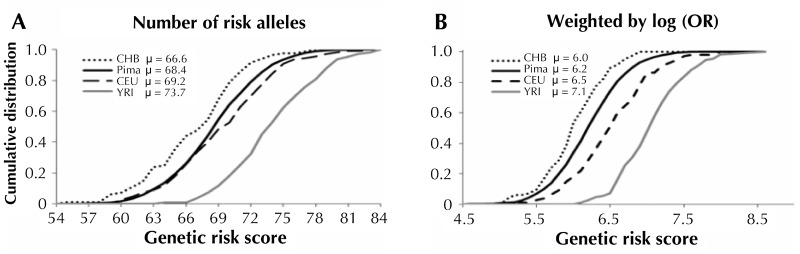
Figure 2. Cumulative distribution of the genetic risk score (GRS) for type 2 diabetes in Pimas and in each of the HapMap populations (Han Chinese in Beijing (CHB), Utah residents with ancestry from northern and western Europe (CEU) and Yoruba in Ibadan (YRI))
In the left panel (A), the GRS was calculated as the sum of the number of risk alleles across 63 type 2 diabetes loci, while in the right panel (B) it is the sum of the number of risk alleles multiplied by log (OR), as determined in Europeans. Differences in the mean GRS (µ) between populations were compared in a mixed model in which population was a fixed effect and sibship was a random effect. Modified from [131].
Figure 3
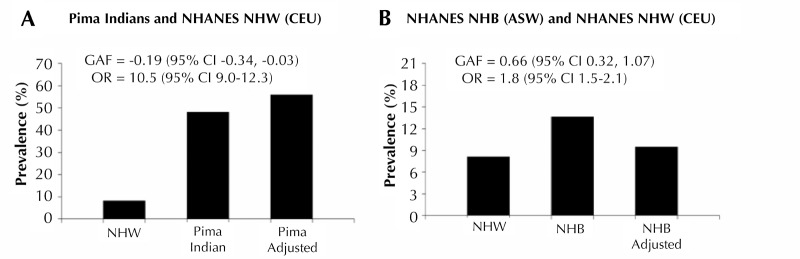
Figure 3. Prevalence of T2D risk in Pima Indians compared with non-Hispanic whites from the United States National Health and Nutrition Examination Survey (NHANES, A), and NHANES non-Hispanic blacks compared with non-Hispanic whites before and after adjusting for risk allele frequency in non-Hispanic whites (B)
A: The age-sex-adjusted prevalence of T2D was significantly higher in Pima Indians than in non-Hispanic whites (48.2% compared to 8.2%, OR = 10.5). When adjusted for the frequency of the risk allele in non-Hispanic whites (Pima adjusted), the prevalence in Pimas was slightly higher (55.9%), resulting in a genetic attributable fraction (GAF) of -0.19 (95% CI, -0.34, -0.03); the low value of GAF reflects the lower value of the genetic risk score in Pimas. B: The diagram shows the comparison between non-Hispanic whites and non-Hispanic blacks in NHANES. The "adjusted" value represents the age-sex-adjusted prevalence for the target population adjusted to the frequency of the risk alleles in the reference population across all 63 loci. Modified from [131].

References

    1. Lillioja S, Mott DM, Spraul M, Ferraro R, Foley JE, Ravussin E, Knowler WC, Bennett PH, Bogardus C. Insulin resistance and insulin secretory dysfunction as precursors of non-insulin-dependent diabetes mellitus. Prospective studies of Pima Indians. N Engl J Med. 1993;329(27):1988–1992. - PubMed
    1. Mayer-Davis EJ, Costacou T. Obesity and sedentary lifestyle: modifiable risk factors for prevention of type 2 diabetes. Curr Diab Rep. 2001;1(2):170–176. - PubMed
    1. Meigs JB, Cupples LA, Wilson PW. Parental transmission of type 2 diabetes: the Framingham Offspring Study. Diabetes. 2000;49(12):2201–2207. - PubMed
    1. Barnett AH, Eff C, Leslie RD, Pyke DA. Diabetes in identical twins. A study of 200 pairs. Diabetologia. 1981;20(2):87–93. - PubMed
    1. Newman B, Selby JV, King MC, Slemenda C, Fabsitz R, Friedman GD. Concordance for type 2 (non-insulin-dependent) diabetes mellitus in male twins. Diabetologia. 1987;30(10):763–768. - PubMed

LinkOut - more resources