Review
. 2016 Feb:36:34-40.
doi: 10.1016/j.gde.2016.03.008. Epub 2016 Apr 22.

TAD disruption as oncogenic driver

Affiliations
Review

TAD disruption as oncogenic driver

Anne-Laure Valton et al. Curr Opin Genet Dev. 2016 Feb.

Abstract

Topologically Associating Domains (TADs) are conserved during evolution and play roles in guiding and constraining long-range regulation of gene expression. Disruption of TAD boundaries results in aberrant gene expression by exposing genes to inappropriate regulatory elements. Recent studies have shown that TAD disruption is often found in cancer cells and contributes to oncogenesis through two mechanisms. One mechanism locally disrupts domains by deleting or mutating a TAD boundary leading to fusion of the two adjacent TADs. The other mechanism involves genomic rearrangements that break up TADs and creates new ones without directly affecting TAD boundaries. Understanding the mechanisms by which TADs form and control long-range chromatin interactions will therefore not only provide insights into the mechanism of gene regulation in general, but will also reveal how genomic rearrangements and mutations in cancer genomes can lead to misregulation of oncogenes and tumor suppressors.


Conflict of interest statement

The authors declare that they have no competing interests.

Figures
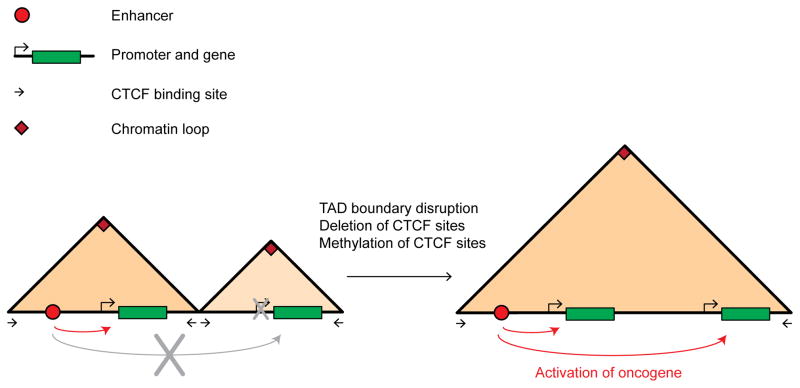
Figure 1
Figure 1. Oncogene activation through local TAD boundary disruption
In 5C/Hi-C interaction matrices TADs stand out as triangles along the diagonal of the interaction map. Here we show schematic TADs as triangles along the horizontal axis that represents the genome. Left: Before TAD boundary disruption, one TAD expresses a gene and the other TAD does not express the oncogene. Right: After TAD boundary disruption, a new fused TAD is formed that allows the activation of the oncogene by the enhancer that is now located in the same functional TAD. Enhancer is represented by a red dot. Genes are represented by green rectangles. Boundaries with CTCF sites in opposite directions are represented by black arrows and the chromatin loop formed by the CTCF sites is represented by a red rectangle at the corner of the TAD.
Figure 2
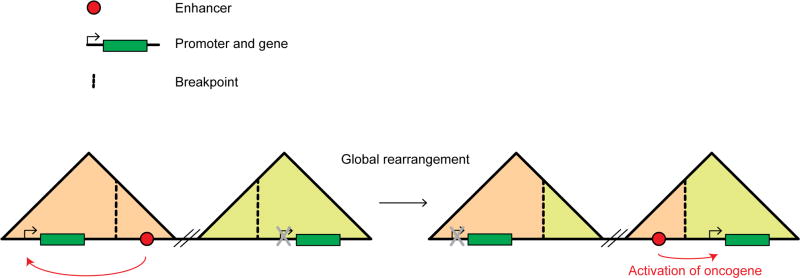
Figure 2. Oncogene activation through global rearrangements of TADs
Two TADs that are located several megabases away are represented as triangles (as in Figure 1). The first TAD possesses an enhancer and an expressed gene. The second TAD does not express the proto-oncogene. Global rearrangements that occur at breakpoints (dashed black line) fuse the two far away TADs by inverting the sequence in between the two TADs and create two chimeric TADs. The gene in the first TAD is no longer expressed and the oncogene in the second TAD is now expressed by activation of the relocated enhancer. Enhancer is represented by a red dot and genes by green rectangles.

References

    1. Tolhuis B, Palstra RJ, Splinter E, Grosveld F, de Laat W. Looping and interaction between hypersensitive sites in the active beta-globin locus. Mol Cell. 2002;10:1453–1465. - PubMed
    1. Gheldof N, Smith EM, Tabuchi TM, Koch CM, Dunham I, Stamatoyannopoulos JA, Dekker J. Cell-type-specific long-range looping interactions identify distant regulatory elements of the CFTR gene. Nucleic Acids Res. 2010;38:4325–4336. - PMC - PubMed
    1. Sanyal A, Lajoie BR, Jain G, Dekker J. The long-range interaction landscape of gene promoters. Nature. 2012;489:109–113. - PMC - PubMed
    1. Li G, Ruan X, Auerbach RK, Sandhu KS, Zheng M, Wang P, Poh HM, Goh Y, Lim J, Zhang J, et al. Extensive promoter-centered chromatin interactions provide a topological basis for transcription regulation. Cell. 2012;148:84–98. - PMC - PubMed
    1. Dixon JR, Selvaraj S, Yue F, Kim A, Li Y, Shen Y, Hu M, Liu JS, Ren B. Topological domains in mammalian genomes identified by analysis of chromatin interactions. Nature. 2012;485:376–380. - PMC - PubMed

Publication types

LinkOut - more resources