Clinicopathological analysis of 241 thymic epithelial tumors-experience in the Shanghai Chest Hospital from 1997-2004
- PMID: 27114840
- PMCID: PMC4824732
- DOI: 10.21037/jtd.2016.03.24
Clinicopathological analysis of 241 thymic epithelial tumors-experience in the Shanghai Chest Hospital from 1997-2004
Abstract
Background: To assess the correlation of WHO histological classification of thymomas and thymic carcinomas (TCs) with prognosis in recently treated patient cohort compared to a historical one from a single institution.
Methods: Retrospective review of clinical charts and histological sections of 241 patients treated during 1997-2004. Univariate and multivariate analysis of associations between risk factors including gender, age, tumor size, myasthenia gravis, WHO histological subtype, Masaoka stage, resection status, (neo-)adjuvant therapies, and survival.
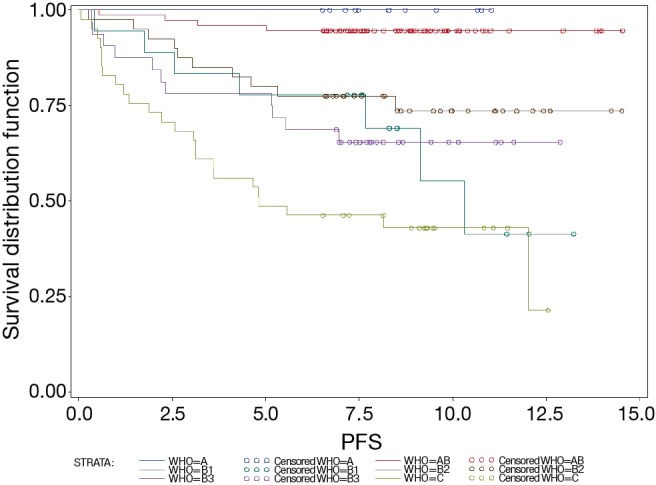
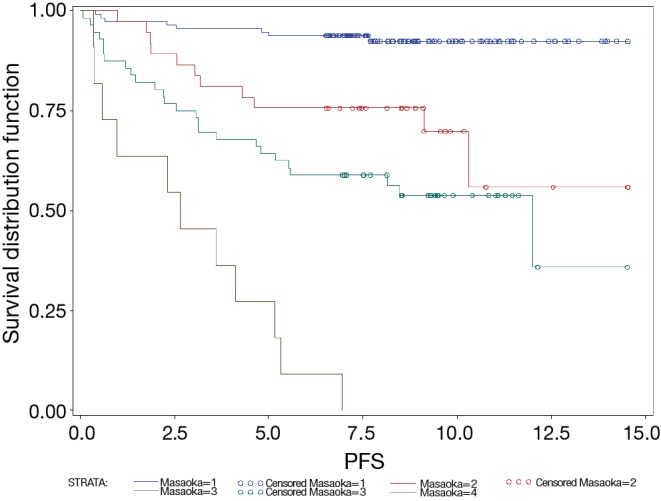
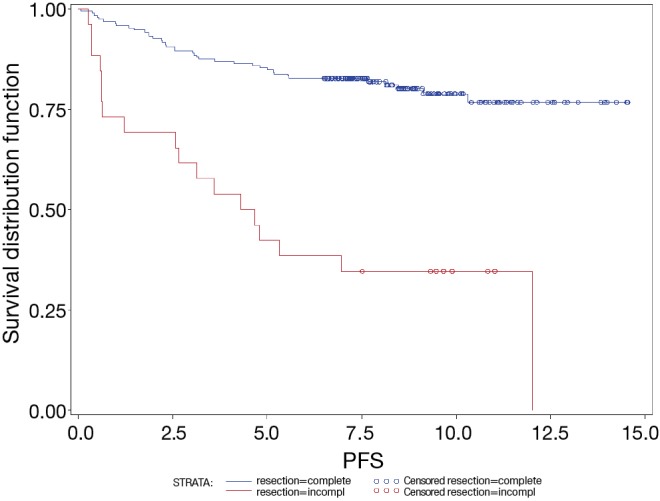
Results: The 5-year overall survival (OS) of A, AB, B1, B2, B3 thymomas and TCs patients was 100%, 100%, 94%, 80%, 94% and 45%. Five-year progression-free survival (PFS) was 100%, 96%, 78%, 80%, 78% and 39%, respectively. The 5-year OS of patients with Masaoka stage I, II, III and IV thymomas and TCs was 96%, 89%, 59% and 50%. (Neo-)adjuvant therapies were administered more often than in the historical cohort. Tumor-related death mainly occurred in patients with stage III, IV and B2, B3 thymomas and TCs. By univariate analysis, gender, tumor size, myasthenia gravis (MG) status, histotype, Masaoka stage, resection status and treatment were associated with OS. By multivariate analysis, histological subtype, Masaoka stage, and (neo-)adjuvant therapy were revealed as independent prognostic indicators.
Conclusions: WHO histological subtype, Masaoka stage and (neo-)adjuvant treatment have remained independent determinants of OS in patients with thymomas and TCs. Compared with the historical cohort during 1969-1996, prognosis of patients with B2, B3 thymomas has improved, which may be partly due to the increased use of adjuvant therapies. Prognosis of patients with TCs remained unsatisfactory, suggesting that neoadjuvant treatment should be tested to improve survival.
Keywords: Thymic epithelial tumors (TET); WHO histological subtype; prognosis; thymic carcinoma (TC); thymoma.
Conflict of interest statement
Figures
References
-
- Rosai J, Sobin LH. Histological Typing of Tumors of the Thymus. 2nd ed. Berlin: Springer, 1999.
-
- Travis WD, Brambilla E, Müller-Hermerlink Hk., et al. WHO Classification of tumors of the Lung, Pleura, Thymus and Heart. Lyon: IARC Press, 2004.
LinkOut - more resources
Full Text Sources
Other Literature Sources