


Transcriptomics in type 2 diabetes: Bridging the gap between genotype and phenotype
- PMID: 27114903
- PMCID: PMC4832048
- DOI: 10.1016/j.gdata.2015.12.001
Transcriptomics in type 2 diabetes: Bridging the gap between genotype and phenotype
Abstract
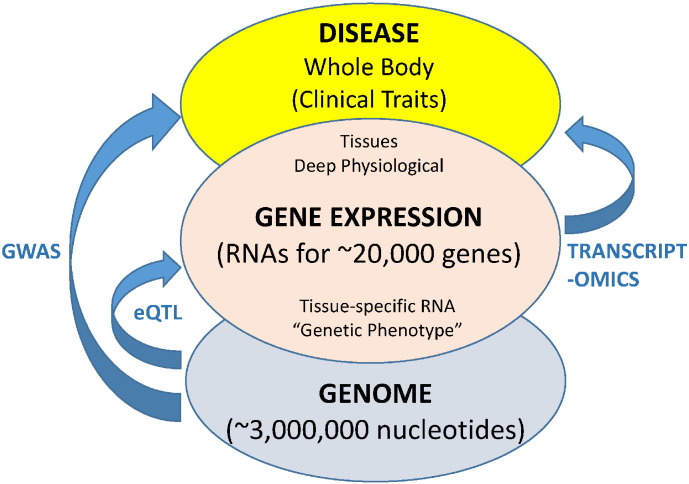
Type 2 diabetes (T2D) is a common, multifactorial disease that is influenced by genetic and environmental factors and their interactions. However, common variants identified by genome wide association studies (GWAS) explain only about 10% of the total trait variance for T2D and less than 5% of the variance for obesity, indicating that a large proportion of heritability is still unexplained. The transcriptomic approach described here uses quantitative gene expression and disease-related physiological data (deep phenotyping) to measure the direct correlation between the expression of specific genes and physiological traits. Transcriptomic analysis bridges the gulf between GWAS and physiological studies. Recent GWAS studies have utilized very large population samples, numbering in the tens of thousands (or even hundreds of thousands) of individuals, yet establishing causal functional relationships between strongly associated genetic variants and disease remains elusive. In light of the findings described below, it is appropriate to consider how and why transcriptomic approaches in small samples might be capable of identifying complex disease-related genes which are not apparent using GWAS in large samples.
Keywords: ADH1B; GWAS; Gene expression; Insulin resistance; Mexican Americans; Obesity; Transcriptomics; Type 2 diabetes; VAGES; eQTL.
Figures
References
-
- Almen M.S., Jacobsson J.A., Moschonis G., Benedict C., Chrousos G.P., Fredriksson R., Schioth H.B. Genome wide analysis reveals association of a FTO gene variant with epigenetic changes. Genomics. 2012;99:132–137. - PubMed
-
- Alvarez M., Rhodes S.J., Bidwell J.P. Context-dependent transcription: all politics is local. Gene. 2003;313:43–57. - PubMed
-
- Apovian C.M. The causes, prevalence, and treatment of obesity revisited in 2009: what have we learned so far? Am. J. Clin. Nutr. 2010;91:277S–279S. - PubMed
-
- Arya R., Puppala S., Farook V.S., Chittoor G., Jenkinson C.P., Blangero J., Hale D.E., Duggirala R., Almasy L. Mapping of susceptibility genes for obesity, type 2 diabetes, and the metabolic syndrome in human populations. In: Almasy L., Duggirala R., Williams-Blangero S., Paul S.F.D., Kole C., editors. Genome Mapping and Genomics in Animals. Springer-Verlag; Berlin Heidelberg: 2015.
-
- Bertone P., Stolc V., Royce T.E., Rozowsky J.S., Urban A.E., Zhu X., Rinn J.L., Tongprasit W., Samanta M., Weissman S., Gerstein M., Snyder M. Global identification of human transcribed sequences with genome tiling arrays. Science. 2004;306:2242–2246. - PubMed
LinkOut - more resources
Full Text Sources
Other Literature Sources
Miscellaneous
