


Incidence of Norovirus-Associated Medical Encounters among Active Duty United States Military Personnel and Their Dependents
- PMID: 27115602
- PMCID: PMC4845987
- DOI: 10.1371/journal.pone.0148505
Incidence of Norovirus-Associated Medical Encounters among Active Duty United States Military Personnel and Their Dependents
Abstract
Background: Norovirus is a leading cause of gastroenteritis episodes and outbreaks in US military deployments, but estimates of endemic disease burden among military personnel in garrison are lacking.
Methods: Diagnostic codes from gastroenteritis-associated medical encounters of active duty military personnel and their beneficiaries from July 1998-June 2011 were obtained from the Armed Forces Health Surveillance Center. Using time-series regression models, cause-unspecified encounters were modeled as a function of encounters for specific enteropathogens. Model residuals (representing unexplained encounters) were used to estimate norovirus-attributable medical encounters. Incidence rates were calculated using population data for both active duty and beneficiary populations.
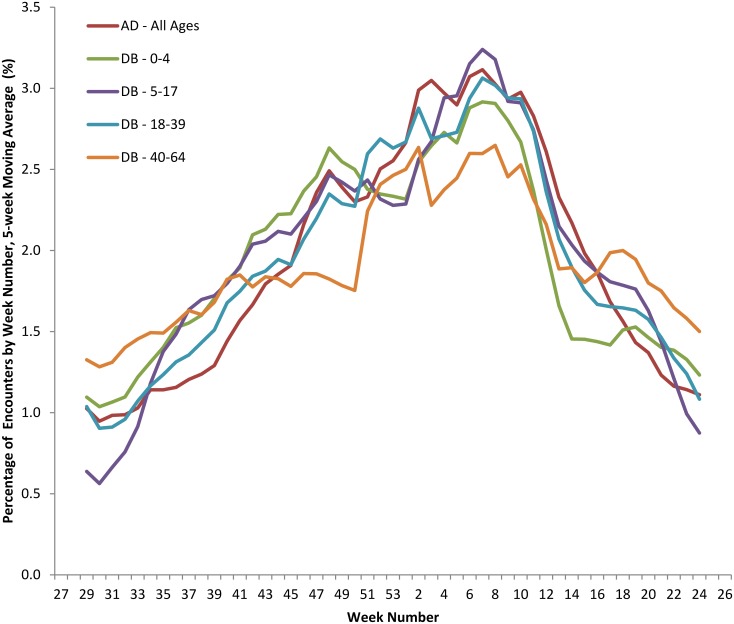
Results: The estimated annual mean rate of norovirus-associated medically-attended visits among active duty personnel and their beneficiaries was 292 (95% CI: 258 to 326) and 93 (95% CI: 80 to 105) encounters per 10,000 persons, respectively. Rates were highest among beneficiaries <5 years of age with a median annual rate of 435 (range: 318 to 646) encounters per 10,000 children. Norovirus was estimated to cause 31% and 27% of all-cause gastroenteritis encounters in the active duty and beneficiary populations, respectively, with over 60% occurring between November and April. There was no evidence of any lag effect where norovirus disease occurred in one population before the other, or in one beneficiary age group before the others.
Conclusions: Norovirus is a major cause of medically-attended gastroenteritis among non-deployed US military active duty members as well as in their beneficiaries.
Conflict of interest statement
Figures


References
-
- Tam CC, O'Brien SJ, Tompkins DS, Bolton FJ, Berry L, Dodds J, et al. Changes in causes of acute gastroenteritis in the United Kingdom over 15 years: microbiologic findings from 2 prospective, population-based studies of infectious intestinal disease. Clinical infectious diseases: an official publication of the Infectious Diseases Society of America. 2012;54(9):1275–86. Epub 2012/03/14. 10.1093/cid/cis028 . - DOI - PubMed
-
- Karsten C, Baumgarte S, Friedrich AW, von Eiff C, Becker K, Wosniok W, et al. Incidence and risk factors for community-acquired acute gastroenteritis in north-west Germany in 2004. European journal of clinical microbiology & infectious diseases: official publication of the European Society of Clinical Microbiology. 2009;28(8):935–43. Epub 2009/03/26. 10.1007/s10096-009-0729-1 - DOI - PMC - PubMed
Publication types
MeSH terms
LinkOut - more resources
Full Text Sources
Other Literature Sources
Medical
Miscellaneous
