Review
. 2016 Apr;13 Suppl 2(Suppl 2):S156-62.
doi: 10.1513/AnnalsATS.201507-455KV.

Mucus Hyperconcentration as a Unifying Aspect of the Chronic Bronchitic Phenotype

Affiliations
Review

Mucus Hyperconcentration as a Unifying Aspect of the Chronic Bronchitic Phenotype

Brian Button et al. Ann Am Thorac Soc. 2016 Apr.

Abstract

Abnormalities in mucus production and qualitative properties such as mucus hydration are central to the pathophysiology of airway disease including cystic fibrosis, asthma, and chronic bronchitis. In vitro air-liquid interface epithelial cell cultures demonstrate direct relationships between mucociliary transport, periciliary liquid (PCL) height, and mucus concentration (expressed as percent solids or partial osmotic pressure). In health, the osmotic modulus/pressure of the PCL exceeds that of the mucus layer, resulting in efficient, low-friction movement of mucus. In disease, through multiple mechanisms, the osmotic pressure of the mucus begins to exceed basal PCL values, resulting in compression of the cilia and slowing of mucus transport. The in vivo data in both cystic fibrosis and chronic bronchitis parallel in vitro data demonstrating that when mucus osmotic pressure is increased, mucociliary clearance is decreased. In chronic bronchitis, there is a direct correlation between FEV1 and percent solids of mucus, demonstrating a strong relationship between disease progression and mucus abnormalities. Animal models, based mechanistically on raised sodium absorption (and therefore water absorption) from airway surfaces, mimic the pathophysiology of chronic obstructive pulmonary disease. Collectively, these data suggest the importance of mucus concentration in the pathogenesis of airway disease. It is important to understand the precise mechanisms that result in mucus hyperconcentration, for example, mucin overproduction versus abnormal regulation of ion/water transport, which may be unique to and characteristic of each disease phenotype. The measurement of mucus concentration may be a simple method to diagnose chronic bronchitis, monitor its progression, and serve as a biomarker for development of new therapies.

Keywords: chronic bronchitis; mucociliary clearance; mucus; osmotic pressure.


Figures
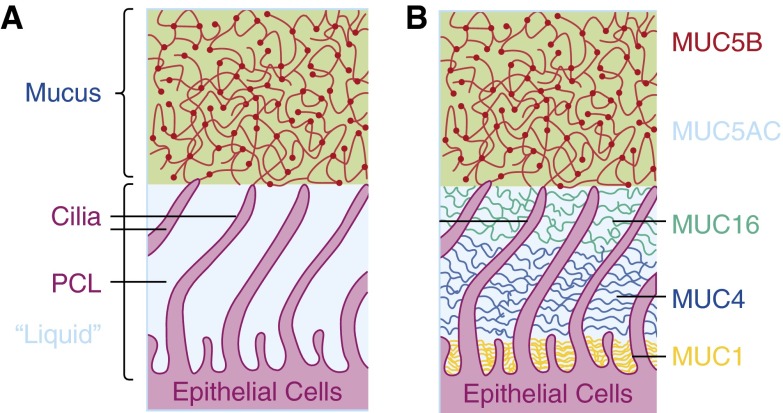
Figure 1.
Figure 1.
Anatomy of the mucociliary apparatus. (A) Traditional view of system as composed of a mucus layer comprised of secreted mucins that resides over a water periciliary liquid (PCL) layer. (B) Two-gel (gel on brush) model of mucociliary apparatus. A mucus layer composed of MUC5B and MUC5AC secreted mucins resides over a periciliary and cell surface environment occupied by a relatively high density of tethered mucins, including MUC1, MUC4, and MUC16.
Figure 2.
Figure 2.
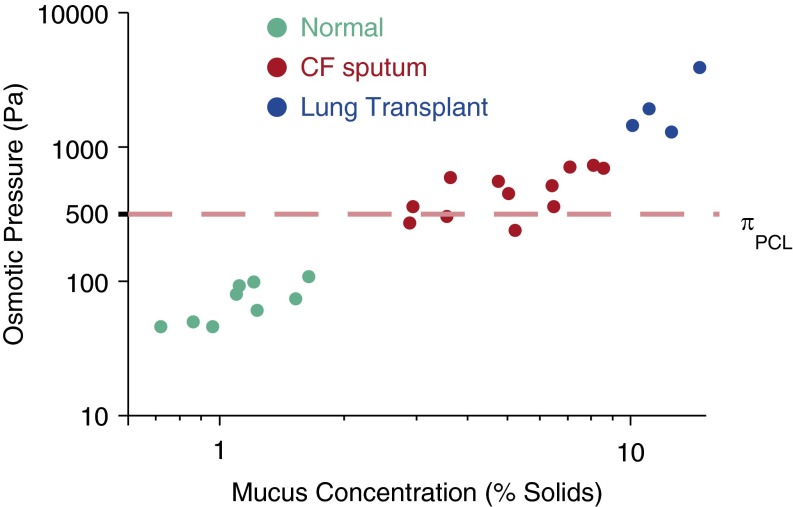
Osmotic pressure of normal versus cystic fibrosis (CF) mucus. Percent solids and osmotic pressure of induced sputum from normal subjects, spontaneous sputum for subjects with stable CF, and mucus obtained from CF lungs at the time of transplantation are shown. The dashed line depicts the basal periciliary liquid (PCL) osmotic pressure value from Button and colleagues (3).
Figure 3.
Figure 3.
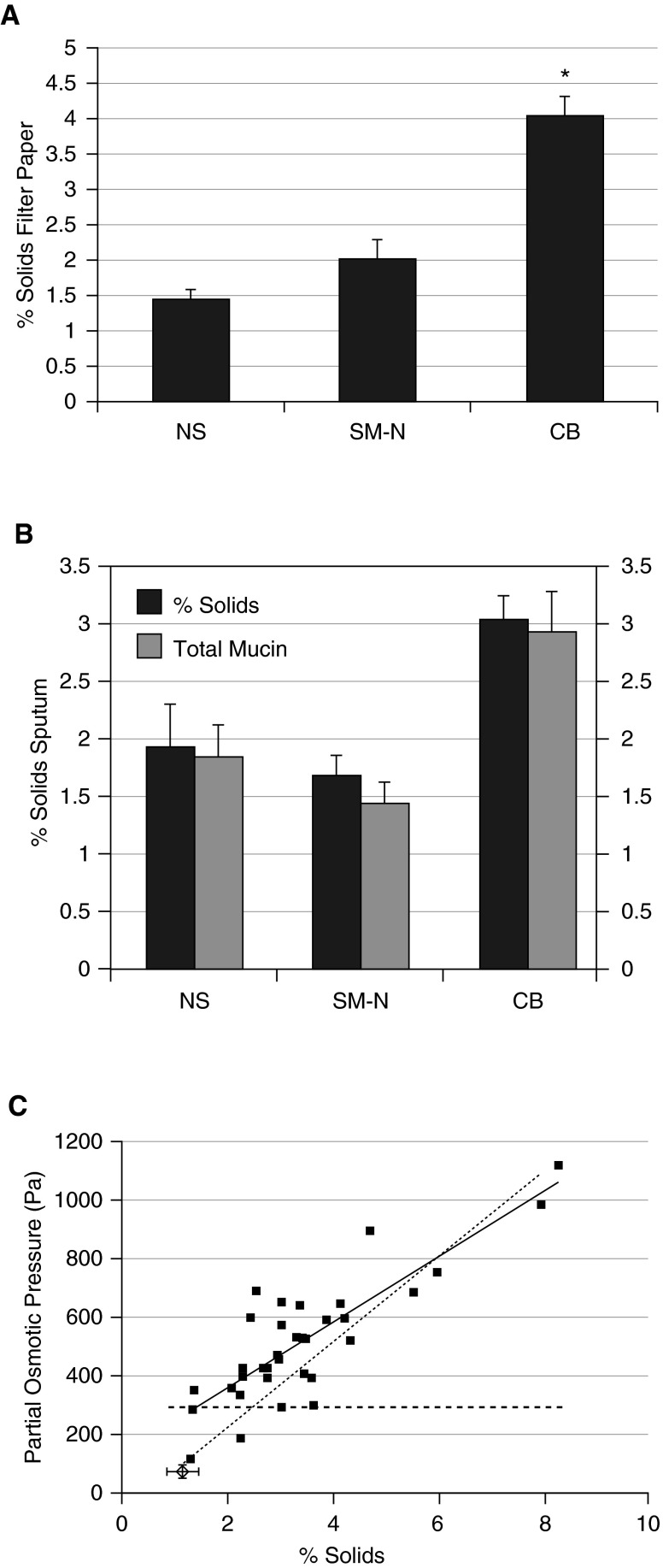
Mucus concentration (expressed as percent solids) for normal subjects (NS), cigarette smokers with normal lung transfer (SM-N), and subjects with chronic bronchitis (CB). (A) Samples obtained by the filter paper technique. (B) Sputum percent solids and total mucin concentrations of induced sputum for NS, SM-N, and CB subjects. (C) Relationship between sputum percent solids and measured osmotic pressure for subjects with CB. Dashed line depicts basal periciliary liquid (PCL) osmotic pressure.
Figure 4.
Figure 4.
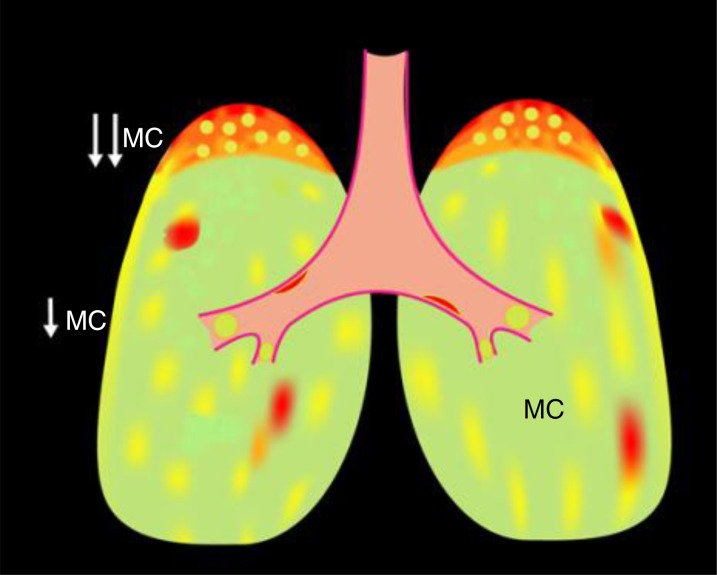
Heterogeneity of muco-obstructive lung disease with respect to mucin hyperconcentration and decreased mucus clearance. Green depicts areas of normal mucus concentrations and clearance; yellow depicts areas of increased mucus concentrations and decreased clearance; and red depicts areas of very concentrated mucus and mucus adhesion. The heterogeneity of disease presents broad challenges with respect to mucus sampling, that is, with techniques that harvest samples from discrete areas of disease and/or region (central vs. peripheral). MC = mucus clearance.
Figure 5.
Figure 5.
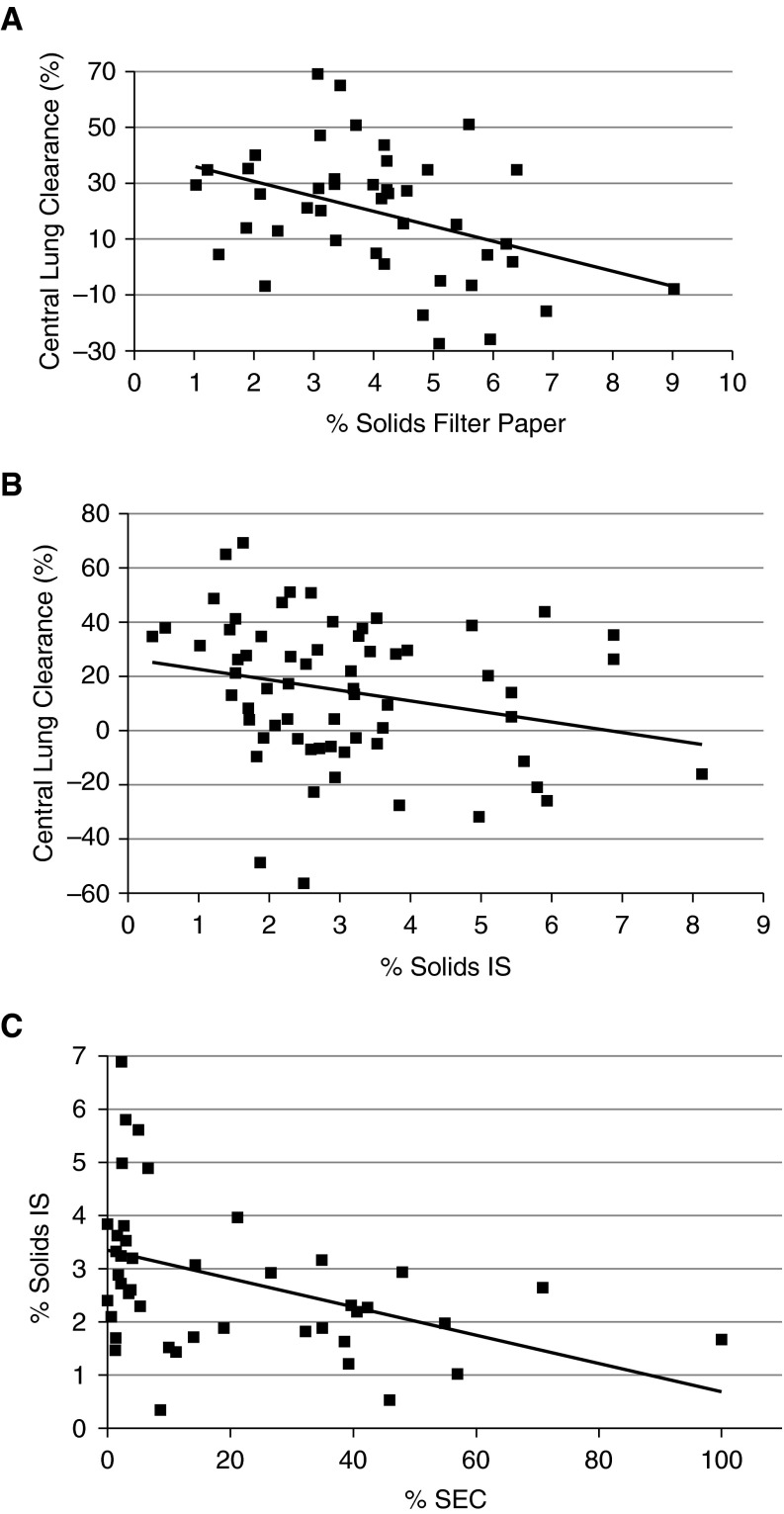
Correlation of mucus via sample type versus central lung clearance and induced sputum (IS) contamination. (A) Bronchoscopic filter paper–obtained percent solids versus central clearance for subjects with chronic bronchitis (CB) (R = –0.387; P = 0.01). (B) Induced sputum values for percent solids versus central clearance for the same subjects with CB (R = –0.271; P = 0.03). (C) The relationship between percentage of squamous epithelial cells (SECs) in sputum versus percent solids in induced sputum (R = –0.427; P = 0.005).

References

    1. Wanner A, Salathé M, O’Riordan TG. Mucociliary clearance in the airways. Am J Respir Crit Care Med. 1996;154:1868–1902. - PubMed
    1. Munkholm M, Mortensen J. Mucociliary clearance: pathophysiological aspects. Clin Physiol Funct Imaging. 2014;34:171–177. - PubMed
    1. Button B, Cai LH, Ehre C, Kesimer M, Hill DB, Sheehan JK, Boucher RC, Rubinstein M. A periciliary brush promotes the lung health by separating the mucus layer from airway epithelia. Science. 2012;337:937–941. - PMC - PubMed
    1. Rubinstein M, Colby RH. Polymer physics. Oxford: Oxford University Press; 2003.
    1. Button B, Okada SF, Frederick CB, Thelin WR, Boucher RC. Mechanosensitive ATP release maintains proper mucus hydration of airways. Sci Signal. 2013;6:ra46. - PMC - PubMed

Publication types