Opportunistic diseases among HIV-infected patients: a multicenter-nationwide Korean HIV/AIDS cohort study, 2006 to 2013
- PMID: 27117317
- PMCID: PMC5016273
- DOI: 10.3904/kjim.2014.322
Opportunistic diseases among HIV-infected patients: a multicenter-nationwide Korean HIV/AIDS cohort study, 2006 to 2013
Abstract
Background/aims: The frequencies of opportunistic diseases (ODs) vary across countries based on genetic, environmental, and social differences. The Korean HIV/AIDS cohort study was initiated in 2006 to promote research on human immunodeficiency virus (HIV) infection in Korea, and to provide a logistical network to support multicenter projects on epidemiological, clinical, and laboratory aspects of HIV infection. This study evaluated the prevalence of ODs among HIV-infected patients in the era of highly active antiretroviral therapy, and the risk factors associated with ODs.
Methods: The study enrolled 1,086 HIV-infected patients from 19 hospitals. This study examined the baseline data of the HIV/AIDS Korean cohort study at the time of enrollment from December 2006 to July 2013.
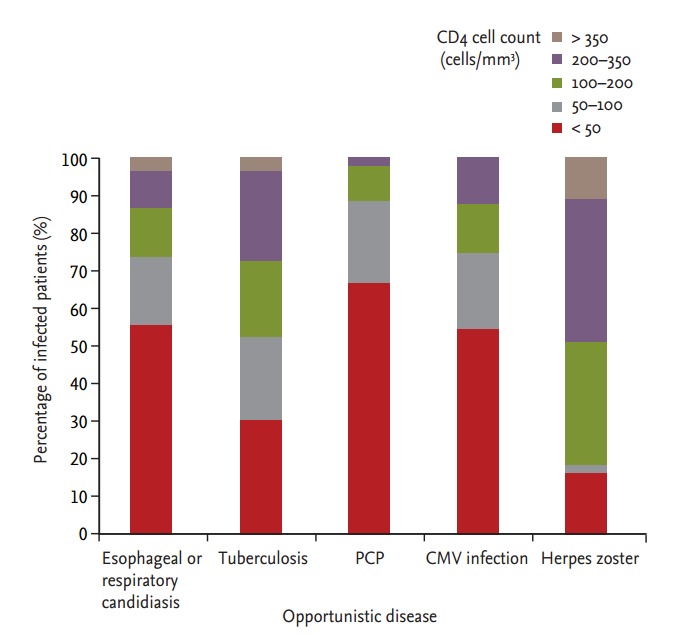
Results: Candidiasis was the most prevalent opportunistic infection (n = 176, 16.2%), followed by Mycobacterium tuberculosis infection (n = 120, 10.9%), Pneumocystis jirovecii pneumonia (n = 121, 11.0%), cytomegalovirus infection (n = 52, 4.7%), and herpes zoster (n = 44, 4.0%). The prevalence rates of Kaposi's sarcoma (n = 8, 0.7%) and toxoplasmosis (n = 4, 0.4%) were very low compared with other countries. The risk factors for ODs were a low CD4 T cell count at the time of HIV diagnosis (odds ratio [OR], 1.01; p < 0.01), current smoking (OR, 2.27; p = 0.01), current alcohol use (OR, 2.57; p = 0.04), and a history of tuberculosis (OR, 5.23; p < 0.01).
Conclusions: Using recent Korean nationwide data, this study demonstrated that an important predictor of ODs was a low CD4 T cell count at the time of HIV diagnosis. Tuberculosis remains one of the most important ODs in HIV-infected patients in Korea.
Keywords: AIDS-related opportunistic infections; HIV; Korea; Tuberculosis.
Conflict of interest statement
No potential conflict of interest relevant to this article was reported.
Figures
References
-
- World Health Organization . Geneva: World Health Organization; c2015. Global health observatory data repository [Internet] [cited 2015 Sep 22]. Available from: http://apps.who.int/ghodata.
-
- Buchacz K, Baker RK, Palella FJ, Jr, et al. AIDS-defining opportunistic illnesses in US patients, 1994-2007: a cohort study. AIDS. 2010;24:1549–1559. - PubMed
-
- Schwarcz L, Chen MJ, Vittinghoff E, Hsu L, Schwarcz S. Declining incidence of AIDS-defining opportunistic illnesses: results from 16 years of population-based AIDS surveillance. AIDS. 2013;27:597–605. - PubMed
-
- Kim JM, Cho GJ, Hong SK, et al. Epidemiology and clinical features of HIV infection/AIDS in Korea. Yonsei Med J. 2003;44:363–370. - PubMed
-
- Oh MD, Park SW, Kim HB, et al. Spectrum of opportunistic infections and malignancies in patients with human immunodeficiency virus infection in South Korea. Clin Infect Dis. 1999;29:1524–1528. - PubMed
Publication types
MeSH terms
LinkOut - more resources
Full Text Sources
Other Literature Sources
Medical
Research Materials