. 2016 May 3;15(5):944-950.
doi: 10.1016/j.celrep.2016.03.091. Epub 2016 Apr 21.

PYY-Dependent Restoration of Impaired Insulin and Glucagon Secretion in Type 2 Diabetes following Roux-En-Y Gastric Bypass Surgery

Affiliations

PYY-Dependent Restoration of Impaired Insulin and Glucagon Secretion in Type 2 Diabetes following Roux-En-Y Gastric Bypass Surgery

Reshma D Ramracheya et al. Cell Rep. .

Abstract

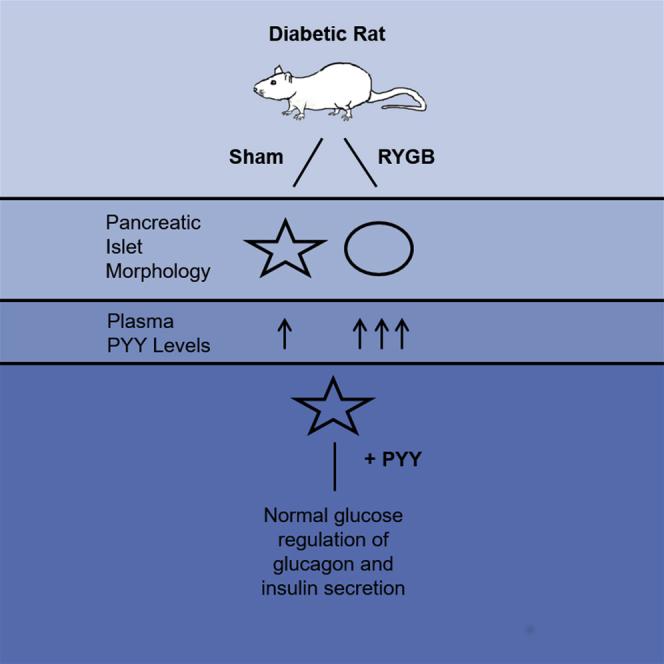
Roux-en-Y gastric bypass (RYGB) is a weight-reduction procedure resulting in rapid resolution of type 2 diabetes (T2D). The role of pancreatic islet function in this restoration of normoglycemia has not been fully elucidated. Using the diabetic Goto-Kakizaki (GK) rat model, we demonstrate that RYGB restores normal glucose regulation of glucagon and insulin secretion and normalizes islet morphology. Culture of isolated islets with serum from RYGB animals mimicked these effects, implicating a humoral factor. These latter effects were reversed following neutralization of the gut hormone peptide tyrosine tyrosine (PYY) but persisted in the presence of a glucagon-like peptide-1 (GLP-1) receptor antagonist. The effects of RYGB on secretion were replicated by chronic exposure of diabetic rat islets to PYY in vitro. These findings indicate that the mechanism underlying T2D remission may be mediated by PYY and suggest that drugs promoting PYY release or action may restore pancreatic islet function in T2D.


Figures

None
Graphical abstract
Figure 1
Figure 1
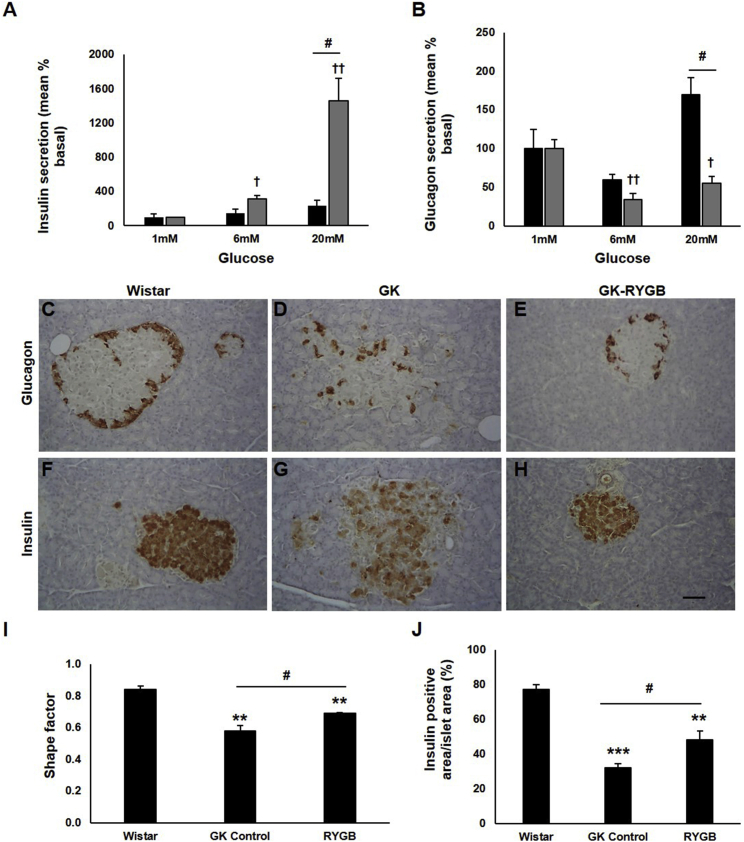
Islet Secretion and Morphology Are Improved in GK Rats Post-RYGB (A and B) Insulin (A) and glucagon (B) secretion in islets isolated from sham (black bars) or RYGB (gray bars) animals. Secretion is presented as percentage of that secreted at basal (mean ± SEM as percentage of total islet content; insulin: sham, 0.023 ± 0.004; RYGB, 0.046 ± 0.001; glucagon: sham, 0.216 ± 0.053; RYGB, 1.314 ± 0.025; n = 6–12 rats; two to five experiments). p < 0.05, ††p < 0.01 versus 1 mM glucose, #p < 0.05 for indicated comparisons. (C–H) Pancreatic sections from Wistar (C and F), GK control (D and G), and GK RYGB (E and H) animals, stained for glucagon (C–E) and insulin (F–H). Scale bar represents 100 μM. (I) Shape factor analysis, used as a measure of islet structure, was determined in GK controls (n = 4), Wistar (n = 3), and RYGB-operated animals (n = 3). (J) Insulin positive area/total islet area was assessed in these animals (n > 30 islets/animal). Data are presented as mean ± SEM, ∗∗p < 0.01, ∗∗∗p < 0.001 compared to Wistar controls, #p < 0.05 for indicated comparisons. See also Figures S1 and S2.
Figure 2
Figure 2
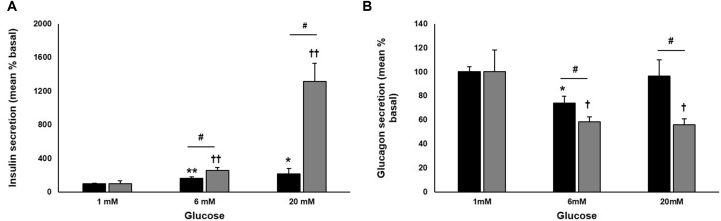
Metabolic Benefits of RYGB Are Driven by a Humoral Factor (A and B) Insulin (A) and glucagon (B) secretion from rat islets treated for 48 hr with serum from sham- (black) or RYGB-operated (gray bars) animals. Data are presented as percentage of basal secretion (mean ± SEM as percentage of content; insulin: sham, 0.974 ± 0.064; RYGB, 2.274 ± 0.0749; glucagon: sham, 0.748 ± 0.032; RYGB, 5.251 ± 0.947; n = 8 rats, five or six experiments). p < 0.05, ∗∗p < 0.01 versus 1 mM glucose sham, ††p < 0.01 versus 1mM glucose RYGB, #p < 0.05 for indicated comparisons. See also Figure S3.
Figure 3
Figure 3
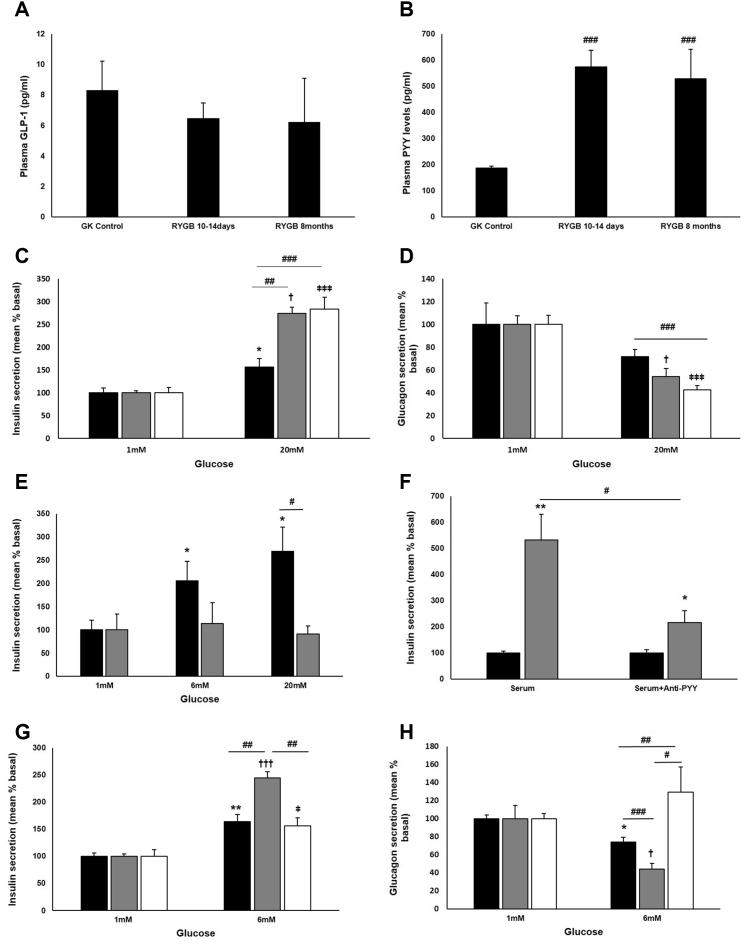
PYY Mediates the Effects of RYGB (A and B) Total plasma GLP-1 (A) and PYY (B) levels in GK sham-operated and RYGB animals at 10–14 days and 8 months post-surgery. (C and D) Insulin (C) and glucagon (D) secretion from rat islets chronically cultured with 100 pM PYY (gray), 100 nM PYY (white), or in the absence of PYY (black bars). Data are presented as percentage of basal secretion (mean ± SEM as percentage of content; insulin: 100 pM PYY: 0.1 ± 0.004; 100 nM PYY: 0.137 ± 0.016; control alone: 0.133 ± 0.014; glucagon: 100 pM PYY: 2.731 ± 0.211; 100 nM PYY: 2.287 ± 0.0.185; control alone: 1.196 ± 0.368; n = 6–8 rats; 3–11 experiments). p < 0.05 versus 1 mM glucose control, p < 0.05 versus 1 mM glucose with 100 pM PYY, ǂǂǂp < 0.001 versus 1 mM glucose with 100 nM PYY, ##p < 0.01, ###p < 0.001 for indicated comparisons. (E) Insulin secretion from rat islets chronically cultured with PYY in the presence (gray) or absence (black) of the NPY1R antagonist BIBP-3226 (1 μM). Data are presented as percentage of basal secretion (mean ± SEM as % of content; PYY: 0.062 ± 0.013; PYY+BIBP-3226: 0.178 ± 0.061; n = 6 experiments). p < 0.05 versus 1 mM glucose control, #p < 0.05 for indicated comparison. (F) Insulin secretion from rat islets at 1 mM (black) and 20 mM (gray bars) glucose following chronic exposure to RYGB serum, with or without PYY antibody (1/500). Data are presented as percentage of basal secretion (mean ± SEM as % of content; serum alone: 0.223 ± 0.018; with antibody: 0.253 ± 0.03; n = 6 experiments). p < 0.05, ∗∗p < 0.01 versus 1 mM glucose. (G and H) Insulin (G) and glucagon (H) secretion from rat islets following chronic exposure to sham-operated serum supplemented with 100 nM PYY with (white) or without (gray) PYY antibody (1/500) or sham-operated serum alone (black). Data are presented as percentage of basal secretion (mean ± SEM as % of content; insulin: PYY with antibody: 0.009 ± 0.001; PYY without antibody: 0.006 ± 0.0002; sham serum alone: 0.974 ± 0.064; glucagon: PYY with antibody: 0.472 ± 0.026; PYY without antibody: 1.109 ± 0.0.161; sham serum alone: 0.748 ± 0.032; n = 6–8 rats; six experiments). p < 0.05, ∗∗p < 0.01 versus 1 mM glucose sham serum, p < 0.05, †††p < 0.001 versus 1 mM glucose sham serum with PYY, ǂp < 0.05 versus 1 mM glucose sham serum, PYY and anti-PYY. #p < 0.05, ##p < 0.01, ###p < 0.001 for indicated comparisons. See also Figures S3 and S4.
Figure 4
Figure 4
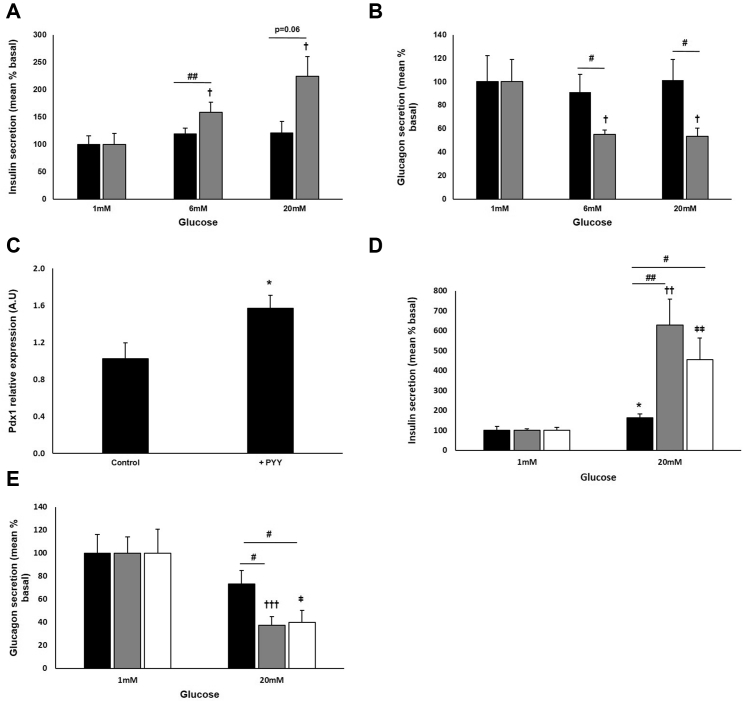
PYY Restores Function in GK Islets and Improves Human Islet Function (A and B) Islets from diabetic GK rats were chronically cultured in the presence (gray) or absence (black bars) of PYY before insulin (A) and glucagon (B) secretion were determined. Data are presented as percentage of basal secretion (mean ± SEM as % of content; insulin: PYY: 0.075 ± 0.015; without PYY: 0.139 ± 0.022; glucagon: PYY: 1.422 ± 0.271; without PYY: 1.443 ± 0.321; n = 5–9 experiments). p < 0.05 versus 1 mM glucose with PYY, #p < 0.05, ##p < 0.01 for indicated comparisons. (C) mRNA expression of the β-cell transcription factor, Pdx1 was determined post-culture with PYY in islets of diabetic GK rats. Data are presented as mean ± SEM, p < 0.05. (D and E) Insulin (D) and glucagon (E) secretion from human islets chronically cultured with 100 pM PYY (gray), 100 nM PYY (white), or in the absence of PYY (black bars). Data are presented as the percentage of that secreted at 1 mM glucose (mean ± SEM as percentage of content; insulin: 100 pM PYY: 0.063 ± 0.004; 100 nM PYY: 0.119 ± 0.018; control: 0.19 ± 0.036; glucagon: 100 pM PYY: 3.023 ± 0.429; 100 nM PYY: 4.137 ± 0.848; control: 1.178 ± 0.189 (n = 14–17 and 17–29 experiments respectively; five or six separate donors). p < 0.05 versus 1 mM glucose without PYY, ††p < 0.01, †††p < 0.001 versus 1 mM glucose with 100 pM PYY. ǂp < 0.05, ǂǂp < 0.01 versus 1 mM glucose with 100 nM PYY. #p < 0.05, ##p < 0.01 for indicated comparisons.

Comment in

References

    1. Adrian T.E., Ferri G.L., Bacarese-Hamilton A.J., Fuessl H.S., Polak J.M., Bloom S.R. Human distribution and release of a putative new gut hormone, peptide YY. Gastroenterology. 1985;89:1070–1077. - PubMed
    1. Batterham R.L., Cohen M.A., Ellis S.M., Le Roux C.W., Withers D.J., Frost G.S., Ghatei M.A., Bloom S.R. Inhibition of food intake in obese subjects by peptide YY3-36. N. Engl. J. Med. 2003;349:941–948. - PubMed
    1. Buchwald H., Avidor Y., Braunwald E., Jensen M.D., Pories W., Fahrbach K., Schoelles K. Bariatric surgery: a systematic review and meta-analysis. JAMA. 2004;292:1724–1737. - PubMed
    1. Cerf M.E. Transcription factors regulating beta-cell function. Eur. J. Endocrinol. 2006;155:671–679. - PubMed
    1. Chan J.L., Mun E.C., Stoyneva V., Mantzoros C.S., Goldfine A.B. Peptide YY levels are elevated after gastric bypass surgery. Obesity (Silver Spring) 2006;14:194–198. - PubMed

Publication types