


Chronic cerebrovascular dysfunction after traumatic brain injury
- PMID: 27117494
- PMCID: PMC5415378
- DOI: 10.1002/jnr.23732
Chronic cerebrovascular dysfunction after traumatic brain injury
Abstract
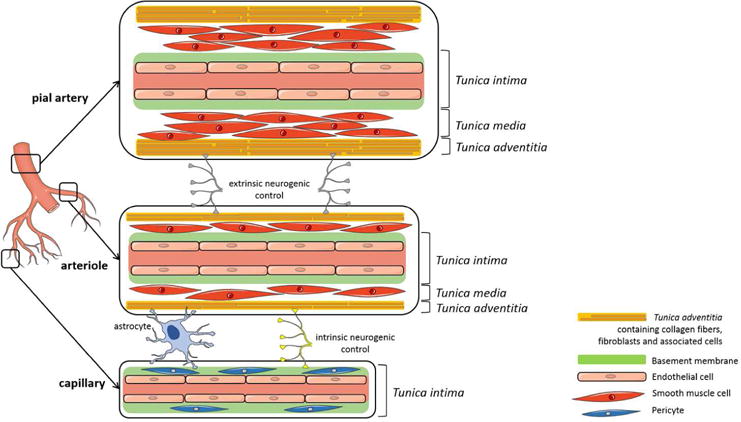
Traumatic brain injuries (TBI) often involve vascular dysfunction that leads to long-term alterations in physiological and cognitive functions of the brain. Indeed, all the cells that form blood vessels and that are involved in maintaining their proper function can be altered by TBI. This Review focuses on the different types of cerebrovascular dysfunction that occur after TBI, including cerebral blood flow alterations, autoregulation impairments, subarachnoid hemorrhage, vasospasms, blood-brain barrier disruption, and edema formation. We also discuss the mechanisms that mediate these dysfunctions, focusing on the cellular components of cerebral blood vessels (endothelial cells, smooth muscle cells, astrocytes, pericytes, perivascular nerves) and their known and potential roles in the secondary injury cascade. © 2016 Wiley Periodicals, Inc.
Keywords: cerebrovascular dysfunction; neurovascular dysfunction; traumatic brain injury.
© 2016 Wiley Periodicals, Inc.
Conflict of interest statement
No author has a conflict of interest.
Figures
References
-
- Abbott NJ, Ronnback L, Hansson E. Astrocyte-endothelial interactions at the blood-brain barrier. Nature reviews Neuroscience. 2006;7(1):41–53. - PubMed
-
- Abdul-Muneer PM, Schuetz H, Wang F, Skotak M, Jones J, Gorantla S, Zimmerman MC, Chandra N, Haorah J. Induction of oxidative and nitrosative damage leads to cerebrovascular inflammation in an animal model of mild traumatic brain injury induced by primary blast. Free radical biology & medicine. 2013;60:282–291. - PMC - PubMed
-
- Adelson PD, Srinivas R, Chang Y, Bell M, Kochanek PM. Cerebrovascular response in children following severe traumatic brain injury. Child’s nervous system: ChNS: official journal of the International Society for Pediatric Neurosurgery. 2011;27(9):1465–1476. - PubMed
-
- Alexander MR, Owens GK. Epigenetic control of smooth muscle cell differentiation and phenotypic switching in vascular development and disease. Annual review of physiology. 2012;74:13–40. - PubMed
Publication types
MeSH terms
Grants and funding
LinkOut - more resources
Full Text Sources
Other Literature Sources
Medical
