


3D printed cellular solid outperforms traditional stochastic foam in long-term mechanical response
- PMID: 27117858
- PMCID: PMC4846814
- DOI: 10.1038/srep24871
3D printed cellular solid outperforms traditional stochastic foam in long-term mechanical response
Erratum in
-
Corrigendum: 3D printed cellular solid outperforms traditional stochastic foam in long-term mechanical response.Sci Rep. 2016 May 25;6:26573. doi: 10.1038/srep26573. Sci Rep. 2016. PMID: 27220513 Free PMC article. No abstract available.
Abstract
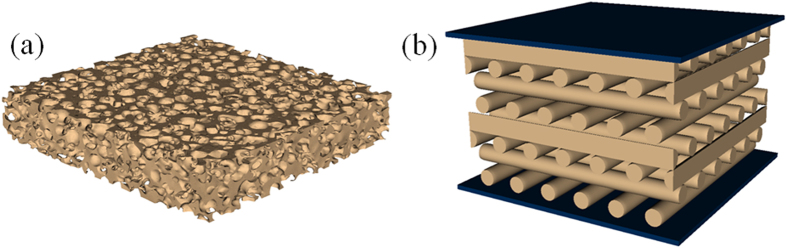
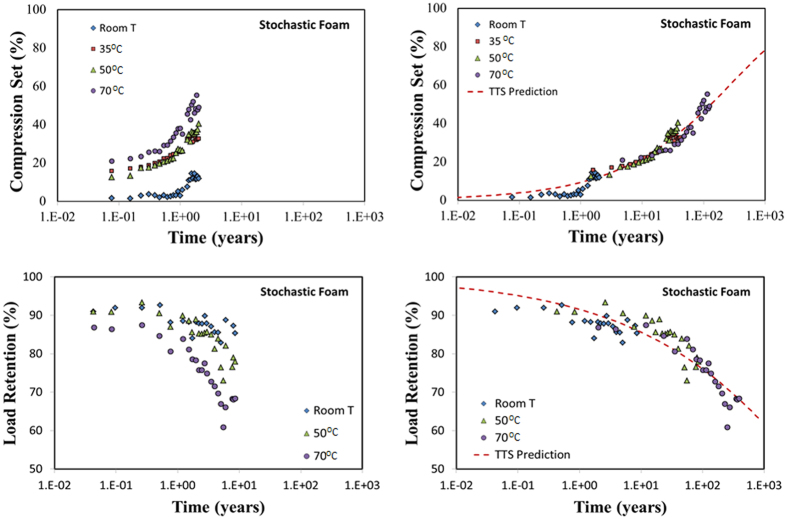
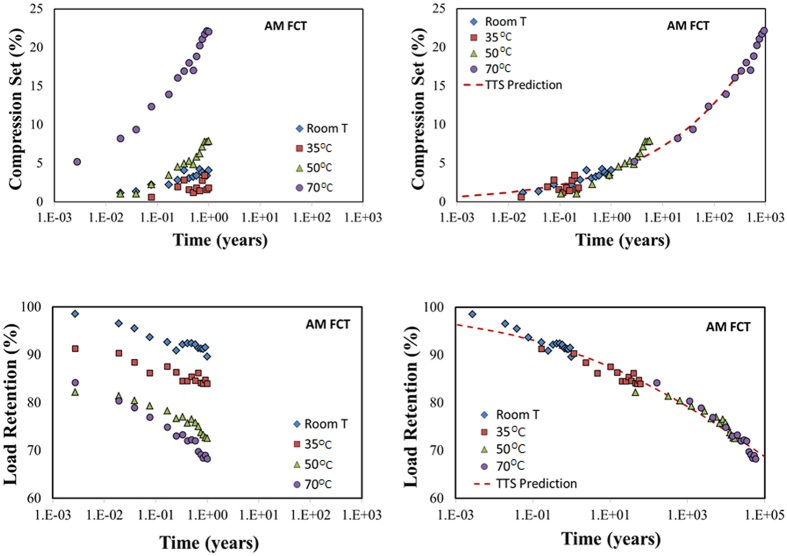
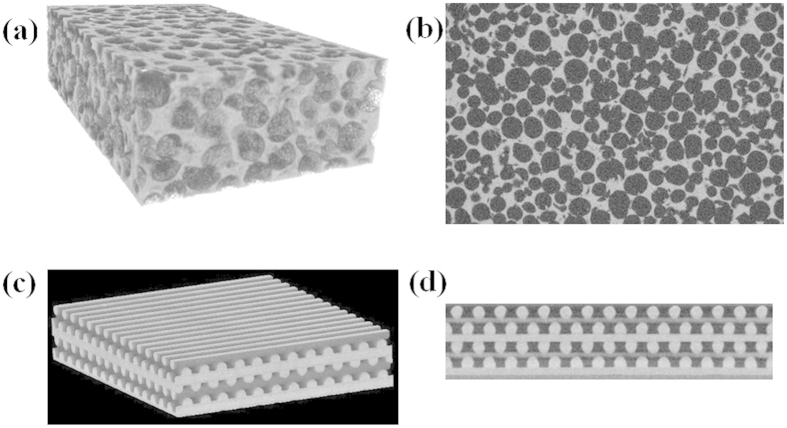
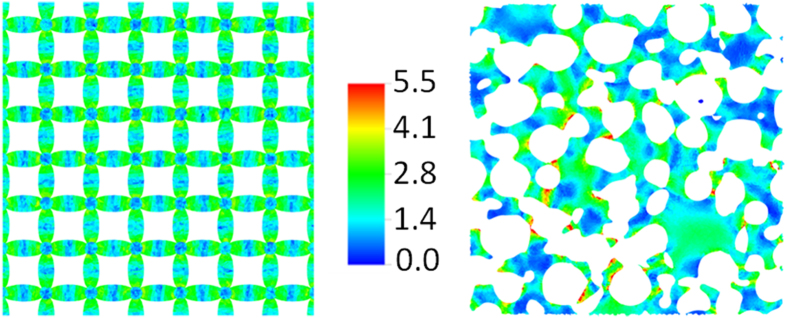
3D printing of polymeric foams by direct-ink-write is a recent technological breakthrough that enables the creation of versatile compressible solids with programmable microstructure, customizable shapes, and tunable mechanical response including negative elastic modulus. However, in many applications the success of these 3D printed materials as a viable replacement for traditional stochastic foams critically depends on their mechanical performance and micro-architectural stability while deployed under long-term mechanical strain. To predict the long-term performance of the two types of foams we employed multi-year-long accelerated aging studies under compressive strain followed by a time-temperature-superposition analysis using a minimum-arc-length-based algorithm. The resulting master curves predict superior long-term performance of the 3D printed foam in terms of two different metrics, i.e., compression set and load retention. To gain deeper understanding, we imaged the microstructure of both foams using X-ray computed tomography, and performed finite-element analysis of the mechanical response within these microstructures. This indicates a wider stress variation in the stochastic foam with points of more extreme local stress as compared to the 3D printed material, which might explain the latter's improved long-term stability and mechanical performance.
Figures

References
-
- Gibson L. J. & Ashby M. E. Cellular Solids: Structure and properties. Cambridge University Press, UK (1997).
-
- Mills N. Polymer Foams Handbook. Elsevier Science (2007).
-
- Evans A. G., Hutchinson J. W., Fleck N. A., Ashby M. F. & Wadley H. N. G. The Topological Design of Multifunctional Cellular Materials. Prog. Mater. Sci. 46, 309–327 (2001).
-
- Patel M., Morrel P. R. & Murphy J. J. Continuous and intermittent stress relaxation studies on foamed polysiloxane rubber. Polym. Degrad. Stab. 87, 201–206 (2005).
-
- Coons J. E., McKay M. D. & Hamada M. S. A Bayesian analysis of the compression set and stress–strain behavior in a thermally aged silicone foam. Polym. Degrad. Stab. 91, 1824–1836 (2006).
Publication types
LinkOut - more resources
Full Text Sources
Other Literature Sources
Molecular Biology Databases
