


The clinical value of metabolic syndrome and risks of cardiometabolic events and mortality in the elderly: the Rotterdam study
- PMID: 27117940
- PMCID: PMC4847340
- DOI: 10.1186/s12933-016-0387-4
The clinical value of metabolic syndrome and risks of cardiometabolic events and mortality in the elderly: the Rotterdam study
Abstract
Background: To evaluate the clinical value of metabolic syndrome based on different definitions [American Heart Association/National Heart, Lung and Blood Institute (AHA/NHLBI), International Diabetes Federation (IDF) and European Group for the Study of Insulin Resistance (EGIR)] in middle-aged and elderly populations.
Methods: We studied 8643 participants from the Rotterdam study (1990-2012; mean age 62.7; 57.6 % female), a large prospective population-based study with predominantly elderly participants. We performed cox-proportional hazards models for different definitions, triads within definitions and each separate component for the risk of incident type 2 diabetes mellitus, coronary heart disease, stroke, cardiovascular- and all-cause mortality.
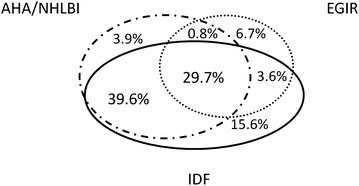
Results: In our population of 8643 subjects, metabolic syndrome was highly prevalent (prevalence between 19.4 and 42.4 %). Metabolic syndrome in general was associated with incident type 2 diabetes mellitus (median follow-up of 6.8 years, hazard ratios 3.13-3.78). The associations with coronary heart disease (median follow-up of 7.2 years, hazard ratios 1.08-1.32), stroke (median follow-up of 7.7 years, hazard ratios 0.98-1.32), cardiovascular mortality (median follow-up of 8.2 years, ratios 0.95-1.29) and all-cause mortality (median follow-up of 8.7 years, hazard ratios 1.05-1.10) were weaker. AHA/NHLBI- and IDF-definitions showed similar associations with clinical endpoints compared to the EGIR, which was only significantly associated with incident type 2 diabetes mellitus. All significant associations disappeared after correcting metabolic syndrome for its individual components.
Conclusions: Large variability exists between and within definitions of the metabolic syndrome with respect to risk of clinical events and mortality. In a relatively old population the metabolic syndrome did not show an additional predictive value on top of its individual components. So, besides as a manner of easy identification of high risk patients, the metabolic syndrome does not seem to add any predictive value for clinical practice.
Keywords: All-cause mortality; Cardiovascular disease; Cardiovascular mortality; Diabetes mellitus; Metabolic syndrome; Preventive medicine; Rotterdam study; Stroke.
Figures
References
-
- Rachas A, Raffaitin C, Barberger-Gateau P, Helmer C, Ritchie K, Tzourio C, et al. Clinical usefulness of the metabolic syndrome for the risk of coronary heart disease does not exceed the sum of its individual components in older men and women. The Three-City (3C) study. Heart. 2012;98(8):650–655. doi: 10.1136/heartjnl-2011-301185. - DOI - PMC - PubMed
Publication types
MeSH terms
LinkOut - more resources
Full Text Sources
Other Literature Sources
Medical
