Efficacy of Mindfulness-Based Cognitive Therapy in Prevention of Depressive Relapse: An Individual Patient Data Meta-analysis From Randomized Trials
- PMID: 27119968
- PMCID: PMC6640038
- DOI: 10.1001/jamapsychiatry.2016.0076
Efficacy of Mindfulness-Based Cognitive Therapy in Prevention of Depressive Relapse: An Individual Patient Data Meta-analysis From Randomized Trials
Abstract
Importance: Relapse prevention in recurrent depression is a significant public health problem, and antidepressants are the current first-line treatment approach. Identifying an equally efficacious nonpharmacological intervention would be an important development.
Objective: To conduct a meta-analysis on individual patient data to examine the efficacy of mindfulness-based cognitive therapy (MBCT) compared with usual care and other active treatments, including antidepressants, in treating those with recurrent depression.
Data sources: English-language studies published or accepted for publication in peer-reviewed journals identified from EMBASE, PubMed/Medline, PsycINFO, Web of Science, Scopus, and the Cochrane Controlled Trials Register from the first available year to November 22, 2014. Searches were conducted from November 2010 to November 2014.
Study selection: Randomized trials of manualized MBCT for relapse prevention in recurrent depression in full or partial remission that compared MBCT with at least 1 non-MBCT treatment, including usual care.
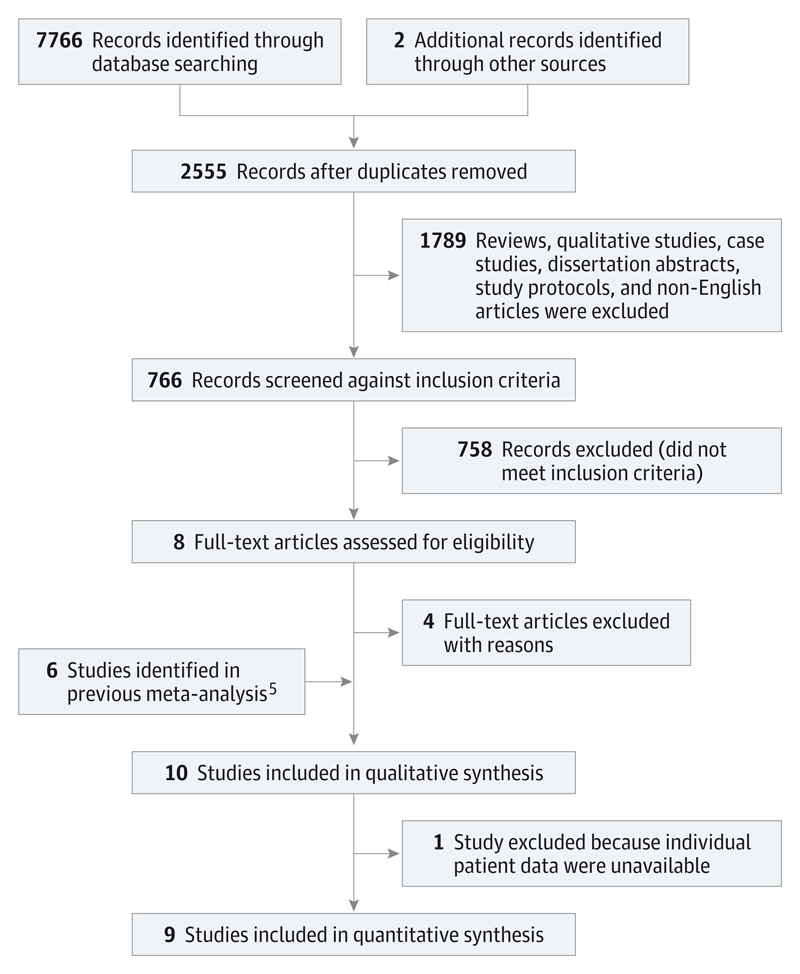
Data extraction and synthesis: This was an update to a previous meta-analysis. We screened 2555 new records after removing duplicates. Abstracts were screened for full-text extraction (S.S.) and checked by another researcher (T.D.). There were no disagreements. Of the original 2555 studies, 766 were evaluated against full study inclusion criteria, and we acquired full text for 8. Of these, 4 studies were excluded, and the remaining 4 were combined with the 6 studies identified from the previous meta-analysis, yielding 10 studies for qualitative synthesis. Full patient data were not available for 1 of these studies, resulting in 9 studies with individual patient data, which were included in the quantitative synthesis.
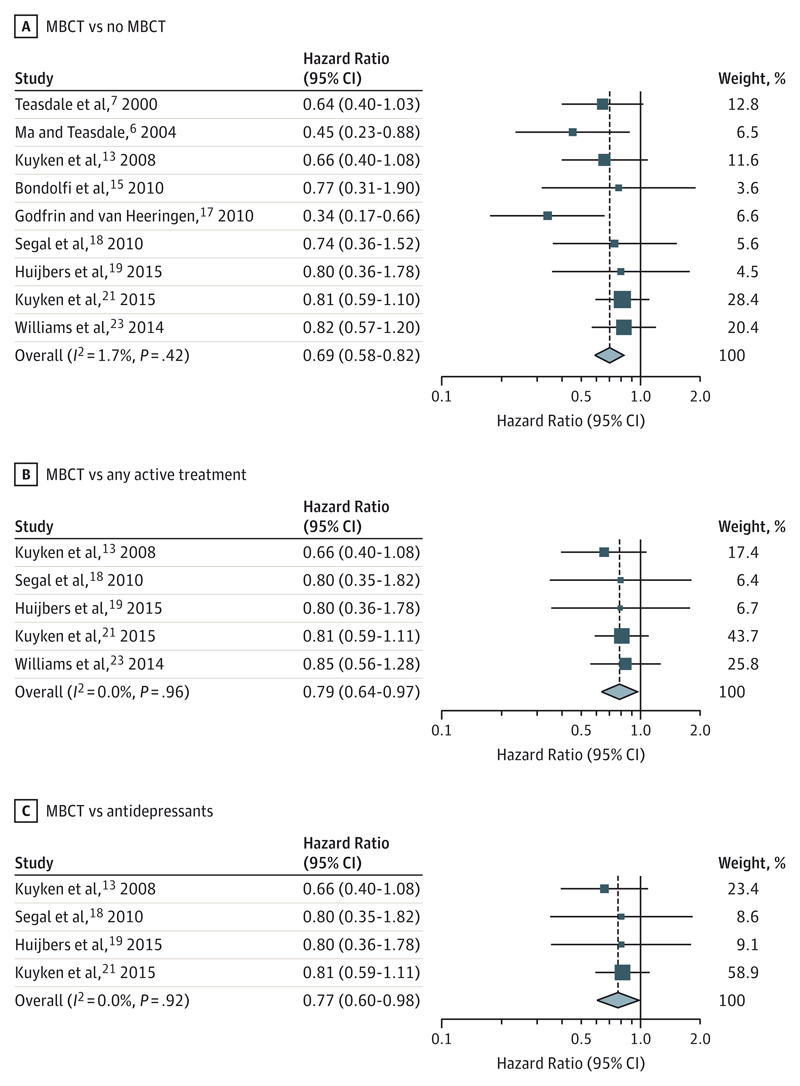
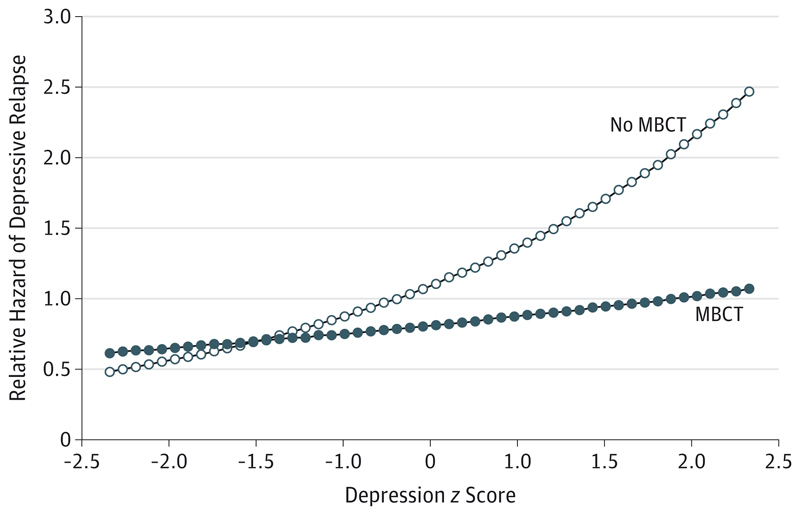
Results: Of the 1258 patients included, the mean (SD) age was 47.1 (11.9) years, and 944 (75.0%) were female. A 2-stage random effects approach showed that patients receiving MBCT had a reduced risk of depressive relapse within a 60-week follow-up period compared with those who did not receive MBCT (hazard ratio, 0.69; 95% CI, 0.58-0.82). Furthermore, comparisons with active treatments suggest a reduced risk of depressive relapse within a 60-week follow-up period (hazard ratio, 0.79; 95% CI, 0.64-0.97). Using a 1-stage approach, sociodemographic (ie, age, sex, education, and relationship status) and psychiatric (ie, age at onset and number of previous episodes of depression) variables showed no statistically significant interaction with MBCT treatment. However, there was some evidence to suggest that a greater severity of depressive symptoms prior to treatment was associated with a larger effect of MBCT compared with other treatments.
Conclusions and relevance: Mindfulness-based cognitive therapy appears efficacious as a treatment for relapse prevention for those with recurrent depression, particularly those with more pronounced residual symptoms. Recommendations are made concerning how future trials can address remaining uncertainties and improve the rigor of the field.
Conflict of interest statement
Figures
Comment in
-
Mindfulness-Based Cognitive Therapy and the Prevention of Depressive Relapse: Measures, Mechanisms, and Mediators.JAMA Psychiatry. 2016 Jun 1;73(6):547-8. doi: 10.1001/jamapsychiatry.2016.0135. JAMA Psychiatry. 2016. PMID: 27119526 No abstract available.
-
Meditation and Medication-What About a Middle Path?JAMA Psychiatry. 2016 Dec 1;73(12):1294-1295. doi: 10.1001/jamapsychiatry.2016.1471. JAMA Psychiatry. 2016. PMID: 27784039 No abstract available.
-
Mindfulness-based cognitive therapy delays depressive relapse across demographic subgroups.Evid Based Ment Health. 2017 Feb;20(1):e5. doi: 10.1136/eb-2016-102526. Epub 2017 Jan 13. Evid Based Ment Health. 2017. PMID: 28087561 Free PMC article. No abstract available.
References
-
- Cuijpers P, van Straten A, Smit F, Mihalopoulos C, Beekman A. Preventing the onset of depressive disorders: a meta-analytic review of psychological interventions. Am J Psychiatry. 2008;165(10):1272–1280. - PubMed
-
- Segal ZV, Williams JMG, Teasdale JD. Mindfulness-Based Cognitive Therapy for Depression: A New Approach to Preventing Relapse. New York, NY: Guilford Press; 2002.
-
- Piet J, Hougaard E. The effect of mindfulness-based cognitive therapy for prevention of relapse in recurrent major depressive disorder: a systematic review and meta-analysis. Clin Psychol Rev. 2011;31(6):1032–1040. - PubMed
Publication types
MeSH terms
Grants and funding
LinkOut - more resources
Full Text Sources
Other Literature Sources
Medical