. 2016 May 5;533(7601):58-63.
doi: 10.1038/nature17938. Epub 2016 Apr 27.

Continuous evolution of Bacillus thuringiensis toxins overcomes insect resistance

Affiliations

Continuous evolution of Bacillus thuringiensis toxins overcomes insect resistance

Ahmed H Badran et al. Nature. .

Abstract

The Bacillus thuringiensis δ-endotoxins (Bt toxins) are widely used insecticidal proteins in engineered crops that provide agricultural, economic, and environmental benefits. The development of insect resistance to Bt toxins endangers their long-term effectiveness. Here we have developed a phage-assisted continuous evolution selection that rapidly evolves high-affinity protein-protein interactions, and applied this system to evolve variants of the Bt toxin Cry1Ac that bind a cadherin-like receptor from the insect pest Trichoplusia ni (TnCAD) that is not natively bound by wild-type Cry1Ac. The resulting evolved Cry1Ac variants bind TnCAD with high affinity (dissociation constant Kd = 11-41 nM), kill TnCAD-expressing insect cells that are not susceptible to wild-type Cry1Ac, and kill Cry1Ac-resistant T. ni insects up to 335-fold more potently than wild-type Cry1Ac. Our findings establish that the evolution of Bt toxins with novel insect cell receptor affinity can overcome insect Bt toxin resistance and confer lethality approaching that of the wild-type Bt toxin against non-resistant insects.


Conflict of interest statement

Competing financial interests

The authors have filed a provisional patent application on the PACE system and related improvements.

Figures
Extended Data Figure 1
Extended Data Figure 1. Bacterial 2-hybrid component validation and optimization
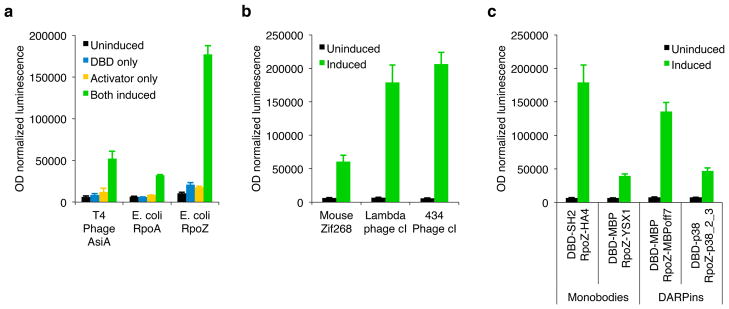
a, Plasmids encoding an IPTG-inducible λcI-SH2 cassette (“DBD”) and an ATc-inducible activator-HA4 cassette (“activator”) were co-transformed into the E. coli S1030 host strain and induced using either or both small molecules. T4 AsiA-mediated transcriptional activation required low-level expression of the σ70 (R541C/F563Y/L607P) mutant to alleviate AsiA toxicity. Use of RpoZ as the activation domain showed the greatest degree of transcriptional activation (~17-fold). b, DNA-binding domain variation shows that multivalent phage repressors yield a greater degree of transcriptional activation than the monomeric zinc finger Zif268. c, Transcriptional activation from a combination of the λcI DNA binding domain and RpoZ transcriptional activator was evaluated using a number of previously evolved protein-protein interactions involving either monobodies or DARPins, showing the generality of binding interaction detection. Error bars reflect the standard deviation of at least three independent biological replicates.
Extended Data Figure 2
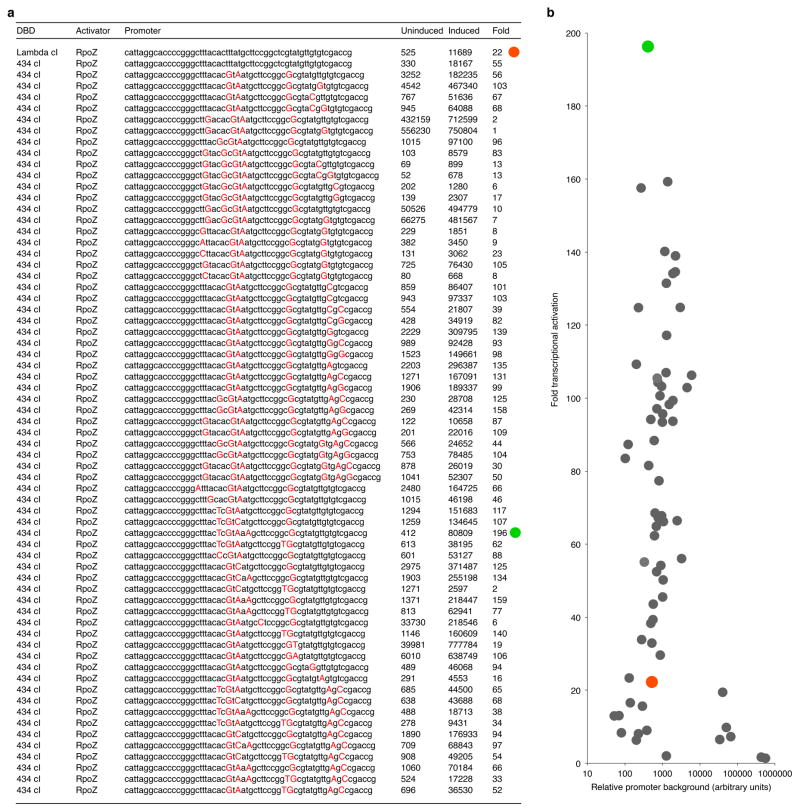
Extended Data Figure 2. Optimization of the PlacZ promoter for improved sensitivity and dynamic range
a, Promoter and DNA-binding domain combinations tested during PlacZ optimization, showing uninduced and induced levels of OD-normalized luminescence. The SH2/HA4 interaction pair was used in all cases. The fold activation in each case was calculated as the ratio of the induced and uninduced luciferase expression signals. b, Graphical representation of the data in part (a), showing the wide distribution of promoter background levels and degrees of transcriptional activation. In both (A) and (B), the red and green dots indicate the starting (Plac62) and final (PlacZ-opt) promoter/DNA-binding domain combinations, respectively. Each data point in (b) reflects the average of at least three independent biological replicates.
Extended Data Figure 3
Extended Data Figure 3. Bacterial 2-hybrid optimization
a, Inducer titration of the interacting fusion proteins driving the 2-hyrbid system. The black and green lines represent the uninduced (0 μM IPTG) and induced (1 μM IPTG) levels of IPTG-inducible 434cI-SH2 expression, while ATc induces expression of the rpoZ-HA4 cassette. In subsequent graphs and assays, the expression level resulting from the IPTG-inducible Plac promoter was measured by Western blot and approximated using a constitutive promoter to reduce experimental variability. b, The degree of transcriptional activation using HA4 monobody mutants correlated with known binding affinities. The highest levels of activation resulted from Kd = low nM affinities, while weak affinities in the Kd = low μM range could still be detected. c, The relationship between DNA-binding domain multivalency state (monomeric, dimeric or tetrameric DNA-binding domain fused to the SH2 domain) and transcriptional activation resulting from the SH2/HA4 interaction, with higher multivalency states yielding greater activation levels. d, RBS modification enables robust modulation of the relative activation levels from the PlacZ-opt promoter using the SH2/HA4 interaction. e, Operator-promoter binding site spacing strongly affects transcriptional activation levels. 434cI binding at 61 base pairs upstream of the PlacZ-opt promoter resulted in the most robust activation. f, Linker extension to include one, two, or three G4S motifs result in reduced activation levels using the SH2/HA4 interacting pair. g, Phage plaque formation as a function of target protein multivalency. “No operator” indicates a scrambled 434cI operator control AP, and “phage control” indicates an AP in which the phage shock promoter (activated by phage infection) drives gene III expression. h, Co-crystal structure of the ABL1 SH2 (blue) bound to the HA4 monobody (red), highlighting the interaction of HA4 Y87 (red spheres) with key residues of the phosophotyrosine-binding pocket (blue spheres) of the SH2 domain (PDB 3K2M). The phosphate ion is shown in orange at the interaction interface. i, Apparent binding activity of mutants of the HA4 monobody at position 87. Tyrosine, tryptophan and phenylalanine are tolerated at position 87 and enable protein-protein interaction by bacterial 2-hybrid assay. Error bars throughout this figure reflect the standard deviation of at least three independent biological replicates.
Extended Data Figure 4
Extended Data Figure 4. Choice of Cry1Ac and TnTBR3 fragments used in PACE
a, Protein sequence alignment of known Cry1Ac-binding motifs from cadherin receptors in a number of lepidopteran species, as well as the cadherin receptor from Trichoplusia ni (TnCAD). The toxin-binding region (TBR; shown in red) of the known Cry1Ac-binding motifs differs from TnCAD at seven positions (shown in blue). Mutation of three residues in the TnCAD TBR (M1433F, L1436S, and D1437A) to resemble the corresponding positions of the cadherin-receptor TBRs yielded the evolutionary stepping-stone target TnTBR3. b, Schematic representations of the Cry1Ac and T. ni TBR3/CAD full-length receptors and fragments tested in this study. The red stars in the TnTBR3 variants represent the three mutations introduced into TnCAD to generate TnTBR3. c, Transcriptional activation assay using Cry1Ac and TnTBR3 fragments shows that the greatest degree of transcriptional activation resulted from full-length Cry1Ac together with TBR3 fragment 3 (TnTBR3-F3). RpoZ-Cry1Ac and 434cI-TnTBR3 fusions were used in all cases. d, Overnight phage enrichment assays using selection phages (SPs) that encode either kanamycin resistance (KanR) only or KanR together with RpoZ-Cry1Ac. Compared to the KanR-only SP, the RpoZ-Cry1Ac SP enriches > 26,000-fold overnight. e, Continuous propagation assays in the PACE format using either the KanR-only SP or the RpoZ-Cry1Ac SP show that the moderate affinity of Cry1Ac for TnTBR3 allows phage propagation at low flow rates (≤ 1.5 lagoon vol/h).
Extended Data Figure 5
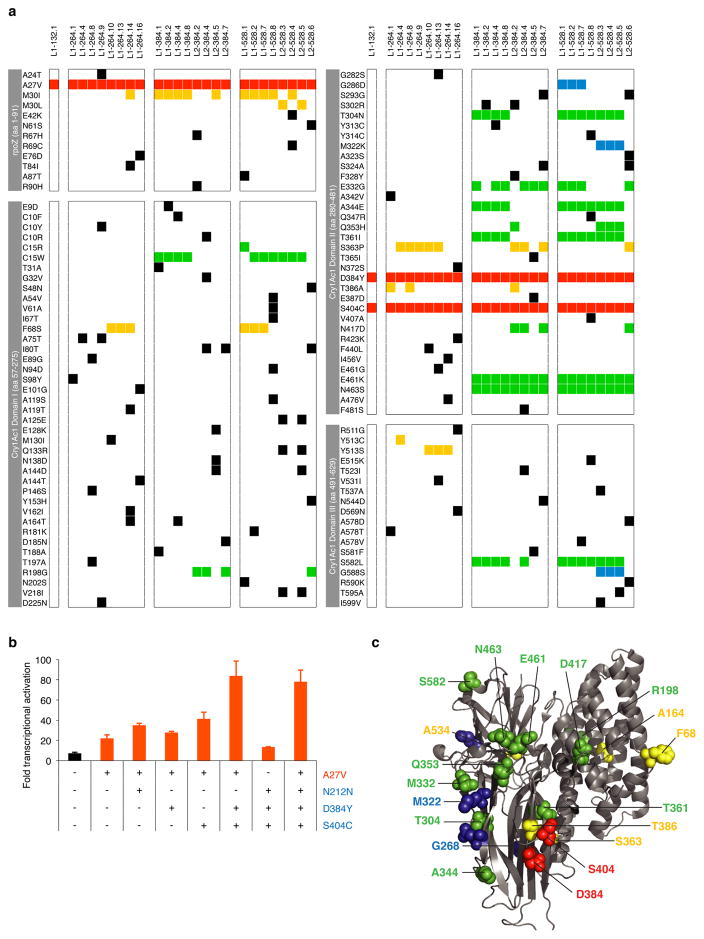
Extended Data Figure 5. Single-clone sequencing and evolved Cry1Ac characterization following PACE using the bacterial 2-hybrid luminescence reporter
a, Coding mutations of the tested RpoZ-Cry1Ac clones at the end of each of the four segments of PACE. Consensus mutations are colored according to the segment in which they became highly enriched in the population (Fig. 3a). Mutations colored in black were observed at low abundance (≤ 5% of sequenced clones). b, Mutational dissection of the consensus mutations from the first segment of PACE reveals the requirement for both D384Y and S404C to achieve high-level transcriptional activation using the TnTBR3-F3 target. Mutations listed in red occurred in the RpoZ activation domain, whereas mutations listed in blue occurred in the Cry1Ac domain. Error bars reflect the standard deviation of at least three independent biological replicates. c, Structure of wild-type Cry1Ac (PDB: 4ARX) showing the positions of the evolved consensus mutations. The colors correspond to the PACE segments shown in Fig. 3 during which the mutations became highly abundant.
Extended Data Figure 6
Extended Data Figure 6. High-throughput DNA sequencing of PACE Cry1Ac selection phage libraries
The number of reads mapped to the wt rpoZ-Cry1Ac reference sequence using (a) Pacific Biosciences (PacBio) or (b) Illumina sequencing. Time points are colored according to the corresponding segment of the PACE experiment (Fig. 3A). c, In general, the majority of PacBio reads aligned to the wt rpoZ-Cry1Ac reference sequence were found to cluster around ~2,200 base pairs, corresponding to the size of the full-length fusion gene and indicating high-quality sequencing reads. d, Illumina high-throughput sequencing yielded a number of high quality SNPs across all time points. The corresponding mutations are shown in (e).
Extended Data Figure 7
Extended Data Figure 7. Insect diet bioassay activity of PACE-evolved Cry1Ac variants against various agricultural pests
Two consensus and three stabilized PACE-evolved Cry1Ac variants were tested for activity in eleven pests: a, Chrysodeixis includes (soybean looper); b, Heliothis virescens (tobacco budworm); c, Helicoverpa zea (corn earworm); d, Plutella xylostella (diamondback moth); e, Agrotis ipsilon (black cutworm); f, Spodoptera frugiperda (fall armyworm); g, Anticarsia gemmatalis (velvetbean caterpillar); h, Diatraea saccharalis (sugarcane borer); Spodoptera eridania (southern armyworm); Leptinotarsa decemlineata (Colorado potato beetle); and Lygus lineolaris (tarnished plant bug). Stabilized variants showed enhanced activity in C. includens and H. virescens as compared to wild-type Cry1Ac, and comparable activity to wild-type Cry1Ac in H. zea, P. xylostella, A. ipsilon, S. frugiperda, A. gemmatalis, and D. saccharalis. No activity was observed for any of the Cry1Ac variants at any tested dose for S. eridania, L. decemlineata or L. lineolaris. No insect larvae mortality was observed for S. frugiperda, although high toxin doses greatly stunted growth.
Extended Data Figure 8
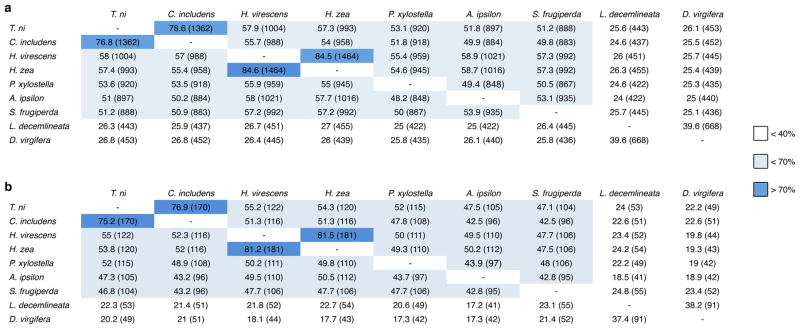
Extended Data Figure 8. Comparison of cadherin receptor sequence identity
The % sequence identity using the full-length cadherin receptor (a) or fragment used for directed evolution experiments (b) for insects tested in Extended Data Figure 8. Numbers in parenthesis denote the number of identical amino acids between the two receptors. In general, mortality and stunting data from diet bioassays correlates with cadherin receptor sequence identity.
Fig. 1
Fig. 1. Protein-binding phage-assisted continuous evolution (PACE)
a, Anatomy of a phage-infected host cell during PACE. The host E. coli cell carries two plasmids: the accessory plasmid (AP), which links protein binding to phage propagation and controls selection stringency, and the mutagenesis plasmid (MP),, which enables arabinose-inducible elevated level mutagenesis during PACE. b, Following infection, selection phage (SP) that encode an evolving protein capable of binding to the target protein induces expression of gene III from the AP, resulting in the production of pIII, a phage protein required for progeny phage produced by that host cell to infect subsequent host cells. PACE takes place in a fixed-volume vessel (the “lagoon”) that is continuously diluted with fresh host cells. Only those SP encoding proteins that bind the target can propagate faster than they are diluted out of the lagoon.
Fig. 2
Fig. 2. Protein-binding PACE selection development and stringency modulation
a, The relationship between target protein multivalency and transcriptional output measured by luciferase expression. The number of ABL1 SH2 domains available to bind the HA4 monobody was modulated by varying the 434cI DNA-binding domain multivalency state (1x, 2x, 4x, or 6x SH2). “No operator” indicates a scrambled 434cI operator control AP. b, During PACE, the inactive monobody mutant HA4Y87A was subjected to no mutagenesis (MP not induced), enhanced mutagenesis (MP induced with arabinose), or enhanced mutagenesis with genetic drift (MP induced with arabinose in addition to an initial period of zero selection stringency), then selected for binding to the ABL1 SH2 target protein. c, The combination of drift and enhanced mutagenesis during PACE (green line) resulted in the evolution of Tyr and Trp residues at position 87, either of which restores SH2-binding activity, while no mutagenesis (red line) or enhanced mutagenesis without drift (blue line) resulted in phage washout. Error bars in (a) reflect the standard deviation of at least three independent biological replicates.
Fig. 3
Fig. 3. Continuous evolution of Cry1Ac variants that bind the Trichoplusia ni cadherin receptor
a, PACE was executed in four segments. The first two segments implemented the designed TnTBR3-F3 “stepping-stone” target under intermediate levels of mutagenesis (MP4). The final two segments implemented the final TnCAD-F3 target under high levels of mutagenesis (MP6). Phage titer (colored lines) and lagoon flow rate (grey lines) are shown at all sampled time points. The dotted lines indicate transfer of evolving phage to a new lagoon fed by the host cell culture corresponding to the next segment of PACE. b, c, Transcriptional activation assays using 434cI-TnTBR3-F3 (b) or 434cI-TnCAD-F3 (c) and individual RpoZ-Cry1Ac variants evolved during PACE, compared to wild-type RpoZ-Cry1Ac (wt). d, Oligotyping analysis of lagoon samples during PACE based on high-throughout DNA sequencing data. Oligotypes containing high frequency mutations (≥ 1%) are represented by different polygons, colored based on the stage in which they first became abundant in the evolving Cry1Ac gene pool. Mutations in Cry1Ac for each oligotype are shown in the table. Numbers in parentheses indicate the oligotype number assigned to that mutant following a synonymous (silent) mutation. e, Plausible evolution trajectories over the entire PACE experiment derived from oligotyping analysis strongly suggests instances of recombination during PACE, and also reveals the influence of mutation rate, selection stringency, and target protein on evolutionary outcomes. The colors and numbers in each circle correspond to those in (d).
Fig. 4
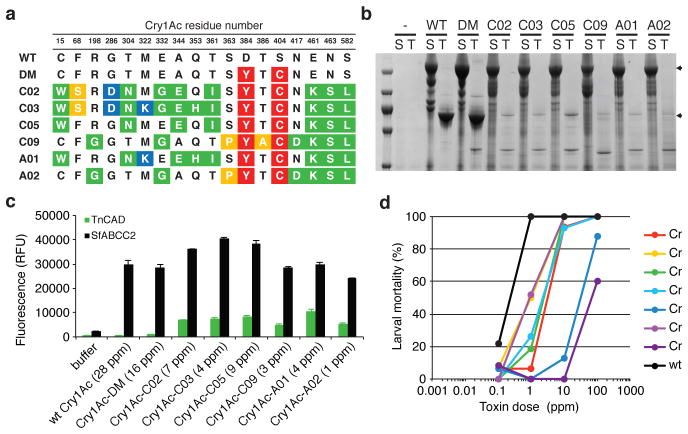
Fig. 4. Characterization of consensus evolved Cry1Ac variants
a, Consensus evolved Cry1Ac mutant sequences, including the D384Y/S404C double mutant (DM) that enabled TnTBR3-F3 recognition during the first segment of PACE. b, SDS-PAGE analysis of Cry1Ac variants following trypsin digestion, revealing proteolytic instability of consensus evolved variants. S = solubilized crude Bt crystals; T = trypsin-treated. c, Toxicity assays using Sf9 cells expressing the ABCC2 (black) or TnCAD receptor (green). Cells were incubated with Cry1Ac variants following trypsin digestion at the concentrations of activated toxin shown. Cry1Ac-induced cell permeabilization causes a fluorescent dye to enter cells, resulting in an increase in fluorescence. The evolved Cry1Ac variants, but not wild-type Cry1Ac, induce permeabilization of cells expressing TnCAD. Error bars reflect the standard deviation of at least three independent biological replicates. d, Insect larvae diet bioassays using wild-type and evolved consensus Cry1Ac variants, showing the loss of evolved Cry1Ac potency in insect larvae arising from impaired stability.
Fig. 5
Fig. 5. Characterization of stabilized evolved Cry1Ac variants reveals potently enhanced activity
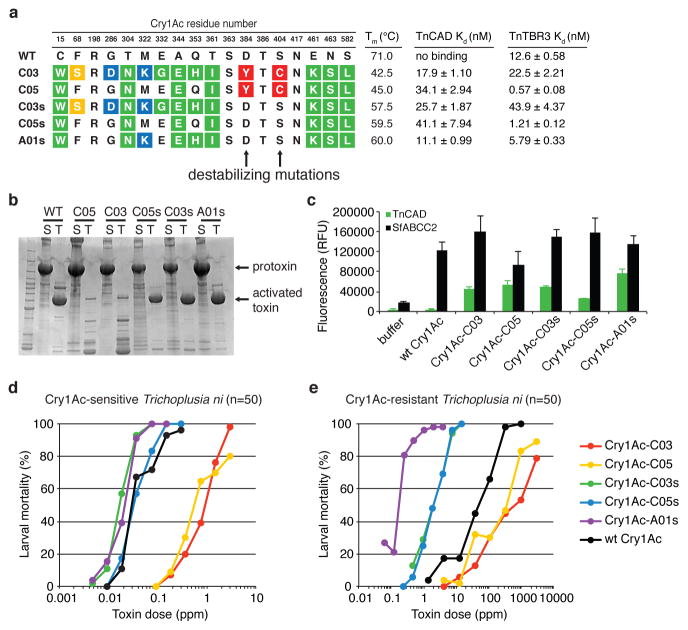
a, Sequence, thermal stability, and TnCAD target-binding affinity of unstable and stabilized PACE evolved consensus mutants. b, SDS-PAGE analysis of trypsin digestion reactions showing dramatically enhanced stability upon D384Y and S404C reversion. S = solubilized crude Bt crystals; T = trypsin-treated. c, Toxicity assays using Sf9 cells overexpressing the ABCC2 (black) or TnCAD receptor (green), demonstrating maintained activity of stabilized variants against both ABCC2 or TnCAD. All variants were used at 10 ppm. Error bars reflect the standard deviation of at least three independent biological replicates. d, e, Highly purified wild-type Cry1Ac, evolved consensus variants, or stabilized evolved variants were added to the diets of Cry1Ac-susceptible (d) or Cry1Ac-resistant (e) T. ni larvae at the indicated doses. Stabilized evolved variants moderately enhance mortality in Cry1Ac-susceptible larvae compared to wild-type Cry1Ac. Stabilized evolved variants greatly outperform wild-type Cry1Ac toxin in killing Bt toxin-resistant T. ni larvae.

Comment in

References

    1. Prado JR, et al. Genetically engineered crops: from idea to product. Annual review of plant biology. 2014;65:769–790. doi: 10.1146/annurev-arplant-050213-040039. - DOI - PubMed
    1. Pardo-Lopez L, Soberon M, Bravo A. Bacillus thuringiensis insecticidal three-domain Cry toxins: mode of action, insect resistance and consequences for crop protection. FEMS microbiology reviews. 2013;37:3–22. doi: 10.1111/j.1574-6976.2012.00341.x. - DOI - PubMed
    1. James C. ISAAA Brief No, 49. ISAAA; Ithaca, NY: 2014. Global Status of Commercialized Biotech/GM Crops: 2014.
    1. Tabashnik BE, Brevault T, Carriere Y. Insect resistance to Bt crops: lessons from the first billion acres. Nature biotechnology. 2013;31:510–521. doi: 10.1038/nbt.2597. - DOI - PubMed
    1. Adang MJ, Crickmore N, Jurat-Fuentes JL. Diversity of Bacillus thuringiensis Crystal Toxins and Mechanism of Action. Adv Insect Physiol. 2014;47:39–87. doi: 10.1016/B978-0-12-800197-4.00002-6. - DOI

Publication types

MeSH terms