


Elementary School-Based Obesity Intervention Using an Educational Curriculum
- PMID: 27121724
- PMCID: PMC5932699
- DOI: 10.1177/2150131916644888
Elementary School-Based Obesity Intervention Using an Educational Curriculum
Abstract
Background: Pediatric obesity is a significant public health problem with a prevalence of 16.9% among US children. School-based obesity interventions show promise for reducing adiposity in elementary age children. This pilot study evaluated the impact of the Let's Go! 5-2-1-0 pediatric obesity intervention program in an elementary school setting.
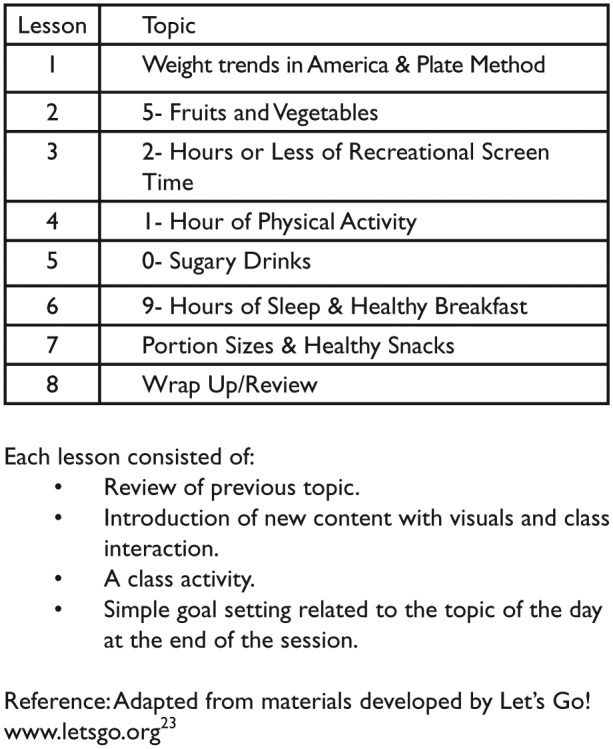
Methods: This was a cluster randomized controlled field trial comprising 8 classrooms of second- and third-grade children. The impact of implementation of a standardized 5-2-1-0 curriculum was evaluated in the classrooms by looking at health behavior (self-reported fruit and vegetable and sugar-containing beverage intake, and screen time), physical activity (steps measured by pedometer), and body mass index (BMI). Half of the classrooms were given 5-2-1-0 teaching over a 4-month period.
Results: There was no statistical difference in improvement of healthy habits, BMI, or physical activity in the intervention group compared with the control group.
Conclusions: The 5-2-1-0 intervention used in this study was feasible. There was no significant change in healthy habits, likely due to the small number of participants in the study. The intervention and control sites were in different classrooms and there could be factors such as teacher enthusiasm, socioeconomic factors, and individual traits affecting habits. Future studies could use pre- and post-intervention quizzes to assess healthy habits knowledge retention, involving the environments the child participates in outside of school, using research-grade pedometers or accelerometers for measuring activity data collection, and recruiting larger samples to ensure adequate statistical power.
Keywords: health promotion; lifestyle change; obesity; pediatrics; physical activity; prevention; primary care; progam evaluation.
© The Author(s) 2016.
Conflict of interest statement
Figures
References
-
- Let’s move. http://www.letsmove.gov/. Accessed May 15, 2014.
-
- National Collaboration on Childhood Obesity Research (NCCOR). http://www.nccor.org/. Accessed May 15, 2014.
-
- Ogden CL, Carroll MD, Curtin LR, Lamb MM, Flegal KM. Prevalence of high body mass index in US children and adolescents, 2007-2008. JAMA. 2010;303:242-249. - PubMed
-
- Institute of Medicine. Accelerating Progress in Obesity Prevention: Solving the Weight of the Nation. Washington DC: Institute of Medicine; 2012. - PubMed
Publication types
MeSH terms
Grants and funding
LinkOut - more resources
Full Text Sources
Other Literature Sources
Medical
