


Randomized Controlled Trial of Social Media: Effect of Increased Intensity of the Intervention
- PMID: 27121850
- PMCID: PMC4889182
- DOI: 10.1161/JAHA.115.003088
Randomized Controlled Trial of Social Media: Effect of Increased Intensity of the Intervention
Abstract
Background: A prior randomized controlled trial of social media exposure at Circulation determined that social media did not increase 30-day page views. Whether insufficient social media intensity contributed to these results is uncertain.
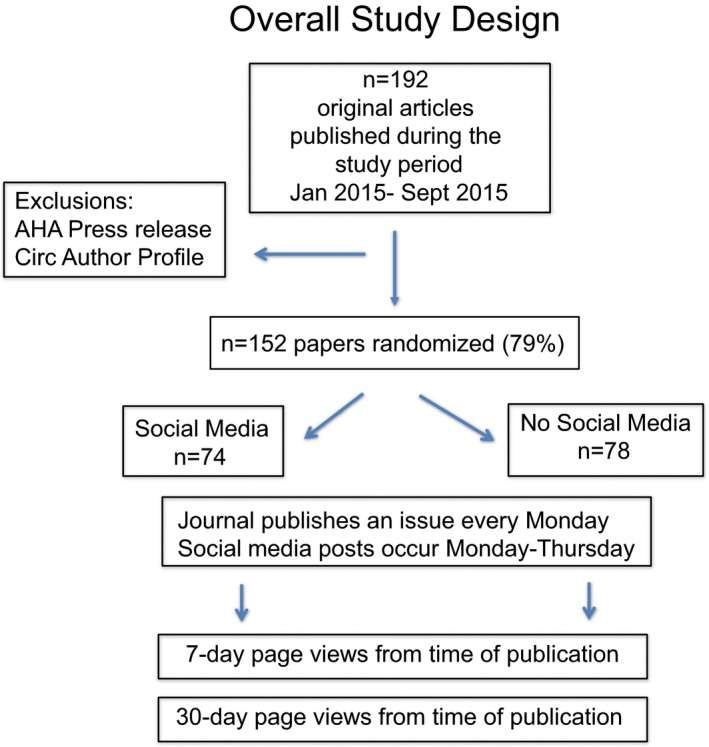
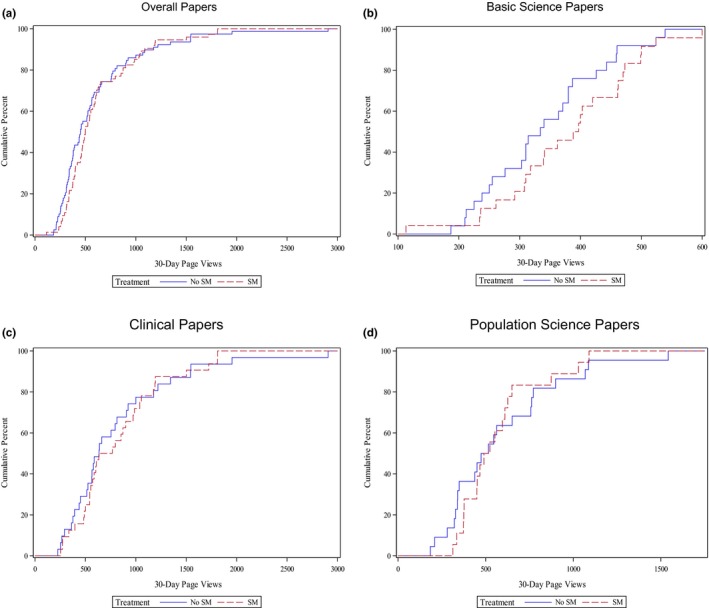
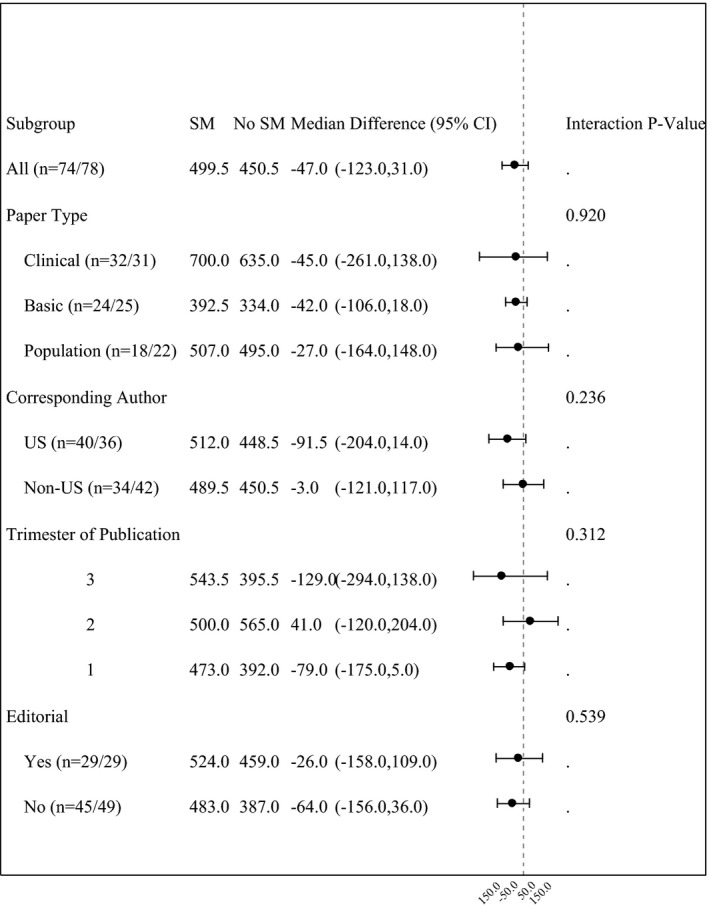
Methods and results: Original article manuscripts were randomized to social media exposure compared with no social media exposure (control) at Circulation beginning in January 2015. Social media exposure consisted of Facebook and Twitter posts on the journal's accounts. To increase social media intensity, a larger base of followers was built using advertising and organic growth, and posts were presented in triplicate and boosted on Facebook and retweeted on Twitter. The primary outcome was 30-day page views. Stopping rules were established at the point that 50% of the manuscripts were randomized and had 30-day follow-up to compare groups on 30-day page views. The trial was stopped for futility on September 26, 2015. Overall, 74 manuscripts were randomized to receive social media exposure, and 78 manuscripts were randomized to the control arm. The intervention and control arms were similar based on article type (P=0.85), geographic location of the corresponding author (P=0.33), and whether the manuscript had an editorial (P=0.80). Median number of 30-day page views was 499.5 in the social media arm and 450.5 in the control arm; there was no evidence of a treatment effect (P=0.38). There were no statistically significant interactions of treatment by manuscript type (P=0.86), by corresponding author (P=0.35), by trimester of publication date (P=0.34), or by editorial status (P=0.79).
Conclusions: A more intensive social media strategy did not result in increased 30-day page views of original research.
Keywords: altmetrics; randomized control trial; social media.
© 2016 The Authors. Published on behalf of the American Heart Association, Inc., by Wiley Blackwell.
Figures
References
Publication types
MeSH terms
LinkOut - more resources
Full Text Sources
Other Literature Sources
