. 2016 Apr 28;8(1):49.
doi: 10.1186/s13073-016-0301-4.

Pretreatment gut microbiome predicts chemotherapy-related bloodstream infection

Affiliations

Pretreatment gut microbiome predicts chemotherapy-related bloodstream infection

Emmanuel Montassier et al. Genome Med. .

Erratum in

Abstract

Background: Bacteremia, or bloodstream infection (BSI), is a leading cause of death among patients with certain types of cancer. A previous study reported that intestinal domination, defined as occupation of at least 30 % of the microbiota by a single bacterial taxon, is associated with BSI in patients undergoing allo-HSCT. However, the impact of the intestinal microbiome before treatment initiation on the risk of subsequent BSI remains unclear. Our objective was to characterize the fecal microbiome collected before treatment to identify microbes that predict the risk of BSI.

Methods: We sampled 28 patients with non-Hodgkin lymphoma undergoing allogeneic hematopoietic stem cell transplantation (HSCT) prior to administration of chemotherapy and characterized 16S ribosomal RNA genes using high-throughput DNA sequencing. We quantified bacterial taxa and used techniques from machine learning to identify microbial biomarkers that predicted subsequent BSI.

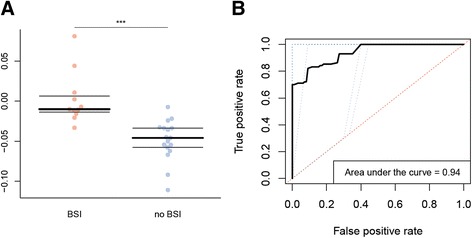
Results: We found that patients who developed subsequent BSI exhibited decreased overall diversity and decreased abundance of taxa including Barnesiellaceae, Coriobacteriaceae, Faecalibacterium, Christensenella, Dehalobacterium, Desulfovibrio, and Sutterella. Using machine-learning methods, we developed a BSI risk index capable of predicting BSI incidence with a sensitivity of 90 % at a specificity of 90 % based only on the pretreatment fecal microbiome.

Conclusions: These results suggest that the gut microbiota can identify high-risk patients before HSCT and that manipulation of the gut microbiota for prevention of BSI in high-risk patients may be a useful direction for future research. This approach may inspire the development of similar microbiome-based diagnostic and prognostic models in other diseases.

Keywords: Bloodstream infection; Chemotherapy; Intestinal microbiome; Prediction.


Figures
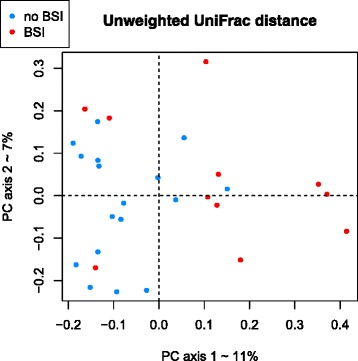
Fig. 1
Fig. 1
Beta-diversity comparisons of the gut microbiomes of fecal samples from samples collected prior to treatment in patients who developed subsequent BSI (n = 11) and in patients who did not develop subsequent BSI (n = 17). The first three axes are shown of principal coordinate analysis (PCoA) of Unweighted UniFrac distances between patient bacterial communities. The proportion of variance explained by each principal coordinate axis is denoted in the corresponding axis label. The plot shows a significant separation between fecal samples from patients who developed subsequent BSI and in patients who did not develop subsequent BSI (PERMANOVA, p = 0.01)
Fig. 2
Fig. 2
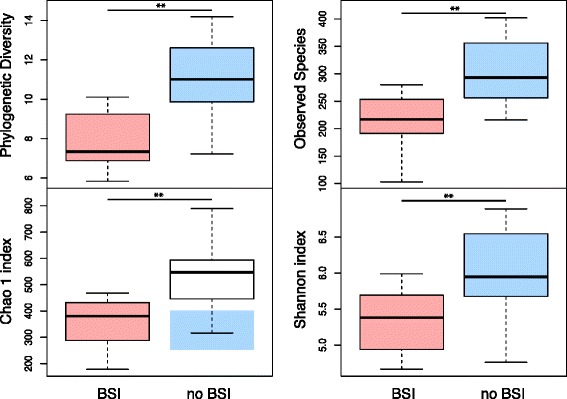
Alpha-diversity indices in samples collected prior to treatment in patients who developed subsequent BSI (red, n = 11) versus samples collected prior to treatment in patients who did not develop subsequent BSI (blue, n = 17), based on phylogenetic and non-phylogenetic richness. Analyses were performed on 16S rRNA V5 and V6 regions data, with a rarefaction depth of 3041 reads per sample. Whiskers in the boxplot represent the range of minimum and maximum alpha diversity values within a population, excluding outliers. Monte-Carlo permutation t-test: *p <0.05; **p <0.01; and ***p <0.001. Boxplots denote top quartile, median, and bottom quartile. BSI, Bloodstream infection. Patients who developed a subsequent BSI had significantly lower microbial richness compared with patients who did not develop subsequent BSI
Fig. 3
Fig. 3
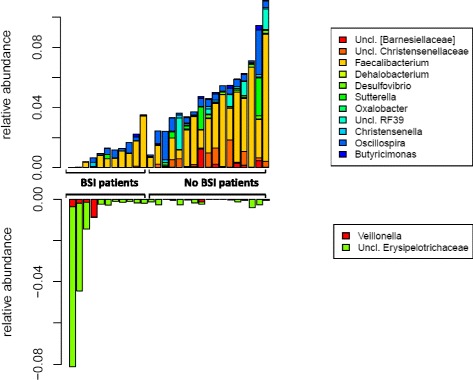
Relative abundance of the differentiated taxa in samples collected prior to treatment in patients who developed subsequent BSI (n = 11) and patients who did not develop BSI (n = 17). BSI, Bloodstream infection
Fig. 4
Fig. 4
a BSI risk index based on the differentiated taxa (n = 28). We included in the BSI risk index all the taxa with a false discovery rate (FDR)-corrected p value less than 0.15. The BSI was then calculated using the sum of relative abundances of the taxa that were significantly associated with BSI minus the sum of the relative abundances of the taxa that were associated with protection from BSI. Mann–Whitney U test: ***p < 0.001. Boxplots denote top quartile, median, and bottom quartile. BSI, Bloodstream infection. b Receiving-operating characteristic (ROC) curve analysis of the BSI risk index in fecal samples collected prior to treatment, to differentiate patients who developed subsequent BSI and patients who did not develop BSI. We applied tenfold jack-knifing; the ten ROC curves are in blue and the mean ROC curve is in black. BSI, Bloodstream infection

References

    1. Tuncer HH, Rana N, Milani C, Darko A, Al-Homsi SA. Gastrointestinal and hepatic complications of hematopoietic stem cell transplantation. World J Gastroenterol. 2012;18:1851–1860. doi: 10.3748/wjg.v18.i16.1851. - DOI - PMC - PubMed
    1. Keefe DM, Schubert MM, Elting LS, Sonis ST, Epstein JB, Raber-Durlacher JE, et al. Updated clinical practice guidelines for the prevention and treatment of mucositis. Cancer. 2007;109:820–831. doi: 10.1002/cncr.22484. - DOI - PubMed
    1. Sonis ST. The pathobiology of mucositis. Nat Rev Cancer. 2004;4:277–284. doi: 10.1038/nrc1318. - DOI - PubMed
    1. Berg RD. Bacterial translocation from the gastrointestinal tract. Adv Exp Med Biol. 1999;473:11–30. doi: 10.1007/978-1-4615-4143-1_2. - DOI - PubMed
    1. Blennow O, Ljungman P, Sparrelid E, Mattsson J, Remberger M. Incidence, risk factors, and outcome of bloodstream infections during the pre-engraftment phase in 521 allogeneic hematopoietic stem cell transplantations. Transpl Infect Dis. 2014;16:106–114. doi: 10.1111/tid.12175. - DOI - PubMed

MeSH terms