. 2016 May;67(10):3137-48.
doi: 10.1093/jxb/erw154. Epub 2016 Apr 27.

Improved analysis of C4 and C3 photosynthesis via refined in vitro assays of their carbon fixation biochemistry

Affiliations

Improved analysis of C4 and C3 photosynthesis via refined in vitro assays of their carbon fixation biochemistry

Robert E Sharwood et al. J Exp Bot. 2016 May.

Abstract

Plants operating C3 and C4 photosynthetic pathways exhibit differences in leaf anatomy and photosynthetic carbon fixation biochemistry. Fully understanding this underpinning biochemical variation is requisite to identifying solutions for improving photosynthetic efficiency and growth. Here we refine assay methods for accurately measuring the carboxylase and decarboxylase activities in C3 and C4 plant soluble protein. We show that differences in plant extract preparation and assay conditions are required to measure NADP-malic enzyme and phosphoenolpyruvate carboxylase (pH 8, Mg(2+), 22 °C) and phosphoenolpyruvate carboxykinase (pH 7, >2mM Mn(2+), no Mg(2+)) maximal activities accurately. We validate how the omission of MgCl2 during leaf protein extraction, lengthy (>1min) centrifugation times, and the use of non-pure ribulose-1,5-bisphosphate (RuBP) significantly underestimate Rubisco activation status. We show how Rubisco activation status varies with leaf ontogeny and is generally lower in mature C4 monocot leaves (45-60% activation) relative to C3 monocots (55-90% activation). Consistent with their >3-fold lower Rubisco contents, full Rubisco activation in soluble protein from C4 leaves (<5min) was faster than in C3 plant samples (<10min), with addition of Rubisco activase not required for full activation. We conclude that Rubisco inactivation in illuminated leaves primarily stems from RuBP binding to non-carbamylated enzyme, a state readily reversible by dilution during cellular protein extraction.

Keywords: CO2-concentrating mechanism; Carbamylation; Rubisco; Rubisco activase.; carbon fixation; photosynthesis.


Figures

Fig. 1.
Fig. 1.
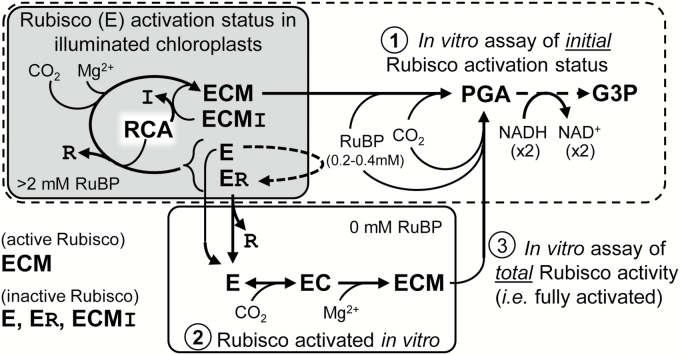
Summary of Rubisco activation status in vivo and modulation in vitro. Summary of the NADH-linked assay used to determine Rubisco activation status using rapidly extracted soluble protein from young, non-stressed leaves sampled during illumination [where inactive ECMI complexes containing the Rubisco inhibitors (I) CA1P or XuBP would be negligible]. See text for details of the three assay stages indicated. R, RuBP; RCA, Rubisco activase. Details of the NADH-linked assay are summarized in Supplementary Fig. S1 and Supplementary Table S1.
Fig. 2.
Fig. 2.
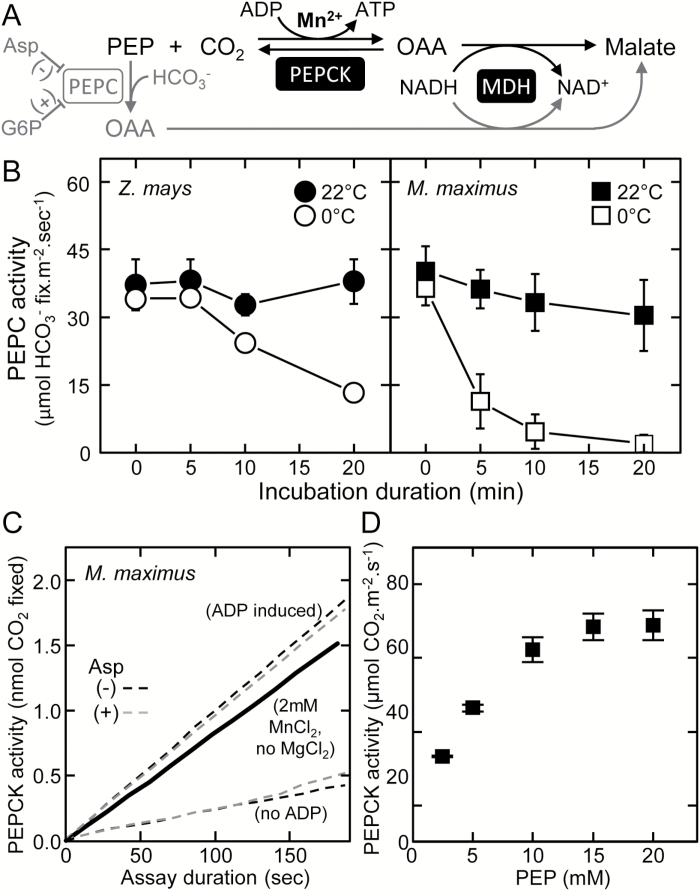
Optimizing the measurement of PEPC and PEPCK activities in leaf extract. (A) Summarizing the commonality of the malate dehydrogenase- (MDH) coupled, NADH oxidation-linked assay to quantify the carboxylation of phosphoenolpyruvate (PEP) into oxaloacetate (OAA) by PEP carboxykinase (PEPCK; in black) and PEP carboxylase (PEPC; in gray), an enzyme inhibited (–) by aspartate (Asp; Huber and Edwards, 1975) and activated (+) by glucose-6-phosphate (G6P). (B) Effect of storage temperature (room temperature, 22 °C, or ice, 0 °C) and time on PEPC activity in the soluble protein from young leaves from mature Z. mays and M. maximus plants (n=3 biological replicates ±SD; see leaves m3b and c3b in Fig. 5A for examples). (C) Representative assay of PEP carboxylation by PEPCK measured in leaf soluble protein extract using the no MgCl2 method of Sharwood et al. (2014) ( black line) and the modified ADP method of this study in assays with (gray dashed lines) or without (black dashed lines) 5mM aspartate (a PEPC inhibitor, A). (D) Response of PEPCK activity to [PEP] in M. maximus leaf soluble protein. To prevent PEPC interference ensure: 1) No MgCl2 in assay and extraction buffers, 2) MnCl2 up to 5mM in extraction and assay buffers, 3) pH of extraction and assay buffers <7.0, 4) No glucose-6-phosphate, and 5) include aspartate in assay buffer.
Fig. 3.
Fig. 3.
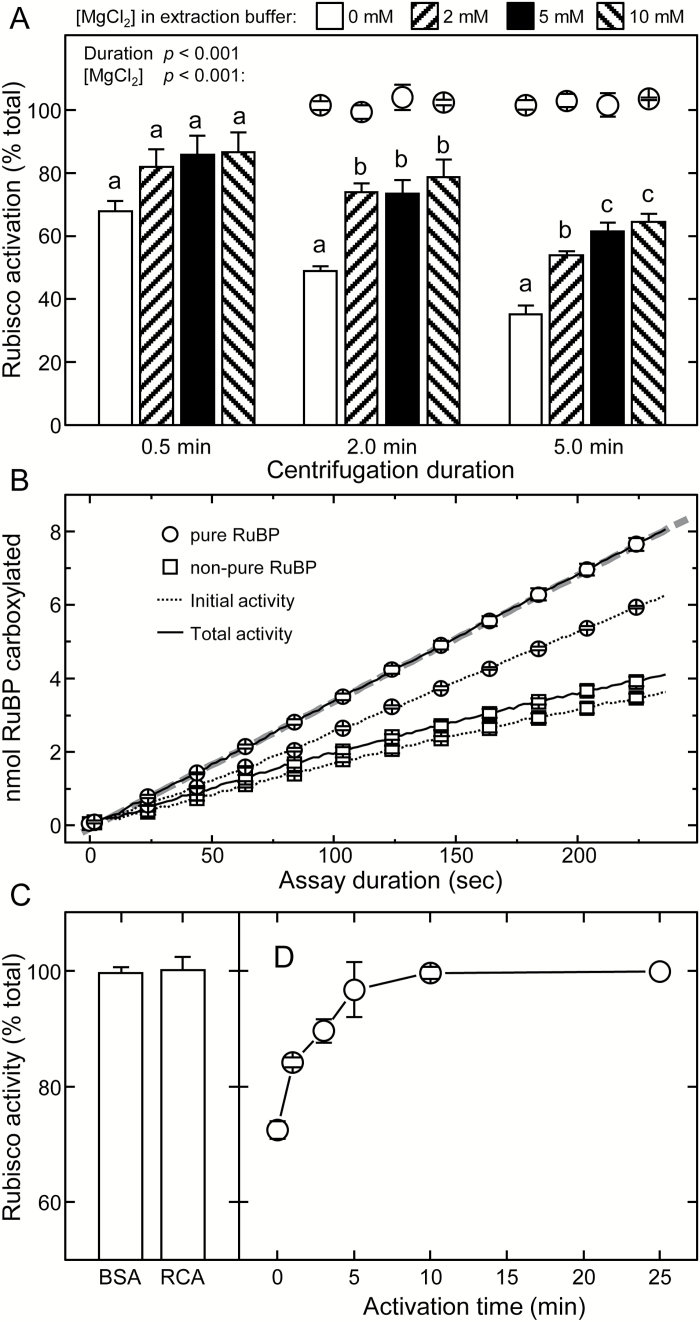
Evaluating the experimental methodology for measuring leaf Rubisco activation status. (A) Appraising how MgCl2 inclusion and quickness of soluble leaf protein extraction influences Rubisco activation quantification. NADH-linked assays were performed on N2-frozen replica (n=5) tobacco leaf discs (0.5cm2) taken from a young, nearly fully expanded upper canopy leaf (15cm in diameter) and stored at –80 °C for up to 3 months without effect on recoverable activity. Circles indicate the total activities measured after 10min activation relative to the 0.5min centrifuged sample (B) Representative NADH-linked spectrophotometric measures of initial (dashed lines) and total (solid lines) Rubisco activities made using low purity commercial RuBP (squares) or that purified according to Kane et al. (1998) (circles). Rates correspond to protein from 0.9mm2 of leaf with a Rubisco active site concentration in each assay of ~34.4nM (i.e. a k cat of 2.2s−1). (C) Incubation of leaf protein extract for 2min at 25 °C with 80 μg ml–1 of either BSA or purified tobacco Rubisco activase (RCA) had no effect on the measured rates of fully activated Rubisco, while the same treatment re-activated >80% of inhibited ER complexes formed using a comparable concentration of purified tobacco Rubisco (Supplementary Fig. S2). (D) Change in the activity status of Rubisco in tobacco soluble protein activated at 25 °C for up to 25min. Data in (C) and (D) are the averages (±SE) from analyses with three separate leaf samples expressed as a percentage of the total activities measured after 10min (C) and 25min (D) activation. For (A), the significance level (P) for the [MgCl2] and centrifugation duration factors are shown. Letters indicate the ranking (lowest=a) of means within each centrifugation duration using a post-hoc Tukey test. Values followed by the same letter are not significantly different at the 5% level (P>0.05).
Fig. 4.
Fig. 4.
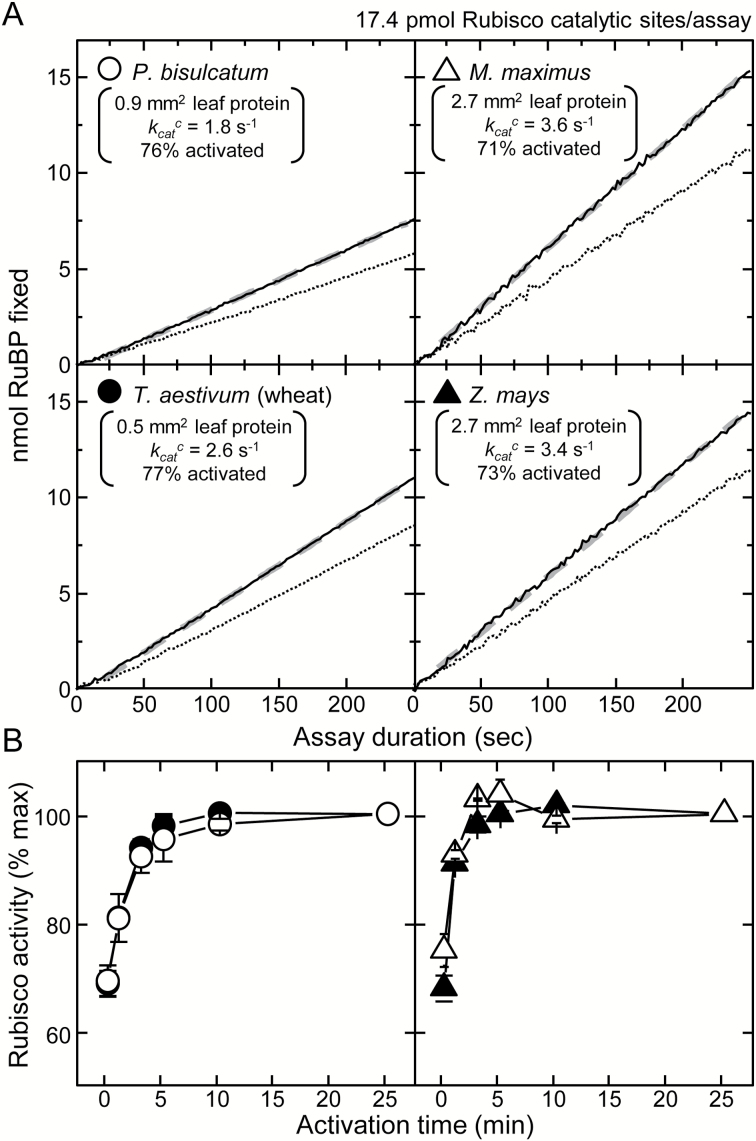
Variations in Rubisco content and activation status during leaf ontogeny can account for variations in the in vivo estimates of V c max. (A) Representative NADH-linked assay data showing the linear RuBP carboxylation rates in assays of initial (dashed lines) and total (solid lines, after 10–15min activation) Rubsico activities at 25 °C using soluble leaf protein from both C3 (P. bisulcatum, T. aestivum) and C4 (M. maximus, Z. mays) monocotyledon species. Shown are details of the calculated Rubisco activation status (% of maximum), the derived carboxylation rates (k cat c, quantified from the slope of the fitted linear regression, gray dashed line, divided by Rubisco content quantified by [14C]CABP binding) and the area of leaf protein required to attain the 17.4 pmol Rubsico catalytic sites used to normalize the plotted data to highlight the variations in k cat c between each species (see also Table 1). (B) Response of Rubisco activation and activity in the soluble leaf protein of each species following incubation at 25 °C. Shown is the average (±SE) of analyses from three separate leaf samples for each species expressed as a percentage of the maximum activities measured after 25min activation.
Fig. 5.
Fig. 5.
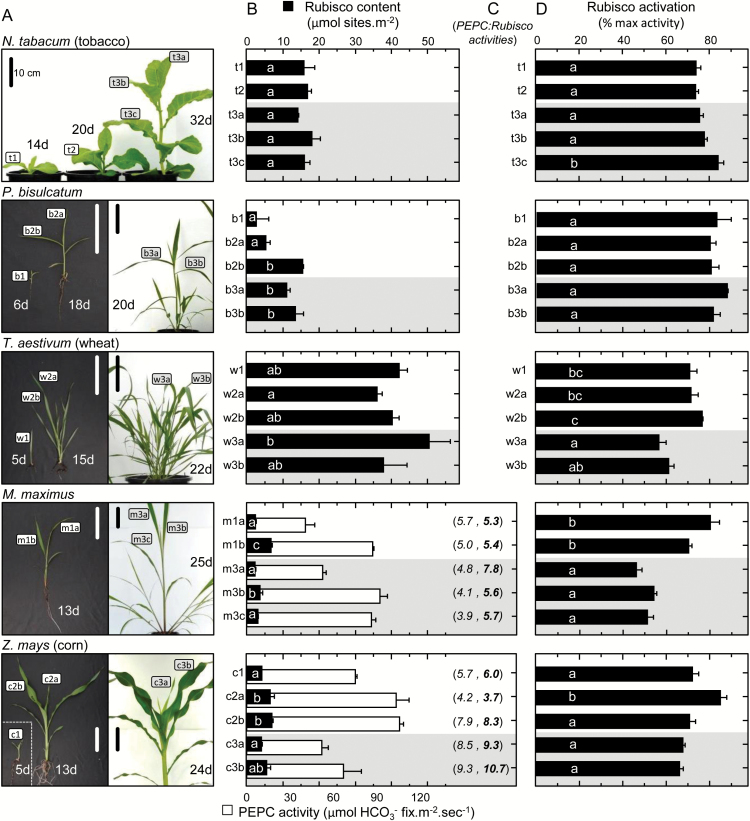
Variation in PEPC activity, Rubisco content, and Rubisco activation status with leaf ontogeny and development in C3 and C4 plants. (A) Pictures showing the leaves at differing stages of ontogeny and plant development (as labeled) that were analyzed for (B) Rubisco content (black bars, determined by [14C]CABP binding) and PEPC activity (white bars). (C) For both C4 species, the corresponding PEPC:Rubisco activity ratios are shown in parenthess; the first value is determined from the rates measured using the NADH-linked assays (in italics) and the second value (in bold) takes into account the higher Rubisco k cat c values quantified using 14CO2 assays (Table 1) and (D) the activation status of Rubisco in each leaf analyzed. The age of each plant (days, d) post-cotyledon emergence is indicated with the scale bar=10cm. All data are averages (±SD) of n=3 leaf discs taken from each leaf (or for the juvenile samples b1, c1, and w1, from replica plantlets). Regions shaded gray in (B) and (D) indicates data for leaves sampled from more mature plants. For (B) and (D), letters indicate the ranking (lowest=a) of means within each species using a post-hoc Tukey test. Values followed by the same letter are not significantly different at the 5% level (P>0.05). The levels of Rubisco measured correlate with those previously measured in the leaves of tobacco (Whitney et al., 2011), P. bisulcatum (Pinto et al., 2014), M. maximus (Pinto et al., 2016), and maize (Sharwood et al., 2014).
Fig. 6.
Fig. 6.
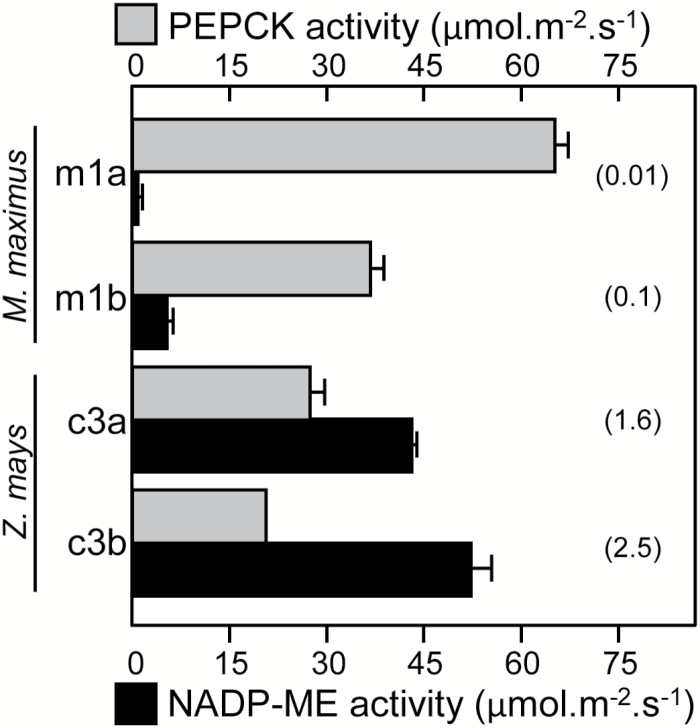
Maximal activity of the decarboxylases in C4 grasses. Comparison of PEPCK (gray) and NADP-ME (black) activities in differing aged Z. mays and M. maximus leaves (n=3, ± SE). The leaves analyzed are shown in Fig. 4A. The PEPCK:NADP-ME ratio activities are indicated in parentheses.

References

    1. Andersson I. 2008. Catalysis and regulation in Rubisco. Journal of Experimental Botany 59, 1555–1568. - PubMed
    1. Andersson I, Backlund A. 2008. Structure and function of Rubisco. Plant Physiology and Biochemistry 46, 275–291. - PubMed
    1. Andralojc PJ, Madgwick PJ, Tao Y, et al. 2012. 2-Carboxy-d-arabinitol 1-phosphate (CA1P) phosphatase: evidence for a wider role in plant Rubisco regulation. Biochemical Journal 442, 733–742. - PubMed
    1. Andrews TJ, Whitney SM. 2003. Manipulating ribulose bisphosphate carboxylase/oxygenase in the chloroplasts of higher plants. Archives of Biochemistry and Biophysics 414, 159–169. - PubMed
    1. Anwaruzzaman, Nakano Y, Yokota A. 1996. Different location in dark-adapted leaves of Phaseolus vulgaris of ribulose-1,5-bisphosphate carboxylase/oxygenase and 2-carboxyarabinitol 1-phosphate. FEBS Letters 388, 223–227. - PubMed

Publication types

MeSH terms

Substances