


Systematic Surveillance Detects Multiple Silent Introductions and Household Transmission of Methicillin-Resistant Staphylococcus aureus USA300 in the East of England
- PMID: 27122590
- PMCID: PMC4936647
- DOI: 10.1093/infdis/jiw166
Systematic Surveillance Detects Multiple Silent Introductions and Household Transmission of Methicillin-Resistant Staphylococcus aureus USA300 in the East of England
Abstract
Background: The spread of USA300 methicillin-resistant Staphylococcus aureus (MRSA) across the United States resulted in an epidemic of infections. In Europe, only sporadic cases or small clusters of USA300 infections are described, and its prevalence in England is unknown. We conducted prospective surveillance for USA300 in the east of England.
Methods: We undertook a 12-month prospective observational cohort study of all individuals with MRSA isolated from community and hospital samples submitted to a microbiology laboratory. At least 1 MRSA isolate from each individual underwent whole-genome sequencing. USA300 was identified on the basis of sequence analysis, and phylogenetic comparisons were made between these and USA300 genomes from the United States.
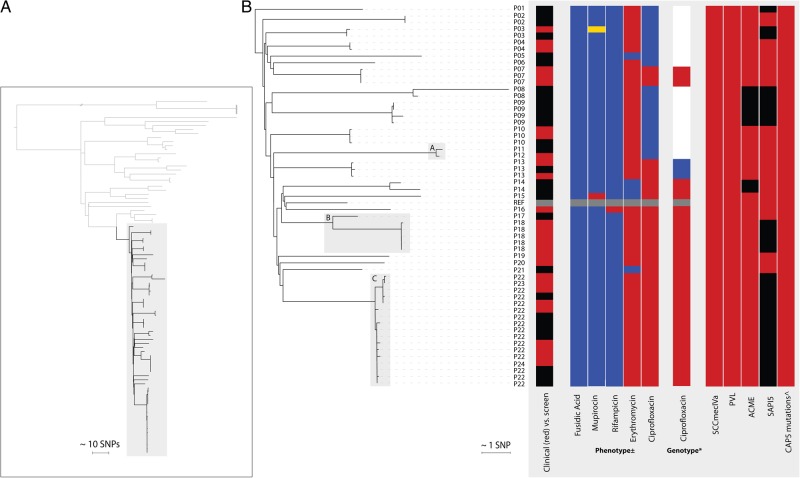
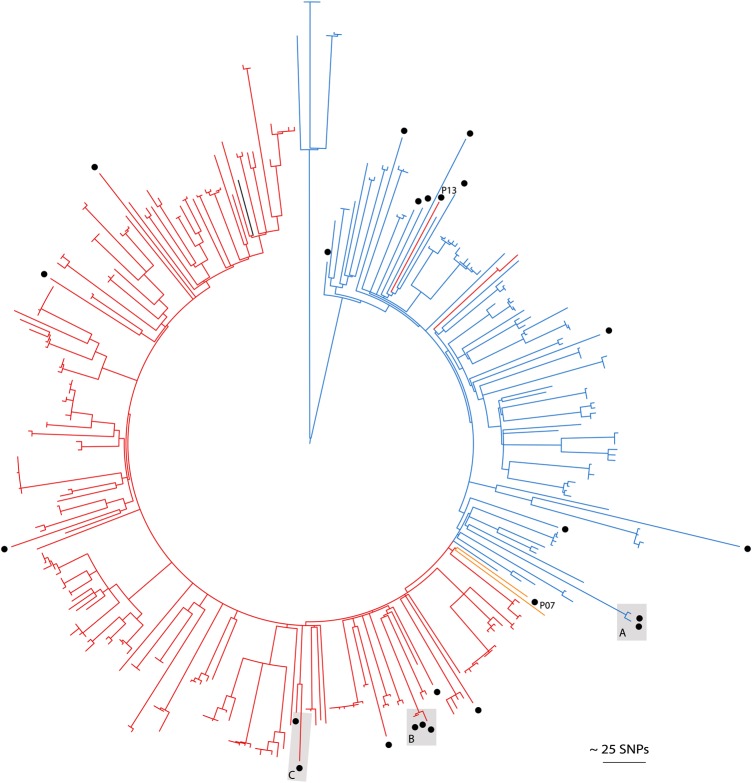
Results: Between April 2012 and April 2013, we sequenced 2283 MRSA isolates (detected during carriage screening and in clinical samples) from 1465 individuals. USA300 was isolated from 24 cases (1.6%). Ten cases (42%) had skin and soft tissue infection, and 2 cases had invasive disease. Phylogenetic analyses identified multiple introductions and household transmission of USA300.
Conclusions: Use of a diagnostic laboratory as a sentinel for surveillance has identified repeated introductions of USA300 in eastern England in 2012-2013, with evidence for limited transmission. Our results show how systematic surveillance could provide an early warning of strain emergence and dissemination.
Keywords: MRSA; Staphylococcus aureus; USA300; molecular epidemiology; whole-genome sequencing.
© The Author 2016. Published by Oxford University Press for the Infectious Diseases Society of America.
Figures
References
-
- Centers for Disease Control and Prevention (CDC). Methicillin-resistant Staphylococcus aureus skin or soft tissue infections in a state prison - Mississippi, 2000. MMWR Morb Mortal Wkly Rep 2001; 50:919–22. - PubMed
-
- Moran GJ, Krishnadasan A, Gorwitz RJ et al. . Methicillin-resistant S. aureus infections among patients in the emergency department. N Engl J Med 2006; 355:666–74. - PubMed
-
- Jenkins TC, McCollister BD, Sharma R et al. . Epidemiology of healthcare-associated bloodstream infection caused by USA300 strains of methicillin-resistant Staphylococcus aureus in 3 affiliated hospitals. Infect Control Hosp Epidemiol 2009; 30:233–41. - PubMed
-
- Seybold U, Kourbatova EV, Johnson JG et al. . Emergence of community-associated methicillin-resistant Staphylococcus aureus USA300 genotype as a major cause of health care-associated blood stream infections. Clin Infect Dis 2006; 42:647–56. - PubMed
Publication types
MeSH terms
Grants and funding
LinkOut - more resources
Full Text Sources
Other Literature Sources
Medical
Miscellaneous
