


High Sensitivity C Reactive Protein (hs-CRP) in Adolescent and Young Adult Patients with History of Kawasaki Disease
- PMID: 27122910
- PMCID: PMC4804970
- DOI: 10.6515/acs20150424e
High Sensitivity C Reactive Protein (hs-CRP) in Adolescent and Young Adult Patients with History of Kawasaki Disease
Abstract
Background: For children with a history of Kawasaki disease (KD), low grade inflammation was generally reported to be associated with persistent coronary artery lesions (CAL). However, this association has not been clearly demonstrated to hold true in KD adolescents and young adults (10-25 years of age).
Methods: We enrolled 104 subjects into our study, who were separated into the following 3 groups and controls: 1): 22 KD patients with angiography-confirmed CAL which persisted for an average of 12.5 years after onset of KD; 2) 38 KD patients with regressed aneurysms; 3) 44 KD patients without any coronary complications from the disease onset; and 4) 31 age-matched (18.7 ± 1.88 years old) healthy controls. Plasma levels of high-sensitivity C reactive protein (hs-CRP) were measured for all participants.
Results: Plasma levels of hs-CRP were significantly higher in KD patients than in the controls, regardless of their coronary severity. However, there was no significant difference in hs-CRP levels among KD patients with different severities of CAL. Of the candidate risk factors of elevated hs-CRP such as body mass index, gender, coronary severity, and levels of high-density lipoprotein-cholesterol, linear regression analysis showed the only independent predictor of hs-CRP levels was BMI (β = 0.306, p = 0.01), rather than patient grouping (p = 0.091).
Conclusions: Our study found that levels of hs-CRP are significantly higher in adolescent and young adult patients with a history of KD, compared with age-matched controls. Low grade inflammation may play a minor role when KD patients enter into adulthood. body mass index (BMI), rather than coronary severity, was independently associated with the elevation of hs-CRP levels, one of biomarkers for further cardiovascular event. Therefore, ongoing control and management of BMI may be one of beneficial strategies that can be employed to help avoid elevation of hs-CRP levels in KD patients.
Key words: Adolescents; High sensitivity-C reactive protein; Kawasaki disease; Young adult.
Figures
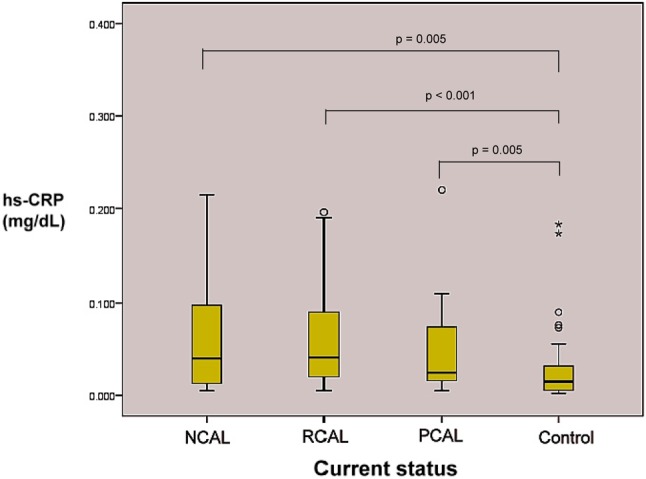
Similar articles
-
Significant relationship between serum high-sensitivity C-reactive protein, high-density lipoprotein cholesterol levels and children with Kawasaki disease and coronary artery lesions.J Formos Med Assoc. 2009 Sep;108(9):719-24. doi: 10.1016/S0929-6646(09)60395-8. J Formos Med Assoc. 2009. PMID: 19773210
-
Elevated levels of high-sensitivity C-reactive protein and serum amyloid-A late after Kawasaki disease: association between inflammation and late coronary sequelae in Kawasaki disease.Circulation. 2005 Jan 4;111(1):38-43. doi: 10.1161/01.CIR.0000151311.38708.29. Epub 2004 Dec 20. Circulation. 2005. PMID: 15611368
-
[Relationship between serum high-sensitivity C-reactive protein and obesity and impaired glycose metabolism in children and adolescents].Zhonghua Er Ke Za Zhi. 2006 Dec;44(12):933-6. Zhonghua Er Ke Za Zhi. 2006. PMID: 17254464 Chinese.
-
High-sensitivity C-reactive protein and atherosclerotic disease: from improved risk prediction to risk-guided therapy.Int J Cardiol. 2013 Oct 15;168(6):5126-34. doi: 10.1016/j.ijcard.2013.07.113. Epub 2013 Aug 24. Int J Cardiol. 2013. PMID: 23978367 Review.
-
Vascular health late after Kawasaki disease: implications for accelerated atherosclerosis.Korean J Pediatr. 2014 Nov;57(11):472-8. doi: 10.3345/kjp.2014.57.11.472. Epub 2014 Nov 30. Korean J Pediatr. 2014. PMID: 25550701 Free PMC article. Review.
Cited by
-
Risk factors and implications of progressive coronary dilatation in children with Kawasaki disease.BMC Pediatr. 2017 Jun 6;17(1):139. doi: 10.1186/s12887-017-0895-8. BMC Pediatr. 2017. PMID: 28587647 Free PMC article.
-
Prognosis and Risk Factors of Coronary Artery Lesions before Immunoglobulin Therapy in Children with Kawasaki Disease.Balkan Med J. 2020 Oct 23;37(6):324-329. doi: 10.4274/balkanmedj.galenos.2020.2020.1.56. Epub 2020 Jul 28. Balkan Med J. 2020. PMID: 32720495 Free PMC article.
-
Platelet Endothelial Cell Adhesion Molecule-1 Gene Polymorphisms are Associated with Coronary Artery Lesions in the Chronic Stage of Kawasaki Disease.Acta Cardiol Sin. 2017 May;33(3):273-284. doi: 10.6515/acs20161010a. Acta Cardiol Sin. 2017. PMID: 28559658 Free PMC article.
-
Long-Term Hypermethylation of FcγR2B in Leukocytes of Patients with Kawasaki Disease.J Clin Med. 2021 May 27;10(11):2347. doi: 10.3390/jcm10112347. J Clin Med. 2021. PMID: 34071896 Free PMC article.
References
-
- Dajani AS, Taubert KA, Gerber MA, et al. Diagnosis and therapy of Kawasaki disease in children. Circulation. 1993;87:1776–1780. - PubMed
-
- Kato H, Sugimura T, Akagi T, et al. Long-term consequences of Kawasaki disease. A 10- to 21-year follow-up study of 594 patients. Circulation. 1996;94:1379–1385. - PubMed
-
- Dajani AS, Taubert KA, Takahashi M, et al. Guidelines for long-term management of patients with Kawasaki disease. Report from the Committee on Rheumatic Fever, Endocarditis, and Kawasaki Disease, Council on Cardiovascular Disease in the Young, American Heart Association. Circulation. 1994;89:916–922. - PubMed
-
- Durongpisitkul K, Gururaj VJ, Park JM, Martin CF. The prevention of coronary artery aneurysm in Kawasaki disease: a meta-analysis on the efficacy of aspirin and immunoglobulin treatment. Pediatrics. 1995;96:1057–1061. - PubMed
-
- McConnell ME, Hannon DW, Steed RD, Gilliland MG. Fatal obliterative coronary vasculitis in Kawasaki disease. J Pediatr. 1998;133:259–261. - PubMed
LinkOut - more resources
Full Text Sources
Research Materials
Miscellaneous