Review
. 2016:2016:9508541.
doi: 10.1155/2016/9508541. Epub 2016 Mar 31.

Neuroprotection as a Therapeutic Target for Diabetic Retinopathy

Affiliations
Review

Neuroprotection as a Therapeutic Target for Diabetic Retinopathy

Cristina Hernández et al. J Diabetes Res. 2016.

Abstract

Diabetic retinopathy (DR) is a multifactorial progressive disease of the retina and a leading cause of vision loss. DR has long been regarded as a vascular disorder, although neuronal death and visual impairment appear before vascular lesions, suggesting an important role played by neurodegeneration in DR and the appropriateness of neuroprotective strategies. Upregulation of vascular endothelial growth factor (VEGF), the main target of current therapies, is likely to be one of the first responses to retinal hyperglycemic stress and VEGF may represent an important survival factor in early phases of DR. Of central importance for clinical trials is the detection of retinal neurodegeneration in the clinical setting, and spectral domain optical coherence tomography seems the most indicated technique. Many substances have been tested in animal studies for their neuroprotective properties and for possible use in humans. Perhaps, the most intriguing perspective is the use of endogenous neuroprotective substances or nutraceuticals. Together, the data point to the central role of neurodegeneration in the pathogenesis of DR and indicate neuroprotection as an effective strategy for treating this disease. However, clinical trials to determine not only the effectiveness and safety but also the compliance of a noninvasive route of drug administration are needed.


Figures
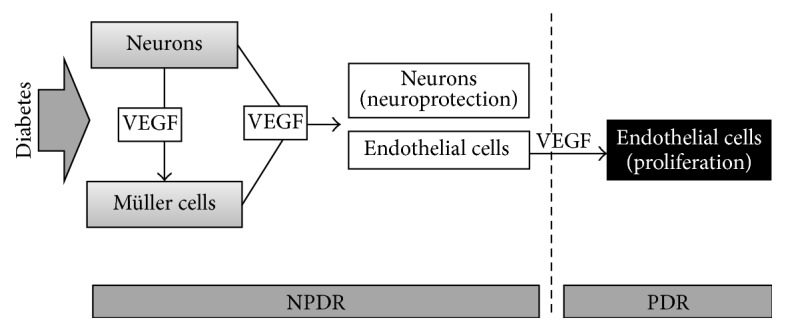
Figure 1
Figure 1
Possible role of VEGF in early DR. Under diabetic stress, VEGF would be immediately released by neurons and by Müller cells, which perhaps receive stimulation by the VEGF of neuronal origin. In the nonproliferative phase of DR (NPDR), released VEGF would act on retinal neurons as a neuroprotectant, while it would also bind to its receptors on endothelial cells. A prolonged interaction of VEGF with endothelial cells would lead to the proliferative phase of DR (PDR).
Figure 2
Figure 2
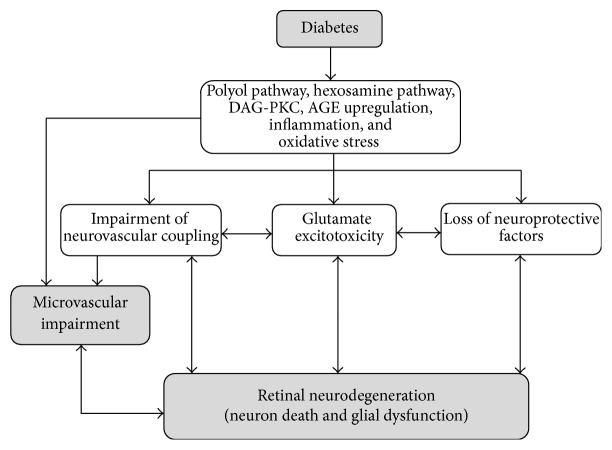
Potential therapeutic targets based on pathogenic mechanisms involved in retinal neurodegeneration induced by diabetes.

References

    1. Abcouwer S. F., Gardner T. W. Diabetic retinopathy: loss of neuroretinal adaptation to the diabetic metabolic environment. Annals of the New York Academy of Sciences. 2014;1311:174–190. doi: 10.1111/nyas.12412. - DOI - PMC - PubMed
    1. Ola M. S., Nawaz M. I., Siddiquei M. M., Al-Amro S., Abu El-Asrar A. M. Recent advances in understanding the biochemical and molecular mechanism of diabetic retinopathy. Journal of Diabetes and Its Complications. 2012;26(1):56–64. doi: 10.1016/j.jdiacomp.2011.11.004. - DOI - PubMed
    1. Qian H., Ripps H. Neurovascular interaction and the pathophysiology of diabetic retinopathy. Experimental Diabetes Research. 2011;2011:11. doi: 10.1155/2011/693426.693426 - DOI - PMC - PubMed
    1. Tarr J. M., Kaul K., Chopra M., Kohner E. M., Chibber R. Pathophysiology of diabetic retinopathy. ISRN Ophthalmology. 2013;2013:13. doi: 10.1155/2013/343560.343560 - DOI - PMC - PubMed
    1. Antonetti D. A., Barber A. J., Bronson S. K., et al. Diabetic retinopathy: seeing beyond glucose-induced microvascular disease. Diabetes. 2006;55(9):2401–2411. doi: 10.2337/db05-1635. - DOI - PubMed

Publication types

MeSH terms

Substances