


Family Burden After Out-of-Hospital Cardiac Arrest in Children
- PMID: 27124565
- PMCID: PMC4893912
- DOI: 10.1097/PCC.0000000000000726
Family Burden After Out-of-Hospital Cardiac Arrest in Children
Abstract
Objectives: To describe family burden among caregivers of children who survived out-of-hospital cardiac arrest and who were at high risk for neurologic disability and examine relationships between family burden, child functioning, and other factors during the first year post arrest.
Design: Secondary analysis of data from the Therapeutic Hypothermia after Pediatric Cardiac Arrest Out-of-Hospital trial.
Setting: Thirty-six PICUs in the United States and Canada.
Patients: Seventy-seven children recruited to the Therapeutic Hypothermia after Pediatric Cardiac Arrest Out-of-Hospital trial who had normal prearrest neurologic functioning and were alive 1 year post arrest.
Interventions: Family burden was assessed using the Infant Toddler Quality of Life Questionnaire for children less than 5 years old and the Child Health Questionnaire for children 5 years old or older at baseline (reflecting prearrest status), 3 months, and 12 months post arrest. Child functioning was assessed using the Vineland Adaptive Behavior Scale II, the Pediatric Overall Performance Category, and Pediatric Cerebral Performance Category scales and caregiver perception of global functioning.
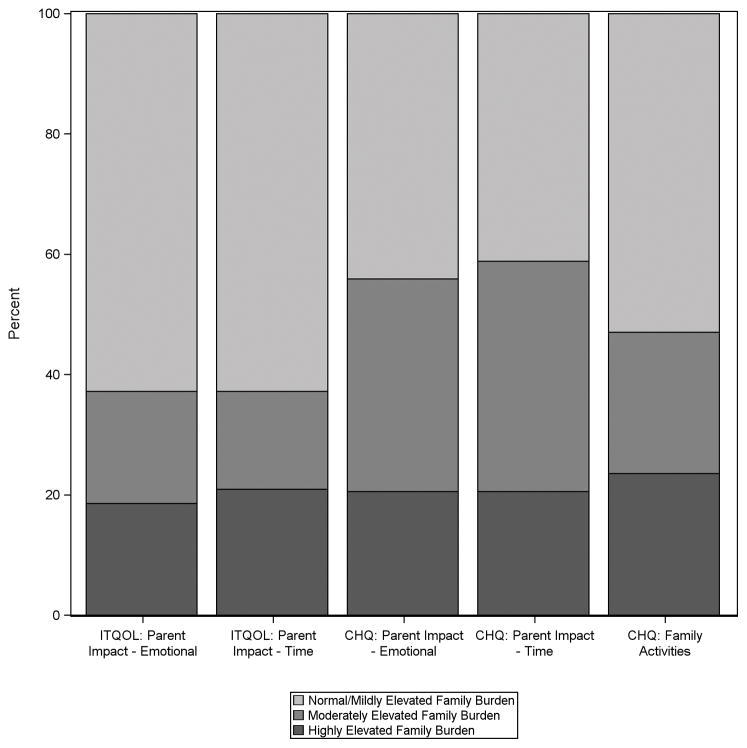
Measurements and main results: Fifty-six children (72.7%) were boys, 48 (62.3%) were whites, and 50 (64.9%) were less than 5 years old prior to out-of-hospital cardiac arrest. Family burden at baseline was not significantly different from reference values. Family burden was increased at 3 and 12 months post arrest compared with reference values (p < 0.001). Worse Pediatric Overall Performance Category and Pediatric Cerebral Performance Category, lower adaptive behavior, lower global functioning, and higher family burden all measured 3 months post arrest were associated with higher family burden 12 months post arrest (p < 0.05). Sociodemographics and prearrest child functioning were not associated with family burden 12 months post arrest.
Conclusions: Families of children who survive out-of-hospital cardiac arrest and have high risk for neurologic disability often experience substantial burden during the first year post arrest. The extent of child dysfunction 3 months post arrest is associated with family burden at 12 months.
Figures
References
-
- Topjian AA, Nadkarni VM, Berg RA. Cardiopulmonary resuscitation in children. Curr Opin Crit Care. 2009;15:203–208. - PubMed
-
- Donoghue AJ, Nadkarni V, Berg RA, et al. CanAM Pediatric Cardiac Arrest Investigators: Out-of-hospital pediatric cardiac arrest: An epidemiologic review and assessment of current knowledge. An Emerg Med. 2005;46:512–522. - PubMed
-
- Van Zellem L, Utens EM, Legerstee JS, et al. Cardiac arrest in children: Long-term health status and health-related quality of life. Pediatr Crit Care Med. 2015;16:693–702. - PubMed
Publication types
MeSH terms
Grants and funding
- UL1 TR000433/TR/NCATS NIH HHS/United States
- R21 HD044955/HD/NICHD NIH HHS/United States
- U54 HD079123/HD/NICHD NIH HHS/United States
- R34 HD050531/HD/NICHD NIH HHS/United States
- U10 HD049945/HD/NICHD NIH HHS/United States
- UG1 HD050096/HD/NICHD NIH HHS/United States
- U10 HD049981/HD/NICHD NIH HHS/United States
- U10 HD050096/HD/NICHD NIH HHS/United States
- UL1 TR000003/TR/NCATS NIH HHS/United States
- RL1 HD107773/HD/NICHD NIH HHS/United States
- U01 HD049934/HD/NICHD NIH HHS/United States
- UL1 RR024986/RR/NCRR NIH HHS/United States
- U01 HL094339/HL/NHLBI NIH HHS/United States
- U10 HD050012/HD/NICHD NIH HHS/United States
- P30 HD040677/HD/NICHD NIH HHS/United States
- P30 HD062171/HD/NICHD NIH HHS/United States
- U01 HL094345/HL/NHLBI NIH HHS/United States
- U10 HD049983/HD/NICHD NIH HHS/United States
LinkOut - more resources
Full Text Sources
Other Literature Sources
Medical
