


Factors Influencing Internal Medicine Resident Choice of Infectious Diseases or Other Specialties: A National Cross-sectional Study
- PMID: 27126345
- PMCID: PMC4928385
- DOI: 10.1093/cid/ciw263
Factors Influencing Internal Medicine Resident Choice of Infectious Diseases or Other Specialties: A National Cross-sectional Study
Abstract
Background: Only 49% of infectious diseases (ID) fellowship programs were filled in 2015 through the national match, but little is known about internal medicine (IM) resident perceptions of ID and factors related to IM resident career choice.
Methods: We conducted 25 interviews and disseminated a Web-based survey to graduating IM residents in the United States utilizing a 2-stage sampling strategy. Participants were categorized into 3 groups based on interest in ID: (1) applied/intended to apply to ID; (2) interested in ID but did not apply; (3) never interested in ID. We conducted all analysis using poststratification adjustment weights with survey data analysis procedures.
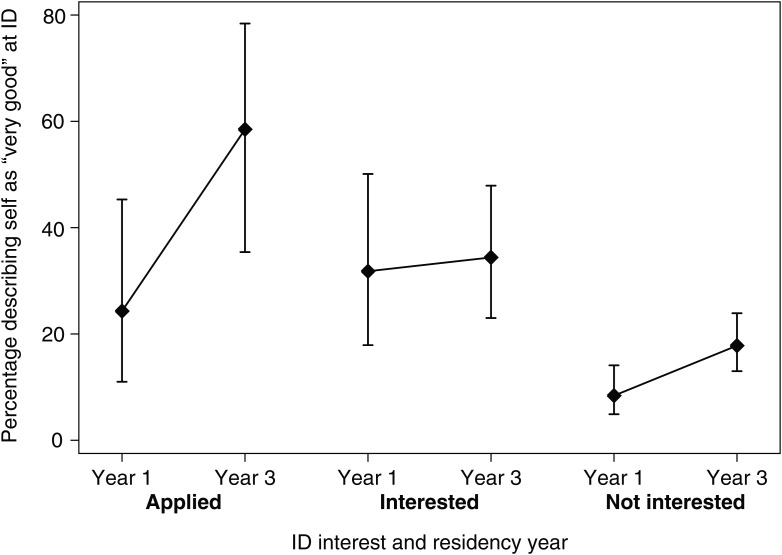
Results: Of the 590 participants, 42 (7%) selected category 1, 188 (32%) category 2, and 360 (61%) category 3. Most (65%) developed an interest in their ultimate career before residency. Of those interested in ID, >52% rated their ID medical school curriculum as very good and influential on their interest in ID. Ninety-one percent of category 2 participants felt mentorship was influential on career choice, although 43% identified an ID mentor. Category 2 chose salary as the most dissuading factor and the most likely intervention to increase ID interest.
Conclusions: In this nationally representative sample of graduating IM residents, most develop an interest in their ultimate career before residency. Factors influencing this decision reside in both medical school and residency, which is consistent with career decision-making constructs. By identifying career determining factors and understanding how they fit into medical training frameworks, we can develop targeted initiatives to reinvigorate interest in ID.
Keywords: career choice; infectious diseases education; mentorship; microbiology curriculum; perception of infectious diseases.
© The Author 2016. Published by Oxford University Press for the Infectious Diseases Society of America. All rights reserved. For permissions, e-mail journals.permissions@oup.com.
Figures

Comment in
-
Editorial Commentary: Recruiting the Next Generation of Infectious Diseases Physicians: How Do We Reignite the Passion?Clin Infect Dis. 2016 Jul 15;63(2):169-71. doi: 10.1093/cid/ciw265. Epub 2016 Apr 28. Clin Infect Dis. 2016. PMID: 27126344 No abstract available.
-
Reply to Sullivan.Clin Infect Dis. 2016 Dec 15;63(12):1677-1678. doi: 10.1093/cid/ciw672. Epub 2016 Sep 28. Clin Infect Dis. 2016. PMID: 27682066 No abstract available.
-
Declining Interest in Infectious Diseases: An Economic Problem That Requires Economic Solutions.Clin Infect Dis. 2016 Dec 15;63(12):1677. doi: 10.1093/cid/ciw671. Epub 2016 Sep 28. Clin Infect Dis. 2016. PMID: 27682071 No abstract available.
References
-
- National Resident Matching Program. Results and data: specialties matching service 2015 appointment year. Washington, DC: NRMP, 2015.
-
- Johnson L. Resident recruitment. In: IDWeek 2013, San Francisco, CA, 2013.
-
- National Resident Matching Program. Results and data: specialties matching service 2008 appointment year. Washington, DC: NRMP, 2008.
-
- Tapper ML. Number of infectious disease specialists declining. Infectious Disease News. Healio. Thorofare, NJ: SLACK Inc., 2011.
Publication types
MeSH terms
Grants and funding
LinkOut - more resources
Full Text Sources
Other Literature Sources
Molecular Biology Databases
