


Assessment of the WHO Stunting Framework using Ethiopia as a case study
- PMID: 27126511
- PMCID: PMC6865882
- DOI: 10.1111/mcn.12310
Assessment of the WHO Stunting Framework using Ethiopia as a case study
Abstract
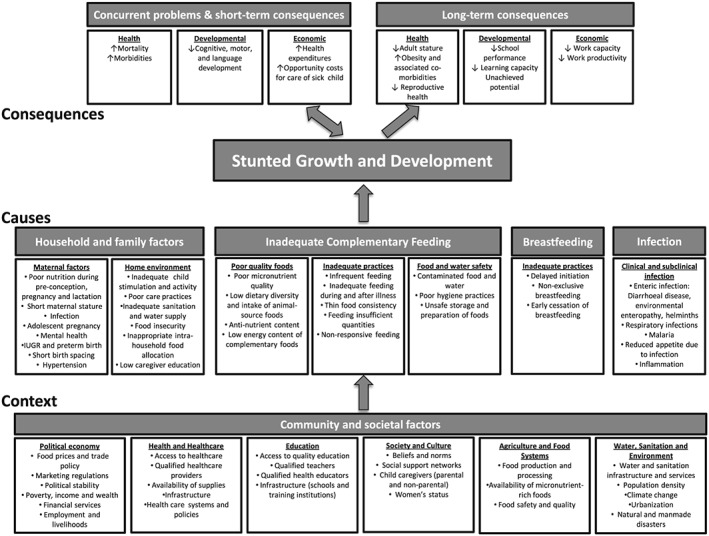
Poor linear growth in children <5 years old, or stunting, is a serious public health problem particularly in Sub-Saharan Africa. In 2013, the World Health Organization (WHO) released a conceptual framework on the Context, Causes and Consequences of Childhood Stunting (the 'WHO framework') that identifies specific and general factors associated with stunting. The framework is based upon a global review of data, and we have applied it to a country-level analysis where health and nutrition policies are made and public health and nutrition data are collected. We reviewed the literature related to sub-optimal linear growth, stunting and birth outcomes in Ethiopia as a case study. We found consistent associations between poor linear growth and indicators of birth size, recent illness (e.g. diarrhoea and fever), maternal height and education. Other factors listed as causes in the framework such as inflammation, exposure to mycotoxins and inadequate feeding during and after illness have not been examined in Ethiopia, and the existing literature suggests that these are clear data gaps. Some factors associated with poor linear growth in Ethiopia are missing in the framework, such as household characteristics (e.g. exposure to indoor smoke). Examination of the factors included in the WHO framework in a country setting helps identifying data gaps helping to target further data collection and research efforts. © 2016 John Wiley & Sons Ltd.
Keywords: Ethiopia; conceptual framework; contributors; stunting.
© 2016 John Wiley & Sons Ltd.
Conflict of interest statement
The authors declare that they have no conflicts of interest.
Figures
References
-
- Abera B., Alem G., Yimer M. & Herrador Z. (2013) Epidemiology of soil‐transmitted helminths, Schistosoma mansoni, and haematocrit values among schoolchildren in Ethiopia. Journal of Infection in Developing Countries 7, 253–260. - PubMed
-
- Agedew E. & Chane T. (2015) Prevalence of stunting among children aged 6–23 months in Kemba Woreda, Southern Ethiopia: a community based cross‐sectional study. Advances in Public Health 2015, 6.
-
- Alemayehu A.A. & Huang W.‐c. (2014) Maternal education, linkages and child nutrition in the long and short‐run: evidence from the Ethiopia Demographic and Health Surveys. International Journal of African Development 1.
Publication types
MeSH terms
Grants and funding
LinkOut - more resources
Full Text Sources
Other Literature Sources
Medical
