


Evaluation of the effect of 4 types of knots on the mechanical properties of 4 types of suture material used in small animal practice
- PMID: 27127344
- PMCID: PMC4836043
Evaluation of the effect of 4 types of knots on the mechanical properties of 4 types of suture material used in small animal practice
Abstract
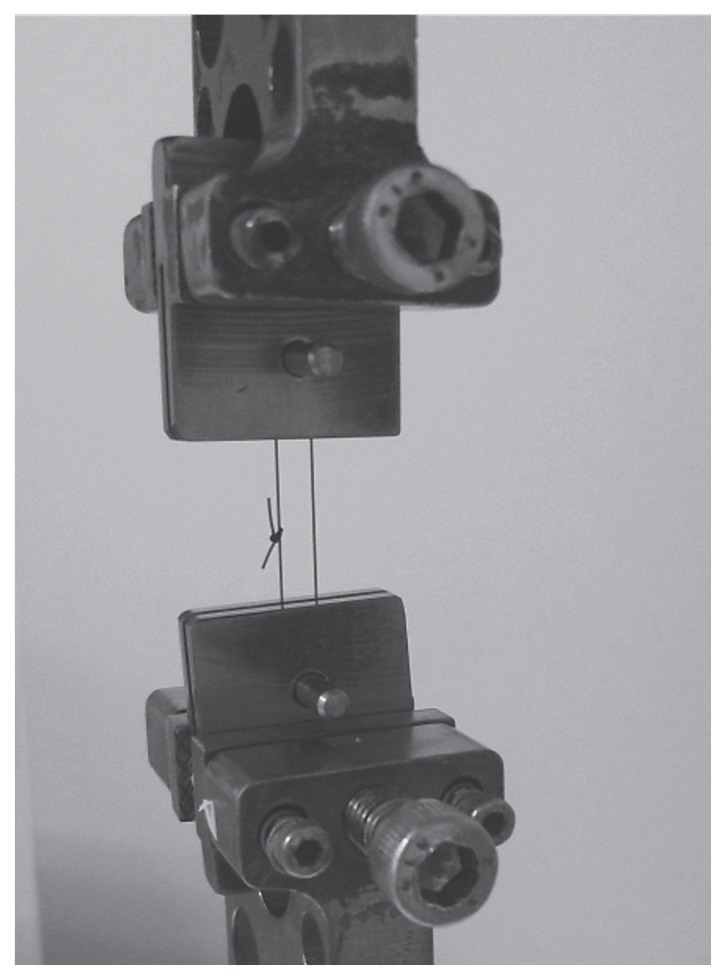
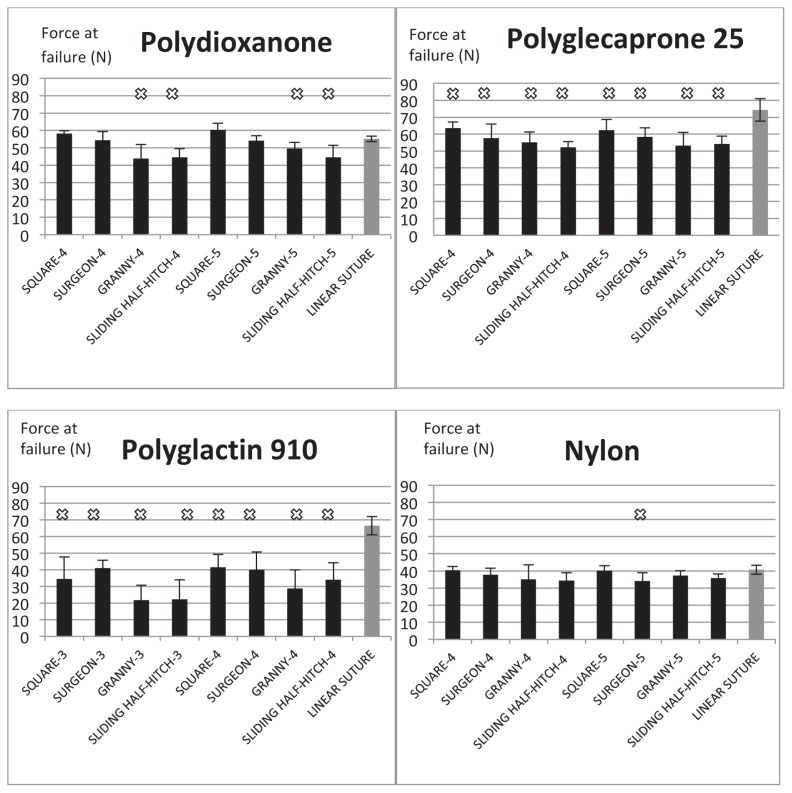
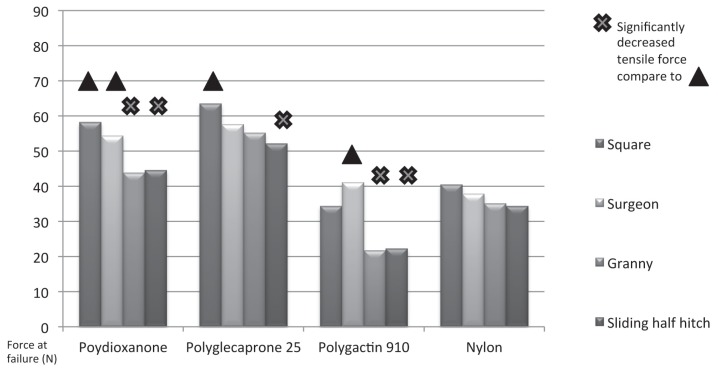
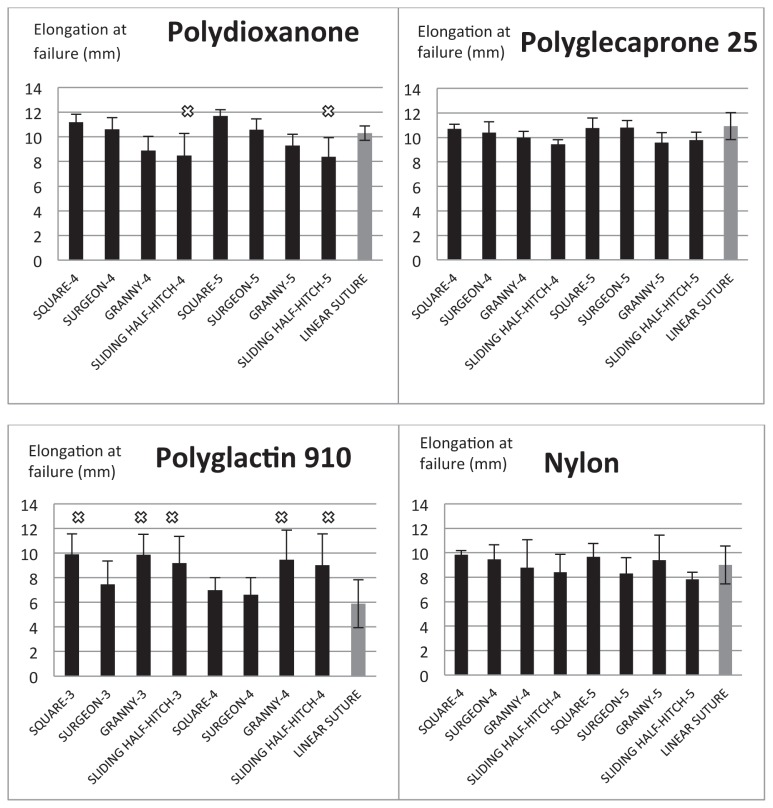
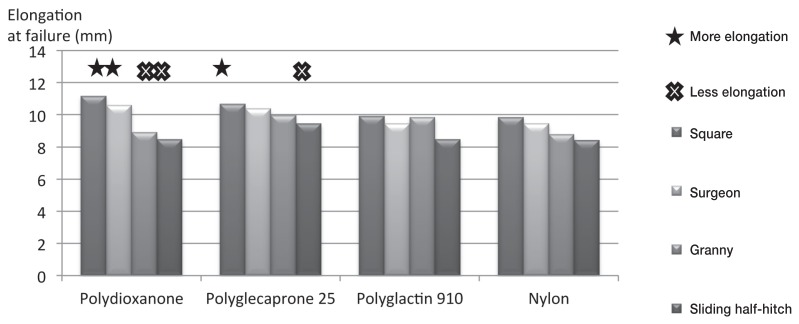
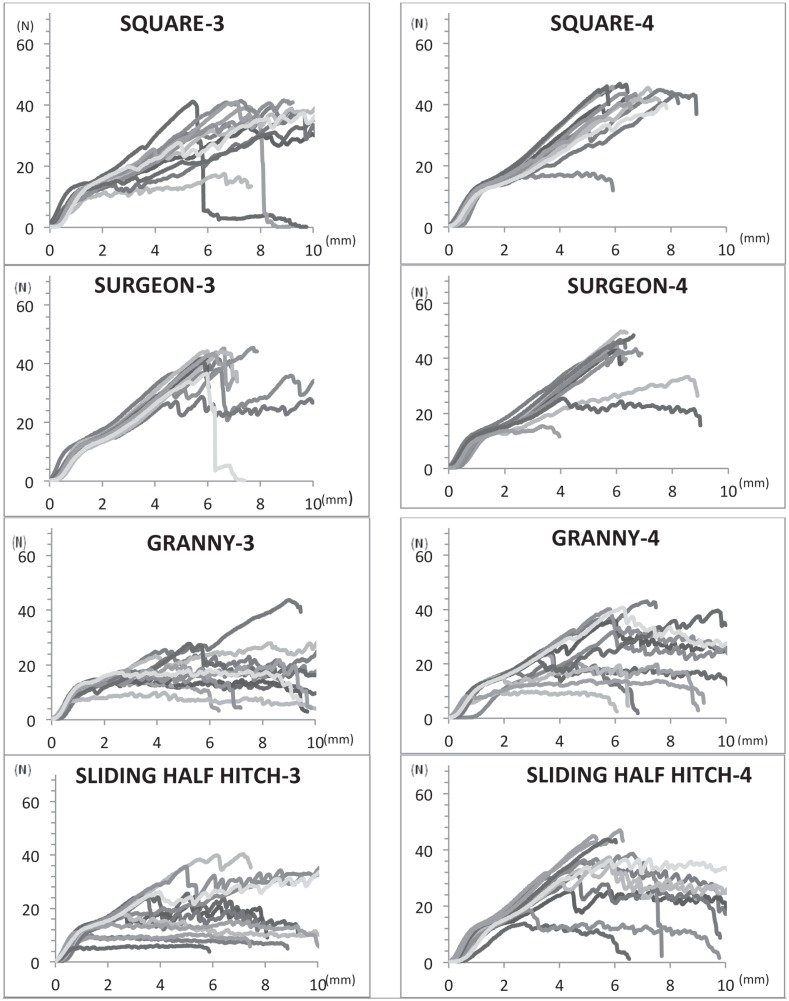
The influence of the type of material used, knot configuration, and use of an additional throw on the tensile force at failure, the elongation, and the mode of failure of different configurations of linear sutures and knotted suture loops was evaluated in this in-vitro mechanical study. We hypothesized that all types of knots would significantly influence the initial force and elongation of suture materials and would influence the force and elongation at which the knotted loops break, but not their mode of failure. A total of 432 samples of 4 types of size 3-0 suture material (polydioxanone, polyglecaprone 25, polyglactin 910, and nylon), representing 9 configurations, were tested in a tensiometer. The configurations were 1 linear suture without a knot and the following loops: square (SQ) knot; surgeon's (SU) knot; granny (GR) knot; and sliding half-hitch (SHH) knot using either 4 and 5 or 3 and 4 throws, depending on the material. For polydioxanone, SQ and SU knots did not decrease the initial force at failure of the suture. Granny (GR) and SHH knots decreased the tensile force at failure and elongation by premature failure of the loop. For polyglecaprone 25, all knots decreased the initial force at failure of the suture, with SHH being weaker than the other knots. For coated polyglactin 910, all knots decreased the initial force at failure of the suture and slippage increased significantly compared with the other 3 sutures. The use of SQ knots with 3 throws did not result in a safe knot. For nylon, knots did not alter the original mechanics of the suture. In conclusion, all knots and types of suture material do not necessarily have the same effect on the initial tensile force at failure of suture materials.
L’objectif de la présente étude était de déterminer, dans des conditions expérimentales contrôlées, l’influence de quatre types de noeud, du nombre de croisements et du type de matériel de suture utilisés sur le mode de rupture, l’élongation et la résistance de différentes configurations de boucles de suture. Un total de 432 échantillons de quatre types de fil de suture 3-0 (polydioxanone, polyglecaprone 25, polyglactin 910, nylon), représentant neuf configurations, ont été évalués à l’aide d’un tensiomètre. Plusieurs paramètres ont été analysés: la force atteinte lors de la rupture, l’élongation maximale de la boucle et son mode de rupture. Les différentes configurations sont: suture linéaire, noeud plat (NP), de chirurgien (NC), de vache (NV) et le noeud coulissant barré (NCB) en réalisant 4 et 5 croisements pour les monofilaments et 3 et 4 croisements pour le multifilament. Les différents matériaux et noeuds utilisés n’affectent pas tous de la même manière la force initiale du matériel de suture. Pour le polydioxanone, le NP et NC ne diminuent pas la force initiale du fil de suture. Le NV et le NCB diminuent la force initiale du fil de suture et diminuent son élongation par un bris prématuré du fil de suture. Pour le polyglecaprone 25, tous les noeuds réduisent la force initiale de la suture; le NCB est celui qui affecte le plus le matériel de suture. Pour le polyglactin 910 enrobé, tous les noeuds réduisent la force initiale de la suture; le glissement est augmenté de manière significative comparé aux trois autres types de matériels de sutures, une élongation significative de la boucle de suture a été observée avec la présence d’un NP avec trois croisements. Pour le nylon, les noeuds n’ont pas modifié les propriétés mécaniques d’origine du fil de suture. En conclusion, un NP et NC avec un polydioxanone 3-0 ne diminue pas la force initiale du fil de suture. Le polyglactin 910 enrobé est significativement associé à un glissement accru. Il n’y a pas de différence statistiquement significative à l’ajout d’un croisement à une boucle de suture 3-0.(Traduit par les auteurs).
Figures

References
-
- Marturello DM, McFadden MS, Bennett RA, Ragetly GR, Horn G. Knot security and tensile strength of suture materials. Vet Surg. 2014;43:73–79. - PubMed
-
- Good MM, Good LB, Mclntire DD, Brown SA, Wai CY. Surgical knot integrity: Effect of suture type and caliber, and level of residency training. J Surg Educ. 2013;70:156–160. - PubMed
-
- Muffly TM, Cook C, Distasio J, Bonham AJ, Blandon RE. Suture end length as a function of knot integrity. J Surg Educ. 2009;66:276–280. - PubMed
-
- Rosin E, Robinson G. Knot security of suture materials. Vet Surg. 1989;18:269–273. - PubMed
MeSH terms
LinkOut - more resources
Full Text Sources