. 2016 May;2(3):317-327.
doi: 10.1016/j.jcmgh.2015.12.010. Epub 2016 Jan 9.

CFTR activator increases intestinal fluid secretion and normalizes stool output in a mouse model of constipation

Affiliations

CFTR activator increases intestinal fluid secretion and normalizes stool output in a mouse model of constipation

Onur Cil et al. Cell Mol Gastroenterol Hepatol. 2016 May.

Abstract

Background & aims: Constipation is a common clinical problem that negatively impacts quality of life and is associated with significant health care costs. Activation of the cystic fibrosis transmembrane regulator (CFTR) chloride channel is the primary pathway that drives fluid secretion in the intestine, which maintains lubrication of luminal contents. We hypothesized that direct activation of CFTR would cause fluid secretion and reverse the excessive dehydration of stool found in constipation.

Methods: A cell-based high-throughput screen was done for 120,000 drug-like, synthetic small molecules. Active compounds were characterized for mechanism of action and one lead compound was tested in a loperamide-induced constipation model in mice.

Results: Several classes of novel CFTR activators were identified, one of which, the phenylquinoxalinone CFTRact-J027, fully activated CFTR chloride conductance with EC50 ~ 200 nM, without causing elevation of cytoplasmic cAMP. Orally administered CFTRact-J027 normalized stool output and water content in a loperamide-induced mouse model of constipation with ED50 ~0.5 mg/kg; CFTRact-J027 was without effect in cystic fibrosis mice lacking functional CFTR. Short-circuit current, fluid secretion and motility measurements in mouse intestine indicated a pro-secretory action of CFTRact-J027 without direct stimulation of intestinal motility. Oral administration of 10 mg/kg CFTRact-J027 showed minimal bioavailability, rapid hepatic metabolism and blood levels <200 nM, and without apparent toxicity after chronic administration.

Conclusions: CFTRact-J027 or alternative small-molecule CFTR-targeted activators may be efficacious for the treatment of constipation.

Keywords: CFTR; constipation; high-throughput screening; loperamide.


Figures
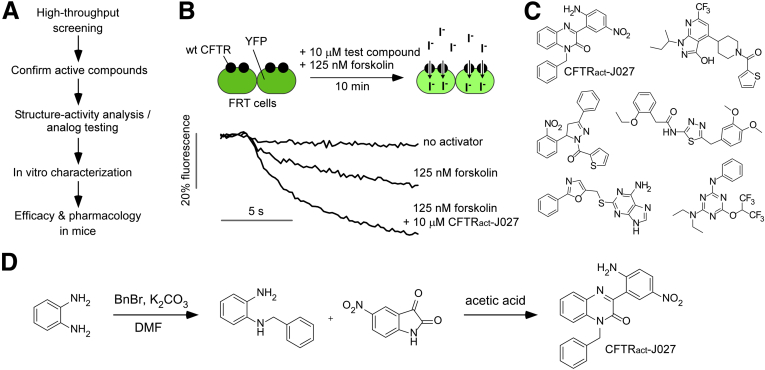
Figure 1
Figure 1
Identification of small-molecule CFTR activators. (A) Project overview. (B) CFTR activator screen using FRT cells co-expressing human wild-type CFTR and YFP iodide–sensing protein. Test compounds at 10 μmol/L were added for 10 minutes at room temperature in the presence of forskolin (125 nmol/L) before iodide addition. Examples of data from single wells of a 96-well plate showing CFTR activation by CFTRact-J027 are shown. (C) Structures of CFTR activators emerging from the screen. (D) Synthesis of CFTRact-J027. DMF, dimethylformamide.
Figure 2
Figure 2
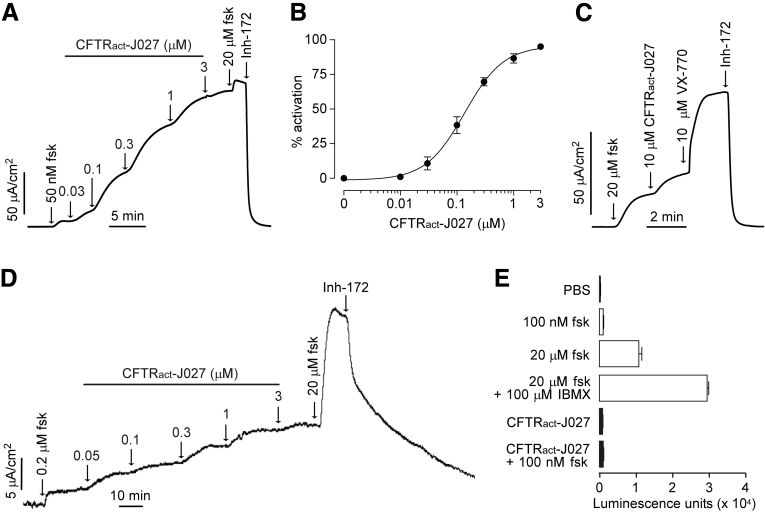
Characterization of CFTR activation by CFTRact-J027. Short-circuit current measured in FRT cells expressing (A) human wild-type CFTR and (C) ΔF508-CFTR showing responses to indicated concentrations of forskolin (fsk), CFTRact-J027, and VX-770. The ΔF508-CFTR–expressing FRT cells were corrected with 3 μmol/L VX-809 at 37°C for 24 hours before measurement. CFTRinh-172 (Inh-172, 10 μmol/L) was added where indicated (representative of 3 experiments for each). (B) CFTRact-J027 concentration-dependent activation of wild-type CFTR Cl- current (means ± SEM; n = 3 cultures). (D) Short-circuit current in mouse colon showing responses to indicated concentrations of forskolin (fsk), CFTRact-J027, and CFTRinh-172 (representative of 3 experiments). (E) Assay of cAMP concentration in FRT cells measured after a 10-minute incubation with indicated concentrations of forskolin and 5 μmol/L CFTRact-J027. Positive controls included forskolin (100 nmol/L and 20 μmol/L), and forskolin plus 3-isobutyl-1-methylxanthine (IBMX, 100 μmol/L) (means ± SEM, n = 4–8).
Figure 3
Figure 3
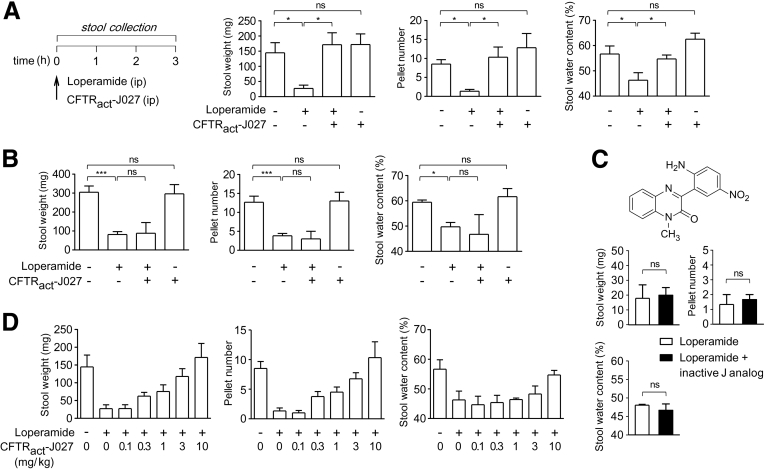
CFTRact-J027 normalizes stool output and water content in loperamide-treated mice. (A) Mouse model of constipation with loperamide (left). Three-hour stool weight, number of pellets, and stool water content in mice (means ± SEM, 6 mice per group). (B) Same study as shown in panel A, but with cystic fibrosis mice lacking functional CFTR (3–6 mice per group). (C) Same study as shown in panel A, but with an inactive chemical analog of CFTRact-J027 (structure shown, 3 mice per group). (D) Dose-response for intraperitoneal administration of CFTRact-J027 in loperamide-treated mice (4–6 mice per group). One-way analysis of variance was used for panels A and B, the Student's t test was used for panel C. *P < .05, ***P < .001.
Figure 4
Figure 4
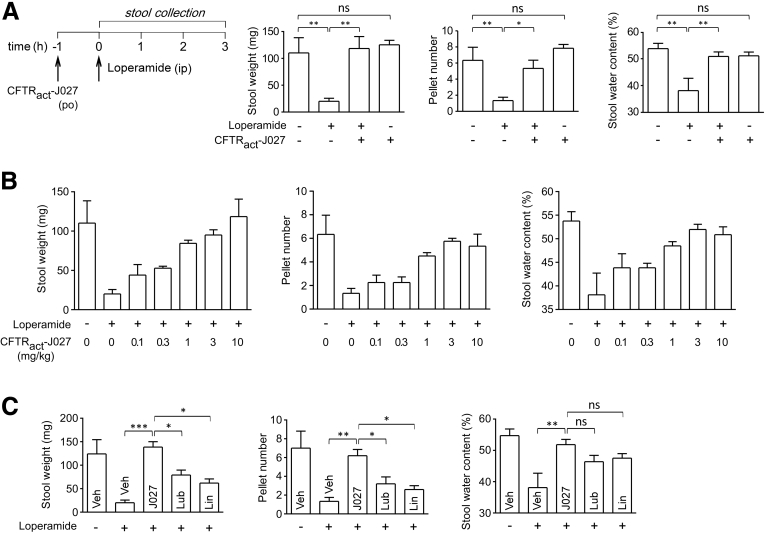
Orally administered CFTRact-J027 normalizes stool output and water content in loperamide-treated mice. (A) Study protocol (left) and stool output, pellet number, and water content as performed in Figure 3 (means ± SEM, 6 mice per group). (B) Dose-response study of CFTRact-J027 administered orally in loperamide-treated mice (4–6 mice per group). (C) Same study as shown in panel A, but with oral lubiprostone (Lub) (0.5 mg/kg) or linaclotide (Lin) (0.5 mg/kg) (5–6 mice per group). One-way analysis of variance, *P < .05, **P < .01, ***P < .001. Veh, vehicle.
Figure 5
Figure 5
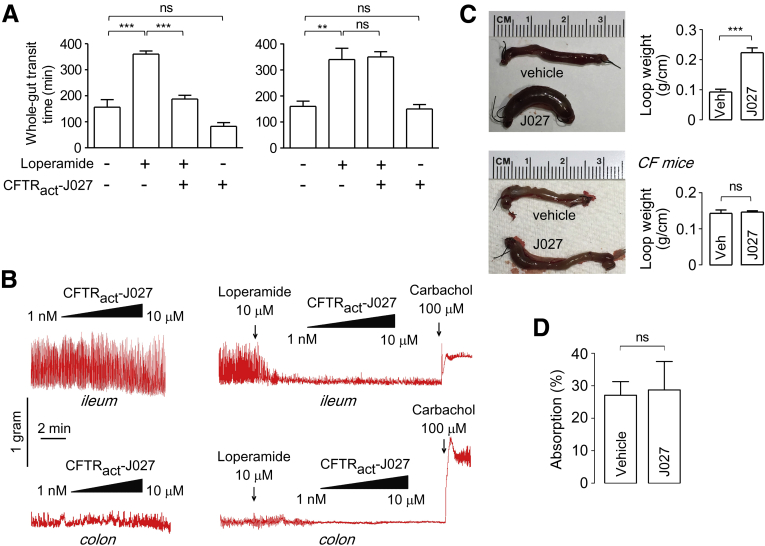
CFTRact-J027 actions on intestinal fluid secretion, absorption, and motility. (A) Whole-gut transit time in control and loperamide-treated wild-type (left) and cystic fibrosis (right) mice (means ± SEM, 3–5 mice per group). Where indicated, loperamide (0.3 mg/kg) and CFTRact-J027 (10 mg/kg) were administered IP at 0 time (means ± SEM, 6 mice per group). (B) Contraction of isolated intestinal strips. Ileum and colon strips (∼2 cm) were suspended in Krebs–Henseleit buffer with 0.5 g and 0.2 g tension, respectively. Where indicated, CFTRact-J027, loperamide, and carbachol were added to the organ chamber. (C) Intestinal fluid secretion was measured in closed midjejunal loops in wild-type mice (upper panel). Loops were injected with 100 μL vehicle or 100 μg CFTRact-J027. Loop weight/length was measured at 90 minutes (means ± SEM, 4 loops per group). Similar experiments were performed in cystic fibrosis mice (lower panel, 4 loops per group). (D) Intestinal fluid absorption was measured in midjejunal loops in cystic fibrosis mice. Loops were injected with 100 μL vehicle or 100 microgram CFTRact-J027. Loop weight/length was measured at 30 minutes. Summary of fluid absorption (means ± SEM, 4 loops per group). One-way analysis of variance was used for panel A , Student's t test was used for panel C and D. ∗∗P < .01, ∗∗∗P < .001.
Figure 6
Figure 6
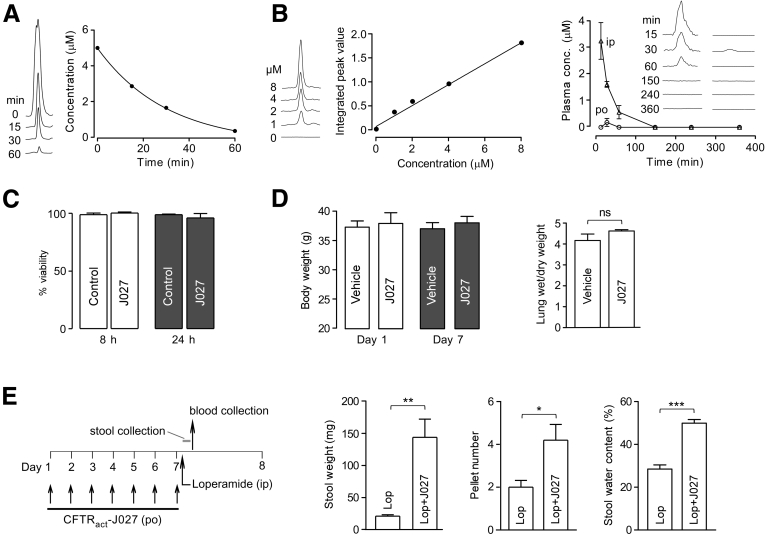
CFTRact-J027 pharmacokinetics, tissue distribution, and toxicity. (A) In vitro metabolic stability of CFTRact-J027 assayed in mouse liver microsomes after incubation for specified times. (B) Standard plasma concentration curve for liquid chromatography–mass spectrometry (left) and kinetics of CFTRact-J027 concentration in plasma determined by liquid chromatography–mass spectrometry after bolus IP or oral administration of 10 mg/kg CFTRact-J027 at zero time (right, means ± SEM, 3 mice per group). (C) In vitro toxicity measured by Alamar Blue assay in FRT cells (means ± SEM; n = 3 cultures). (D) Body weight and lung wet/dry weight ratio in mice receiving 10 mg/kg CFTRact-J027 orally for 7 days (means ± SEM, 5 mice per group). (E) Chronic administration protocol (left) and efficacy of oral CFTRact-J027 after 7-day administration (means ± SEM, 5 mice per group). Student t test, *P < .05, **P < .01, ***P < .001. conc, concentration; Lop, loperamide.

References

    1. Pinto Sanchez M.I., Bercik P. Epidemiology and burden of chronic constipation. Can J Gastroenterol. 2011;25(Suppl B):11B–15B. - PMC - PubMed
    1. Mugie S.M., Di Lorenzo C., Benninga M.A. Constipation in childhood. Nat Rev Gastroenterol Hepatol. 2011;8:502–511. - PubMed
    1. Menees S., Saad R., Chey W.D. Agents that act luminally to treat diarrhoea and constipation. Nat Rev Gastroenterol Hepatol. 2012;9:661–674. - PubMed
    1. Castro J., Harrington A.M., Hughes P.A. Linaclotide inhibits colonic nociceptors and relieves abdominal pain via guanylate cyclase-C and extracellular cyclic guanosine 3',5'-monophosphate. Gastroenterology. 2013;145:1334–1346. - PubMed
    1. Busby R.W., Bryant A.P., Bartolini W.P. Linaclotide, through activation of guanylate cyclase C, acts locally in the gastrointestinal tract to elicit enhanced intestinal secretion and transit. Eur J Pharmacol. 2010;649:328–335. - PubMed