


Peripheral Skin Temperature and Circadian Biological Clock in Shift Nurses after a Day off
- PMID: 27128899
- PMCID: PMC4881449
- DOI: 10.3390/ijms17050623
Peripheral Skin Temperature and Circadian Biological Clock in Shift Nurses after a Day off
Abstract
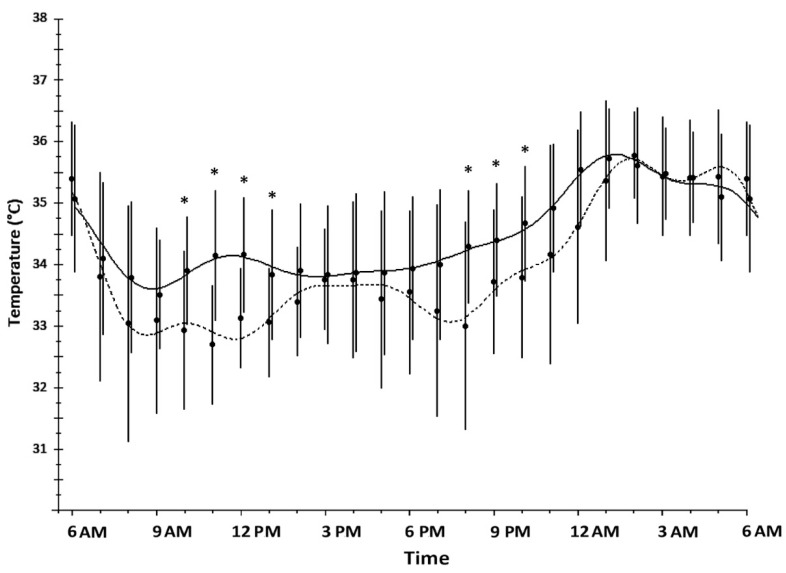
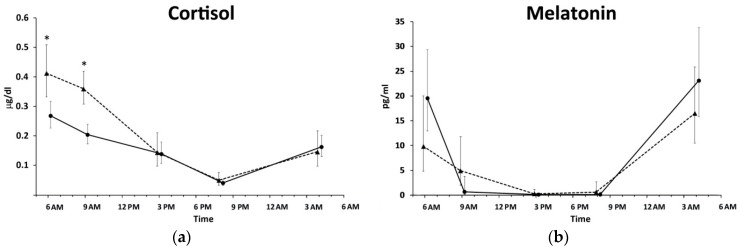
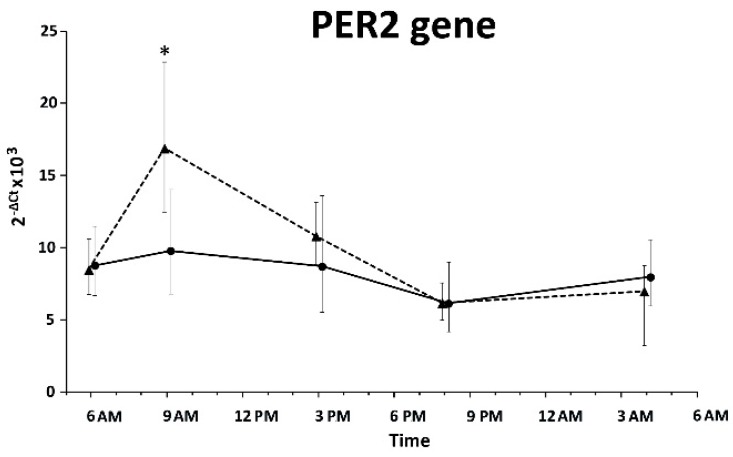
The circadian biological clock is essentially based on the light/dark cycle. Some people working with shift schedules cannot adjust their sleep/wake cycle to the light/dark cycle, and this may result in alterations of the circadian biological clock. This study explored the circadian biological clock of shift and daytime nurses using non-invasive methods. Peripheral skin temperature, cortisol and melatonin levels in saliva, and Per2 expression in pubic hair follicle cells were investigated for 24 h after a day off. Significant differences were observed in peripheral skin temperature and cortisol levels between shift and daytime nurses. No differences in melatonin levels were obtained. Per2 maximum values were significantly different between the two groups. Shift nurses exhibited lower circadian variations compared to daytime nurses, and this may indicate an adjustment of the circadian biological clock to continuous shift schedules. Non-invasive procedures, such as peripheral skin temperature measurement, determination of cortisol and melatonin in saliva, and analysis of clock genes in hair follicle cells, may be effective approaches to extensively study the circadian clock in shift workers.
Keywords: PER2 gene; circadian clocks; circadian dysregulation; circadian rhythm; cortisol; light dark cycle; melatonin; occupational health; shift work; skin temperature.
Figures
References
-
- Akhtar R.A., Reddy A.B., Maywood E.S., Clayton J.D., King V.M., Smith A.G., Gant T.W., Hastings M.H., Kyriacou C.P. Circadian cycling of the mouse liver transcriptome, as revealed by cDNA microarray, is driven by the suprachiasmatic nucleus. Curr. Biol. 2002;12:540–550. doi: 10.1016/S0960-9822(02)00759-5. - DOI - PubMed
-
- Archer S.N., Laing E.E., Moller-Levet C.S., van der Veen D.R., Bucca G., Lazar A.S., Santhi N., Slak A., Kabiljo R., von Schantz M., et al. Mistimed sleep disrupts circadian regulation of the human transcriptome. Proc. Natl. Acad. Sci. USA. 2014;111:E682–E691. doi: 10.1073/pnas.1316335111. - DOI - PMC - PubMed
-
- Miller B.H., McDearmon E.L., Panda S., Hayes K.R., Zhang J., Andrews J.L., Antoch M.P., Walker J.R., Esser K.A., Hogenesch J.B., et al. Circadian and clock-controlled regulation of the mouse transcriptome and cell proliferation. Proc. Natl. Acad. Sci. USA. 2007;104:3342–3347. doi: 10.1073/pnas.0611724104. - DOI - PMC - PubMed
MeSH terms
Substances
LinkOut - more resources
Full Text Sources
Other Literature Sources
