


Bacterioplankton niche partitioning in the use of phytoplankton-derived dissolved organic carbon: quantity is more important than quality
- PMID: 27128994
- PMCID: PMC5113854
- DOI: 10.1038/ismej.2016.66
Bacterioplankton niche partitioning in the use of phytoplankton-derived dissolved organic carbon: quantity is more important than quality
Abstract
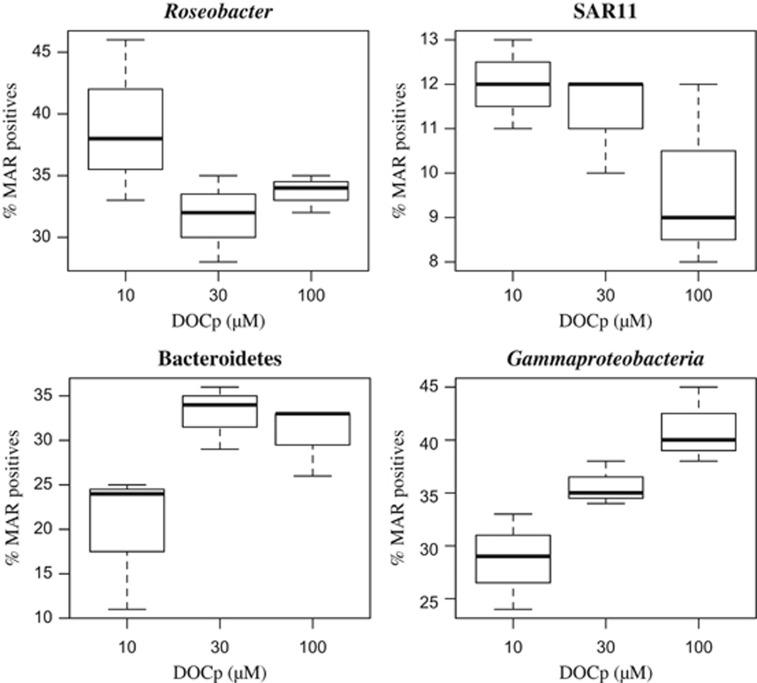
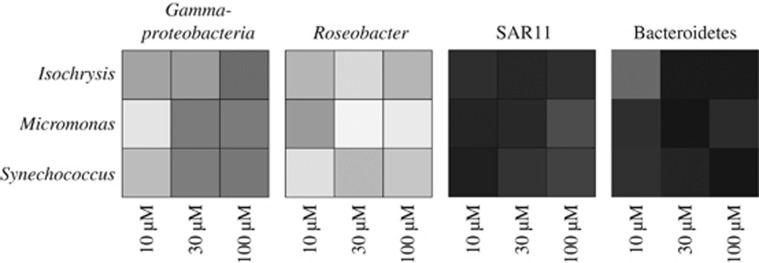
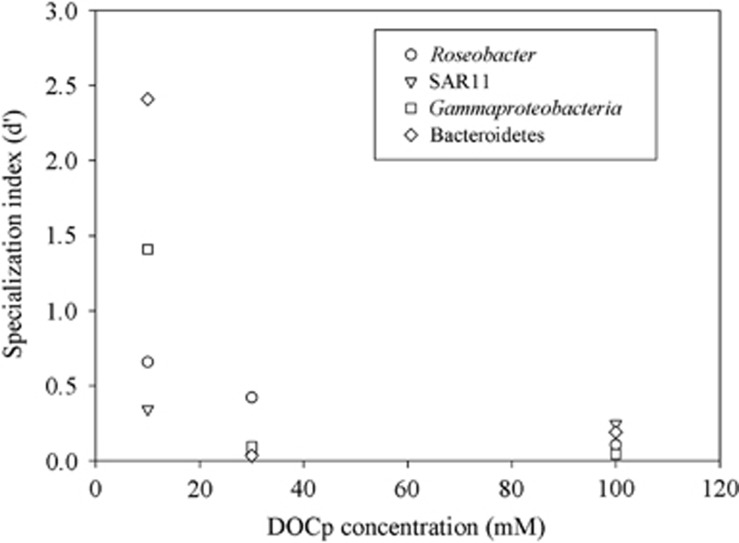
Some prokaryotes are known to be specialized in the use of phytoplankton-derived dissolved organic carbon (DOCp) originated by exudation or cell lysis; however, direct quantification measurements are extremely rare. Several studies have described bacterial selectivity based on DOCp quality, but very few have focused on the quantity of DOCp, and the relative importance of each of these variables (for example, quantity versus quality) on prokaryote responses. We applied an adapted version of the MAR-FISH (microautoradiography coupled with catalyzed reporter deposition fluorescence in situ hybridization) protocol using radiolabelled exudates from axenic algal cultures to calculate a specialization index (d') for large bacterioplankton phylogenetic groups using DOCp from different phytoplankton species and at different concentrations to elucidate to what extent the bacterial response to DOCp is driven by resource quantity (different DOCp concentrations) or by quality (DOCp from different phytoplankton species). All bacterial phylogenetic groups studied had lower d' at higher DOCp concentration, indicating more generalist behavior at higher resource availabilities. Indeed, at increasing resource concentrations, most bacterial groups incorporated DOCp indiscriminately, regardless of its origin (or quality). At low resource concentrations, only some specialists were able to actively incorporate the various types of organic matter effectively. The variability of bacterial responses to different treatments was systematically higher at varying concentrations than at varying DOCp types, suggesting that, at least for this range of concentrations (10-100 μM), DOCp quantity affects bacterial responses more than quality does. Therefore, resource quantity may be more relevant than resource quality in the bacterial responses to DOCp and affect how bacterioplankton use phytoplankton-derived carbon.
Figures
References
-
- Alonso C, Musat N, Adam B, Kuypers M, Amann R. (2012). HISH–SIMS analysis of bacterial uptake of algal-derived carbon in the Río de la Plata estuary. Syst Appl Microbiol 35: 541–548. - PubMed
MeSH terms
Substances
LinkOut - more resources
Full Text Sources
Other Literature Sources
