


Implementation of a new guideline in cardiovascular secondary preventive care: subanalysis of a randomized controlled trial
- PMID: 27129980
- PMCID: PMC4851797
- DOI: 10.1186/s12872-016-0252-0
Implementation of a new guideline in cardiovascular secondary preventive care: subanalysis of a randomized controlled trial
Abstract
Background: Cardiovascular secondary preventive recommendations are often not reached. We investigated whether a nurse-led telephone-based follow-up could improve the implementation of a new guideline within a year after its release.
Methods: In February 2013, a new secondary preventive guideline for diabetic patients was released in the county of Jämtland, Sweden. It included a changed of the low-density lipoprotein cholesterol (LDL-C) target value from <2.5 mmol/L to <1.8 mmol/L. In the Nurse-Based Age-Independent Intervention to Limit Evolution of Disease (NAILED) trial, patients with an acute coronary syndrome, stroke, or transient ischemic attack were randomized to secondary preventive care with nurse-based telephone follow-up (intervention) or usual care (control). Patient data were obtained from the NAILED trial to study the implementation of the new LDL-C guideline by comparing telephone follow-up with usual care. The Mann-Whitney U-test was used for continuous variables, and Person's χ (2) test was used for categorical variables to assess between-group differences.
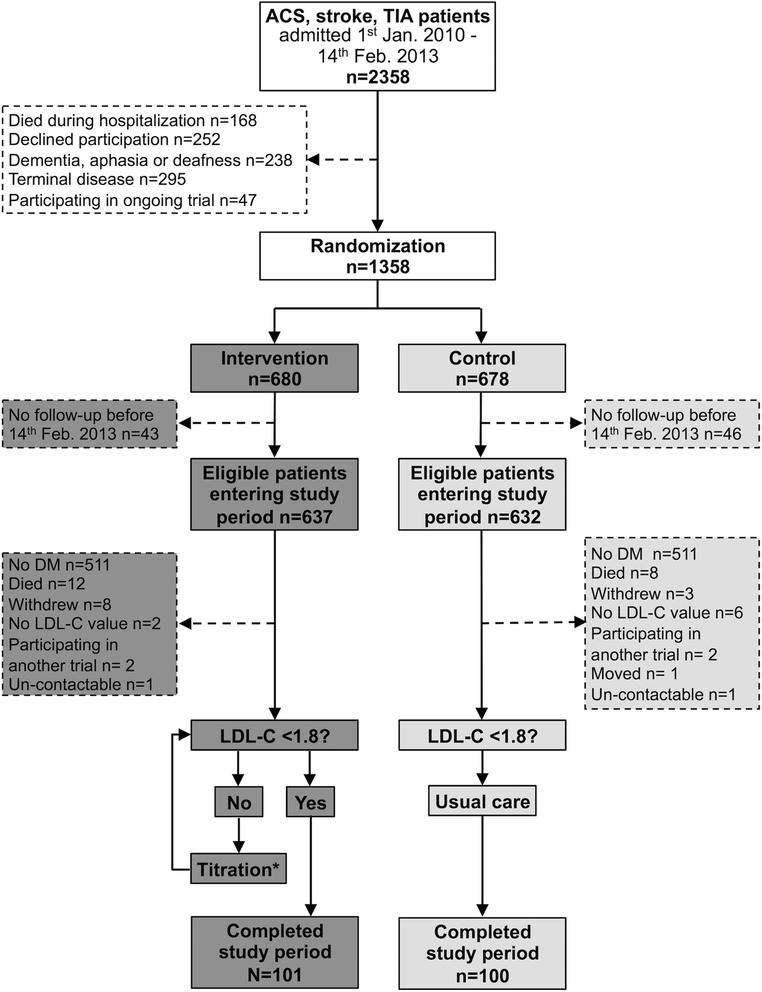
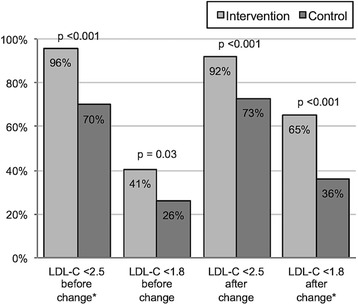
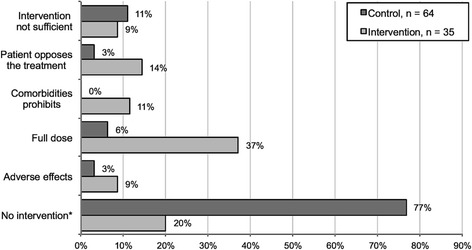
Results: Out of the 1267 patients that entered the study period, 101 intervention and 100 control patients with diabetes fulfilled the inclusion criteria and completed the study period. Before the guideline change, 96 % of the intervention patients and 70 % of the control patients reached the target LDL-C value (p < 0.001). After the guideline change, the corresponding respective proportions were 65 % and 36 % (p < 0.001). The main reason that intervention patients did not achieve the target LDL-C value was that they received full-dose treatment; for control patients, the main reason was that medication was not adjusted, for an unknown reason.
Conclusions: One year after a change in the cardiovascular secondary preventive guideline, nurse-based telephone follow-up performed better than usual care to implement the new recommendation.
Trial registration: ISRCTN registry; ISRCTN96595458 (date of registration 10 July 2011) and ISRCTN23868518 (date of registration 13 May 2012).
Keywords: Acute coronary syndrome; Cardiovascular disease; Myocardial infarction; Randomized controlled trial; Secondary prevention; Stroke; Transient ischemic attack.
Figures
References
-
- Mancia G, Fagard R, Narkiewicz K, Redon J, Zanchetti A, Bohm M, et al. 2013 ESH/ESC guidelines for the management of arterial hypertension: the Task Force for the Management of Arterial Hypertension of the European Society of Hypertension (ESH) and of the European Society of Cardiology (ESC) Eur Heart J. 2013;34(28):2159–219. doi: 10.1093/eurheartj/eht151. - DOI - PubMed
-
- Perk J, De Backer G, Gohlke H, Graham I, Reiner Z, Verschuren M, et al. European Guidelines on cardiovascular disease prevention in clinical practice (version 2012). The Fifth Joint Task Force of the European Society of Cardiology and Other Societies on Cardiovascular Disease Prevention in Clinical Practice (constituted by representatives of nine societies and by invited experts) Eur Heart J. 2012;33(13):1635–701. doi: 10.1093/eurheartj/ehs092. - DOI - PubMed
-
- Kernan WN, Ovbiagele B, Black HR, Bravata DM, Chimowitz MI, Ezekowitz MD, et al. Guidelines for the prevention of stroke in patients with stroke and transient ischemic attack: a guideline for healthcare professionals from the American Heart Association/American Stroke Association. Stroke. 2014;45(7):2160–236. doi: 10.1161/STR.0000000000000024. - DOI - PubMed
-
- Smith SC, Jr, Benjamin EJ, Bonow RO, Braun LT, Creager MA, Franklin BA, et al. AHA/ACCF Secondary Prevention and Risk Reduction Therapy for Patients with Coronary and other Atherosclerotic Vascular Disease: 2011 update: a guideline from the American Heart Association and American College of Cardiology Foundation. Circulation. 2011;124(22):2458–73. doi: 10.1161/CIR.0b013e318235eb4d. - DOI - PubMed
Publication types
MeSH terms
Substances
Associated data
LinkOut - more resources
Full Text Sources
Other Literature Sources
Medical
