


Sigmoidal mixed models for longitudinal data
- PMID: 27130491
- PMCID: PMC5503801
- DOI: 10.1177/0962280216645632
Sigmoidal mixed models for longitudinal data
Abstract
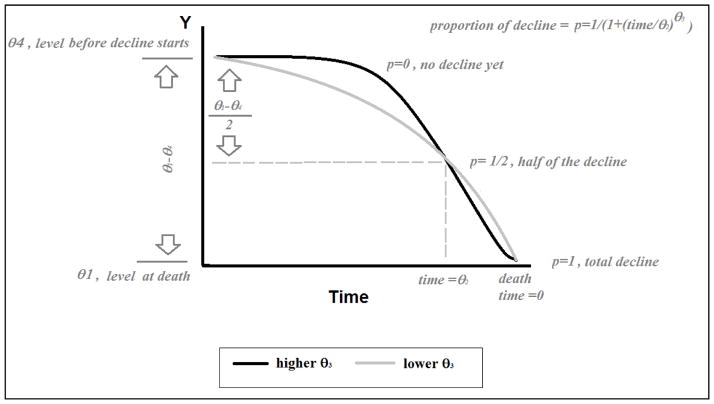
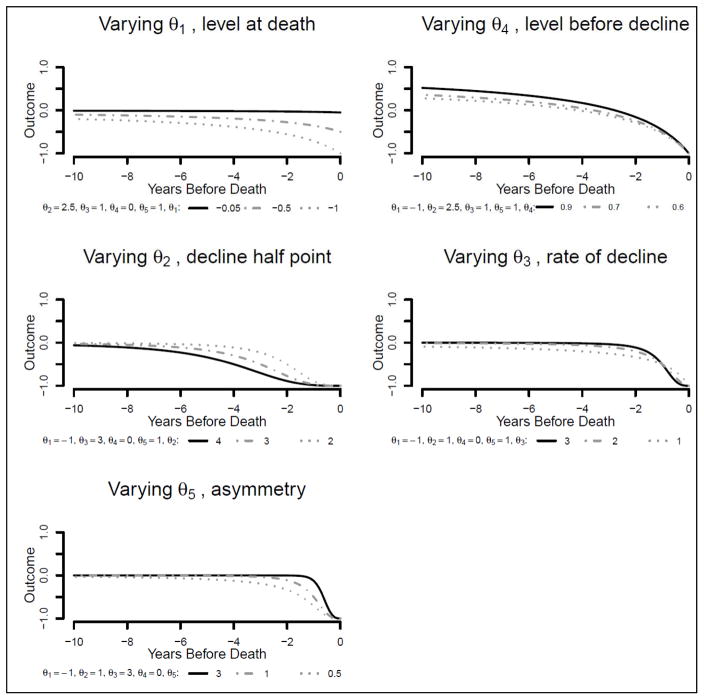
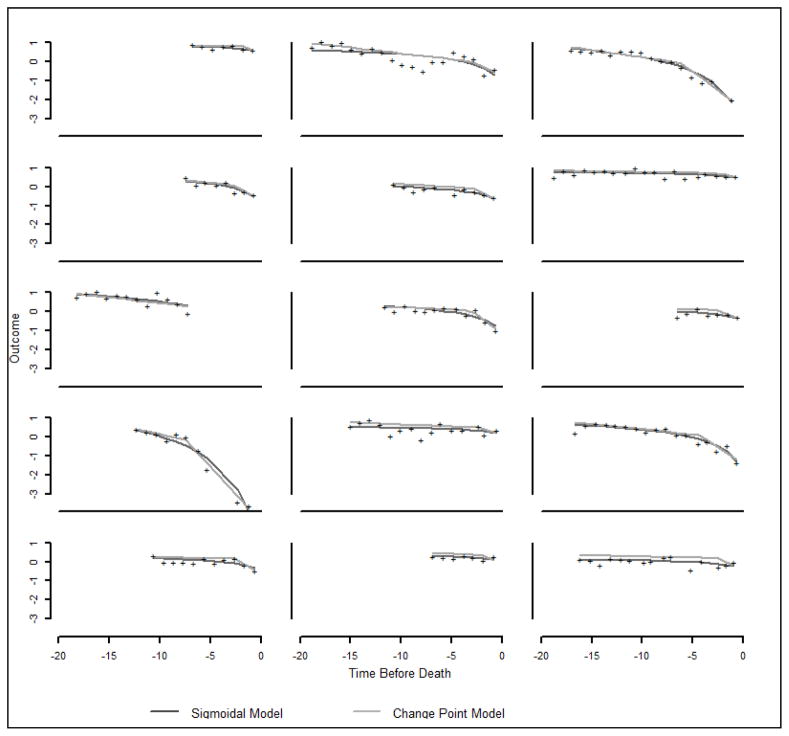
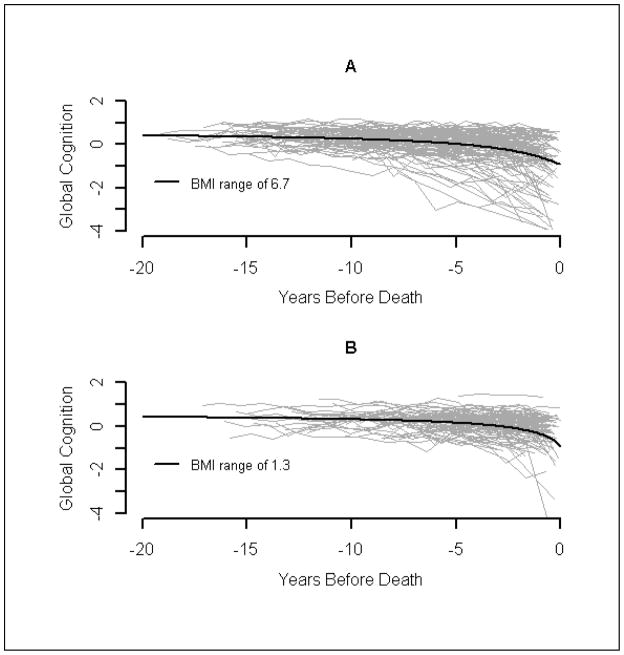
Linear mixed models are widely used to analyze longitudinal cognitive data. Often, however, the trajectory of cognitive function is nonlinear. For example, some participants may experience cognitive decline that accelerates as death approaches. Polynomial regression and piecewise linear models are common approaches used to characterize nonlinear trajectories, although both have assumptions that may not correspond with the actual trajectories. An alternative is to use a flexible sigmoidal mixed model based on the logistic family of curves. We describe a general class of such a model, which has up to five parameters, representing (1) final level, (2) rate of decline, (3) midpoint of decline, (4) initial level before decline, and (5) asymmetry. Focusing on a four-parameter symmetric sub-class of the model, with random effects on two of the parameters, we demonstrate that a likelihood approach to fitting this model produces accurate estimates of mean levels across time, even in the case of model misspecification. We also illustrate the method on deceased participants who had completed at least 5 years of annual cognitive testing and annual assessment of body mass. We show that departures from a stable body can modify the trajectory curves and anticipate cognitive decline.
Keywords: Alzheimer’s disease; Nonlinear models; cognitive decline; longitudinal data; mixed models; terminal decline.
Figures
References
-
- Lindenberger U, Ghisletta P. Cognitive and sensory declines in old age: gauging the evidence for a common cause. Psychol Aging. 2009;24:1–16. - PubMed
-
- Amieva H, Le Goff M, Millet X, et al. Prodromal Alzheimer’s disease: successive emergence of the clinical symptoms. Ann Neurol. 2008;64:492–498. - PubMed
Publication types
MeSH terms
Grants and funding
LinkOut - more resources
Full Text Sources
Other Literature Sources
