


The MPI bioinformatics Toolkit as an integrative platform for advanced protein sequence and structure analysis
- PMID: 27131380
- PMCID: PMC4987908
- DOI: 10.1093/nar/gkw348
The MPI bioinformatics Toolkit as an integrative platform for advanced protein sequence and structure analysis
Abstract
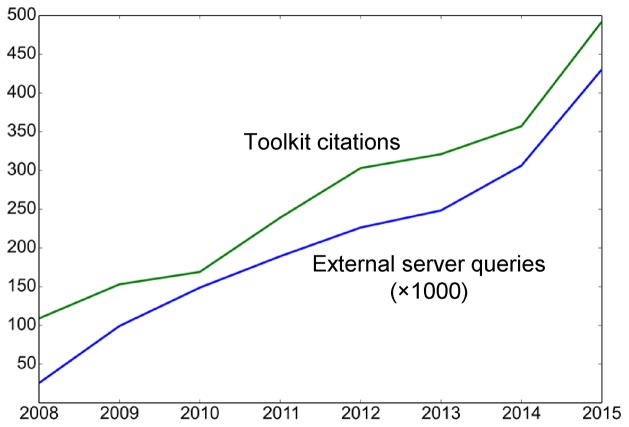
The MPI Bioinformatics Toolkit (http://toolkit.tuebingen.mpg.de) is an open, interactive web service for comprehensive and collaborative protein bioinformatic analysis. It offers a wide array of interconnected, state-of-the-art bioinformatics tools to experts and non-experts alike, developed both externally (e.g. BLAST+, HMMER3, MUSCLE) and internally (e.g. HHpred, HHblits, PCOILS). While a beta version of the Toolkit was released 10 years ago, the current production-level release has been available since 2008 and has serviced more than 1.6 million external user queries. The usage of the Toolkit has continued to increase linearly over the years, reaching more than 400 000 queries in 2015. In fact, through the breadth of its tools and their tight interconnection, the Toolkit has become an excellent platform for experimental scientists as well as a useful resource for teaching bioinformatic inquiry to students in the life sciences. In this article, we report on the evolution of the Toolkit over the last ten years, focusing on the expansion of the tool repertoire (e.g. CS-BLAST, HHblits) and on infrastructural work needed to remain operative in a changing web environment.
© The Author(s) 2016. Published by Oxford University Press on behalf of Nucleic Acids Research.
Figures
References
MeSH terms
Substances
LinkOut - more resources
Full Text Sources
Other Literature Sources
Research Materials
