


Allogeneic Hematopoietic Cell Transplantation as Curative Therapy for Patients with Non-Hodgkin Lymphoma: Increasingly Successful Application to Older Patients
- PMID: 27131863
- PMCID: PMC4981559
- DOI: 10.1016/j.bbmt.2016.04.019
Allogeneic Hematopoietic Cell Transplantation as Curative Therapy for Patients with Non-Hodgkin Lymphoma: Increasingly Successful Application to Older Patients
Abstract
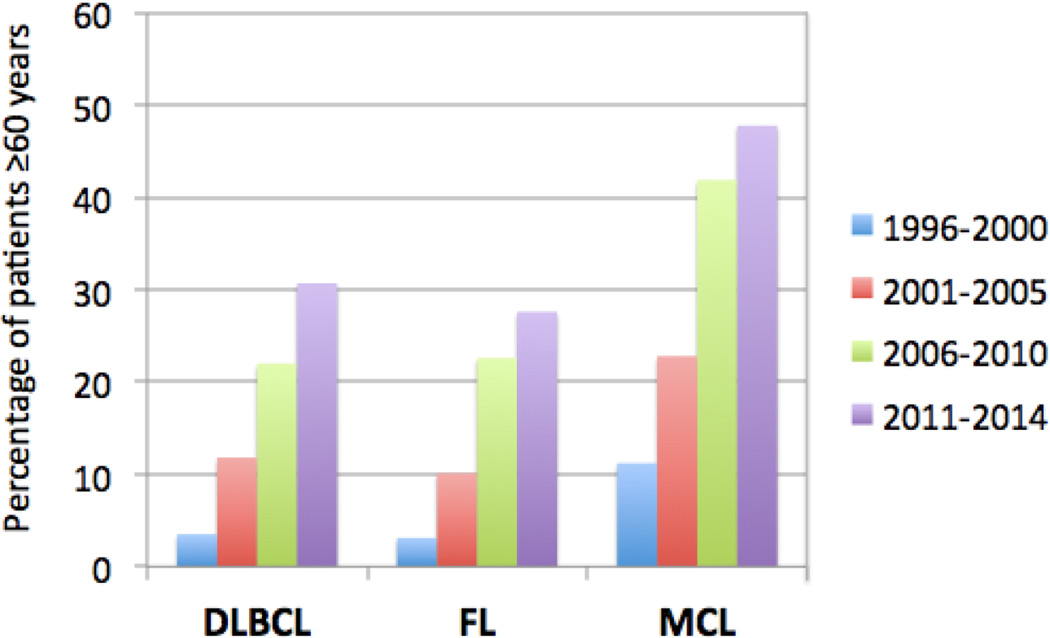
Non-Hodgkin lymphoma (NHL) constitutes a collection of lymphoproliferative disorders with widely varying biological, histological, and clinical features. For the B cell NHLs, great progress has been made due to the addition of monoclonal antibodies and, more recently, other novel agents including B cell receptor signaling inhibitors, immunomodulatory agents, and proteasome inhibitors. Autologous hematopoietic cell transplantation (auto-HCT) offers the promise of cure or prolonged remission in some NHL patients. For some patients, however, auto-HCT may never be a viable option, whereas in others, the disease may progress despite auto-HCT. In those settings, allogeneic HCT (allo-HCT) offers the potential for cure. Over the past 10 to 15 years, considerable progress has been made in the implementation of allo-HCT, such that this approach now is a highly effective therapy for patients up to (and even beyond) age 75 years. Recent advances in conventional lymphoma therapy, peritransplantation supportive care, patient selection, and donor selection (including the use of alternative hematopoietic cell donors), has allowed broader application of allo-HCT to patients with NHL. As a result, an ever-increasing number of NHL patients over age 60 to 65 years stand to benefit from allo-HCT. In this review, we present data in support of the use of allo-HCT for patients with diffuse large B cell lymphoma, follicular lymphoma, and mantle cell lymphoma. These histologies account for a large majority of allo-HCTs performed for patients over age 60 in the United States. Where possible, we highlight available data in older patients. This body of literature strongly supports the concept that allo-HCT should be offered to fit patients well beyond age 65 and, accordingly, that this treatment should be covered by their insurance carriers.
Keywords: Allogeneic hematopoietic cell transplantation; Elderly; Non-Hodgkin lymphoma; Reduced-intensity conditioning.
Copyright © 2016 American Society for Blood and Marrow Transplantation. Published by Elsevier Inc. All rights reserved.
Figures
References
-
- Personal communication. Mehdi Hamadani, Center for International Blood and Marrow Transplant Research. 2016 Apr 18;
-
- Coiffier B, Lepage E, Briere J, et al. CHOP chemotherapy plus rituximab compared with CHOP alone in elderly patients with diffuse large-B-cell lymphoma. N. Engl. J. Med. 2002;346:235–242. - PubMed
-
- Rosenwald A, Wright G, Chan WC, et al. The use of molecular profiling to predict survival after chemotherapy for diffuse large-B-cell lymphoma. N. Engl. J. Med. 2002;346:1937–1947. - PubMed
-
- Hans CP, Weisenburger DD, Greiner TC, et al. Confirmation of the molecular classification of diffuse large B-cell lymphoma by immunohistochemistry using a tissue microarray. Blood. 2004;103:275–282. - PubMed
Publication types
MeSH terms
Grants and funding
LinkOut - more resources
Full Text Sources
Other Literature Sources
Miscellaneous
