


doi: 10.1177/0963721415611601.
Improving the Prediction of Risk for Anxiety Development in Temperamentally Fearful Children
Affiliations
- PMID: 27134416
- PMCID: PMC4846306
- DOI: 10.1177/0963721415611601
Item in Clipboard
Improving the Prediction of Risk for Anxiety Development in Temperamentally Fearful Children
Curr Dir Psychol Sci.
2016 Feb.
Abstract
Pediatric anxiety disorders are among the most common disorders in children and adolescence resulting in both short-term and long-term negative consequences across a variety of domains including social and academic. Early fearful temperament has emerged as a strong predictor of anxiety development in childhood; however, not all fearful children become anxious. The current article summarizes theory and evidence for heterogeneity in the identification of temperamentally fearful children and trajectories of risk for anxiety. The findings presented in this article reveal that identification of subgroups of fearful temperament improves prediction of who is at risk for developing anxiety problems.
Figures
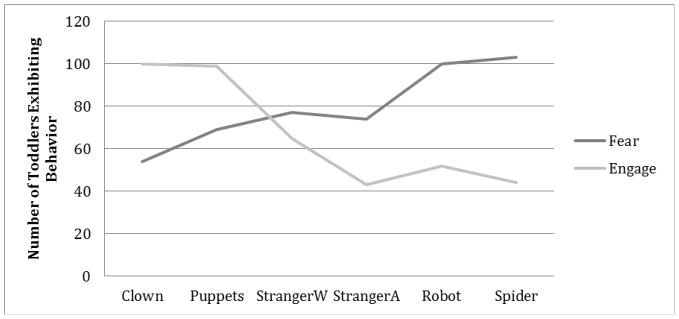
Number of Toddlers Displaying Fear and Engagement Behavior Across Episodes. From Buss, K. A., (2011). Which fearful toddlers should we worry about? Context, fear regulation and anxiety risk. Developmental Psychology, 47(3), 804–819. DOI: 10.1037/a0023227. Reprinted with permission from APA.
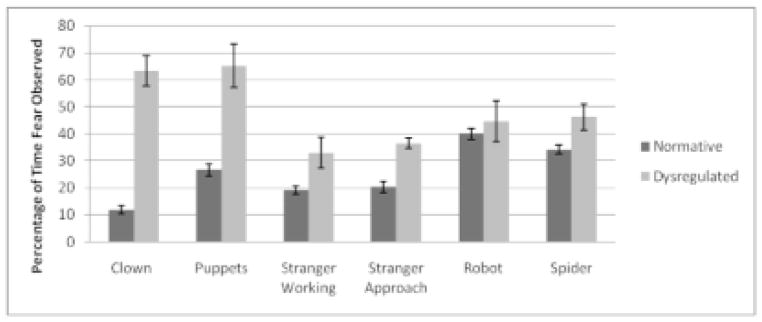
Patterns of Fear Across Episodes for the Two Latent Profiles. From Buss, K. A., (2011). Which fearful toddlers should we worry about? Context, fear regulation and anxiety risk. Developmental Psychology, 47(3), 804–819. DOI: 10.1037/a0023227. Reprinted with permission from APA.
References
-
- Bauer AM, Quas JA, Boyce WT. Associations between physiological reactivity and children’s behavior: Advantages of a multisystem approach. Developmental and Behavioral Pediatrics. 2002;23:102–113. - PubMed
Grants and funding
LinkOut - more resources
Full Text Sources
Other Literature Sources