Review
. 2015 Jul 14;4(3):489-504.
doi: 10.3390/plants4030489.

Cell Wall Amine Oxidases: New Players in Root Xylem Differentiation under Stress Conditions

Affiliations
Review

Cell Wall Amine Oxidases: New Players in Root Xylem Differentiation under Stress Conditions

Sandip A Ghuge et al. Plants (Basel). .

Abstract

Polyamines (PAs) are aliphatic polycations present in all living organisms. A growing body of evidence reveals their involvement as regulators in a variety of physiological and pathological events. They are oxidatively deaminated by amine oxidases (AOs), including copper amine oxidases (CuAOs) and flavin adenine dinucleotide (FAD)-dependent polyamine oxidases (PAOs). The biologically-active hydrogen peroxide (H₂O₂) is a shared compound in all of the AO-catalyzed reactions, and it has been reported to play important roles in PA-mediated developmental and stress-induced processes. In particular, the AO-driven H₂O₂ biosynthesis in the cell wall is well known to be involved in plant wound healing and pathogen attack responses by both triggering peroxidase-mediated wall-stiffening events and signaling modulation of defense gene expression. Extensive investigation by a variety of methodological approaches revealed high levels of expression of cell wall-localized AOs in root xylem tissues and vascular parenchyma of different plant species. Here, the recent progresses in understanding the role of cell wall-localized AOs as mediators of root xylem differentiation during development and/or under stress conditions are reviewed. A number of experimental pieces of evidence supports the involvement of apoplastic H₂O₂ derived from PA oxidation in xylem tissue maturation under stress-simulated conditions.

Keywords: amine oxidases; cell wall; hydrogen peroxide; polyamines; root; xylem differentiation.


Figures
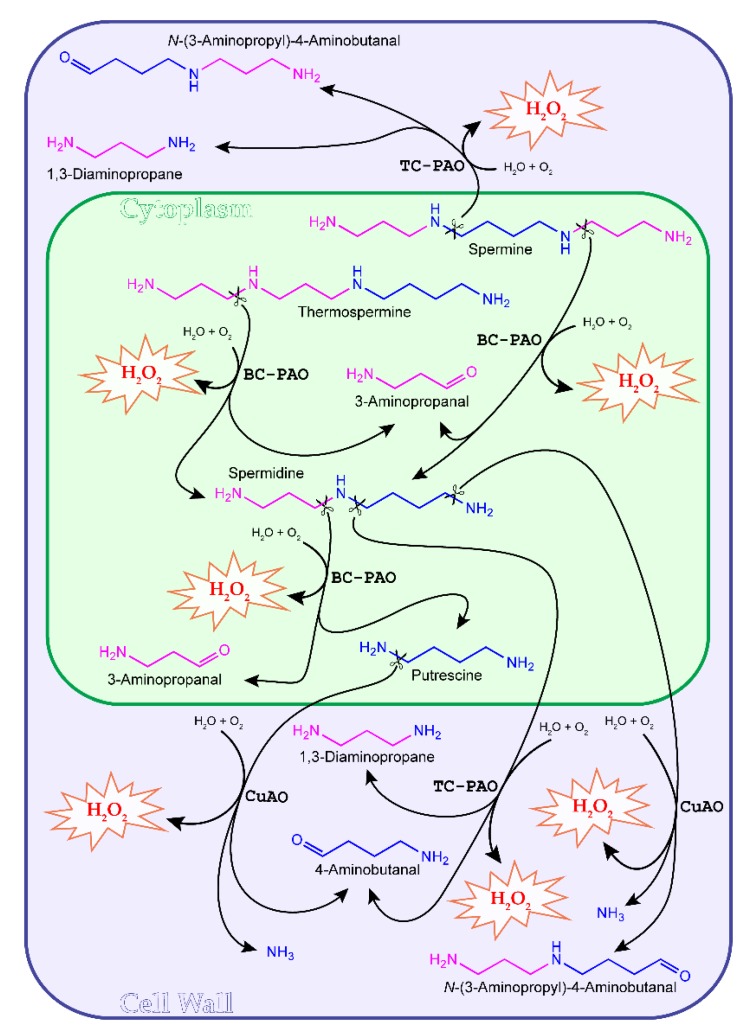
Figure 1
Figure 1
Polyamine (PA) oxidation in plants. The compartment with the violet background highlights PA terminal oxidations occurring in the cell wall. Scissors indicate cleavage sites. The peroxisomal Put and Spd oxidation and the extracellular monoamine oxidation carried out by Arabidopsis thaliana and Malus domestica CuAOs, as well as the vacuolar Hordeum vulgare HvPAO2-mediated oxidation of Spm and Spd are not shown for simplicity. TC, terminal catabolism; BC, back-conversion; PAO, polyamine oxidase.
Figure 2
Figure 2
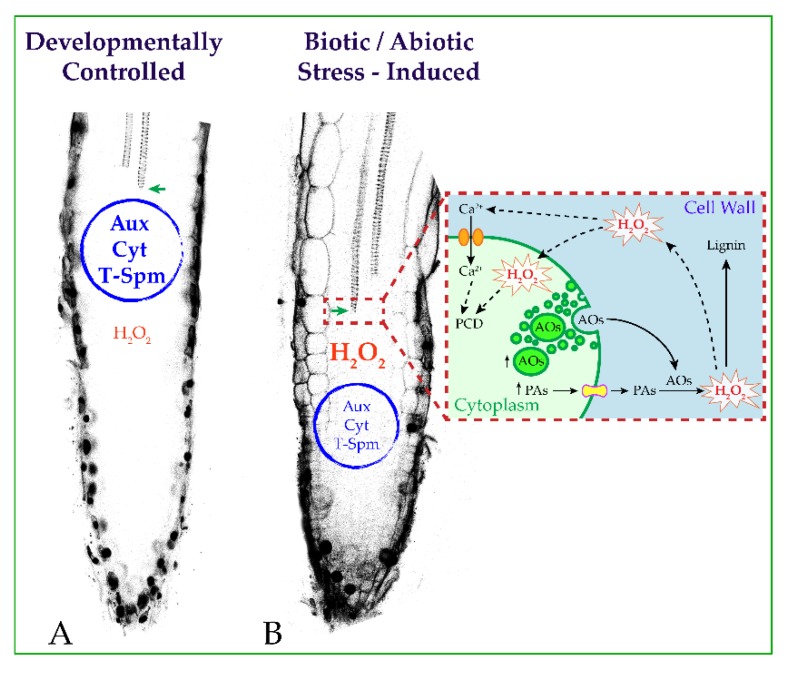
Schematic representation of the hypothetical stress-induced signaling triggered by PA oxidation and leading to root xylem differentiation. (A) Developmentally-controlled xylem differentiation is governed by the auxin/cytokinin/T-Spm loop. Apoplastic PA oxidation-derived H2O2 may contribute to the oxidative burst needed for full differentiation of the secondary wall. (B) Under stress conditions, an early root xylem differentiation occurs, and the first xylem precursor with secondary walls appears positioned closer to the root tip. This event is prevalently signaled by the H2O2 derived from the AO-driven terminal oxidation of PAs in the apoplast of differentiating xylem elements, independent of the auxin/cytokinin/T-Spm loop. (Inset in (B)) The square on the right illustrates a hypothetical scheme of the events at the level of differentiating xylem tissue under biotic/abiotic stress. Under these conditions, the expression of PA metabolic genes and apoplastic vascular-expressed AOs is induced along with PA and AO secretion in the cell wall. Terminal oxidation of PAs accumulated in the cell wall triggers an extracellular oxidative burst. H2O2 in the cell wall signals developmental cell death and acts as co-substrate in peroxidase-mediated lignin polymerization. PCD, programmed cell death.

References

    1. Verbelen J.P., de Cnodder T., Le J., Vissenberg K., Baluska F. The root apex of Arabidopsis thaliana consists of four distinct zones of growth activities: Meristematic zone, transition zone, fast elongation zone and growth terminating zone. Plant Signal. Behav. 2006;1:296–304. doi: 10.4161/psb.1.6.3511. - DOI - PMC - PubMed
    1. Kobayashi K., Takahashi F., Suzuki M., Suzuki H. Examination of morphological changes in the first formed protoxylem in Arabidopsis seedlings. J. Plant Res. 2002;115:107–112. doi: 10.1007/s102650200015. - DOI - PubMed
    1. Rost T.L., Baum S. On the correlation of primary root length, meristem size and protoxylem tracheary element position in pea seedlings. Am. J. Bot. 1988;75:414–424. doi: 10.2307/2443988. - DOI
    1. Perilli S., di Mambro R., Sabatini S. Growth and development of the root apical meristem. Curr. Opin. Plant Biol. 2012;15:17–23. doi: 10.1016/j.pbi.2011.10.006. - DOI - PubMed
    1. Petricka J.J., Winter C.M., Benfey P.N. Control of Arabidopsis root development. Annu. Rev. Plant Biol. 2012;63:563–590. doi: 10.1146/annurev-arplant-042811-105501. - DOI - PMC - PubMed

LinkOut - more resources