


Variants with large effects on blood lipids and the role of cholesterol and triglycerides in coronary disease
- PMID: 27135400
- PMCID: PMC9136713
- DOI: 10.1038/ng.3561
Variants with large effects on blood lipids and the role of cholesterol and triglycerides in coronary disease
Abstract
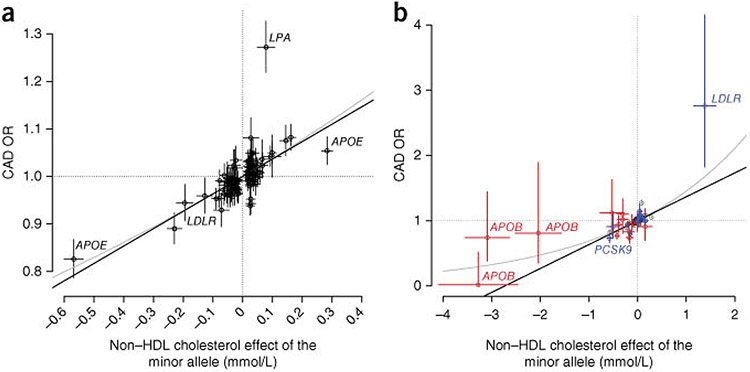
Sequence variants affecting blood lipids and coronary artery disease (CAD) may enhance understanding of the atherogenicity of lipid fractions. Using a large resource of whole-genome sequence data, we examined rare and low-frequency variants for association with non-HDL cholesterol, HDL cholesterol, LDL cholesterol, and triglycerides in up to 119,146 Icelanders. We discovered 13 variants with large effects (within ANGPTL3, APOB, ABCA1, NR1H3, APOA1, LIPC, CETP, LDLR, and APOC1) and replicated 14 variants. Five variants within PCSK9, APOA1, ANGPTL4, and LDLR associate with CAD (33,090 cases and 236,254 controls). We used genetic risk scores for the lipid fractions to examine their causal relationship with CAD. The non-HDL cholesterol genetic risk score associates most strongly with CAD (P = 2.7 × 10(-28)), and no other genetic risk score associates with CAD after accounting for non-HDL cholesterol. The genetic risk score for non-HDL cholesterol confers CAD risk beyond that of LDL cholesterol (P = 5.5 × 10(-8)), suggesting that targeting atherogenic remnant cholesterol may reduce cardiovascular risk.
Figures
References
-
- Barter PJ et al. Effects of torcetrapib in patients at high risk for coronary events. N. Engl. J. Med 357, 2109–2122 (2007). - PubMed
-
- Schwartz GG et al. Effects of dalcetrapib in patients with a recent acute coronary syndrome. N. Engl. J. Med 367, 2089–2099 (2012). - PubMed
-
- HPS2-THRIVE Collaborative Group. Effects of extended-release niacin with laropiprant in high-risk patients. N. Engl. J. Med 371, 203–212 (2014). - PubMed
Publication types
MeSH terms
Substances
Grants and funding
LinkOut - more resources
Full Text Sources
Other Literature Sources
Medical
Miscellaneous
