Trends in Head and Neck Cancer in South Korea Between 1999 and 2012
- PMID: 27136364
- PMCID: PMC4996101
- DOI: 10.21053/ceo.2015.01123
Trends in Head and Neck Cancer in South Korea Between 1999 and 2012
Abstract
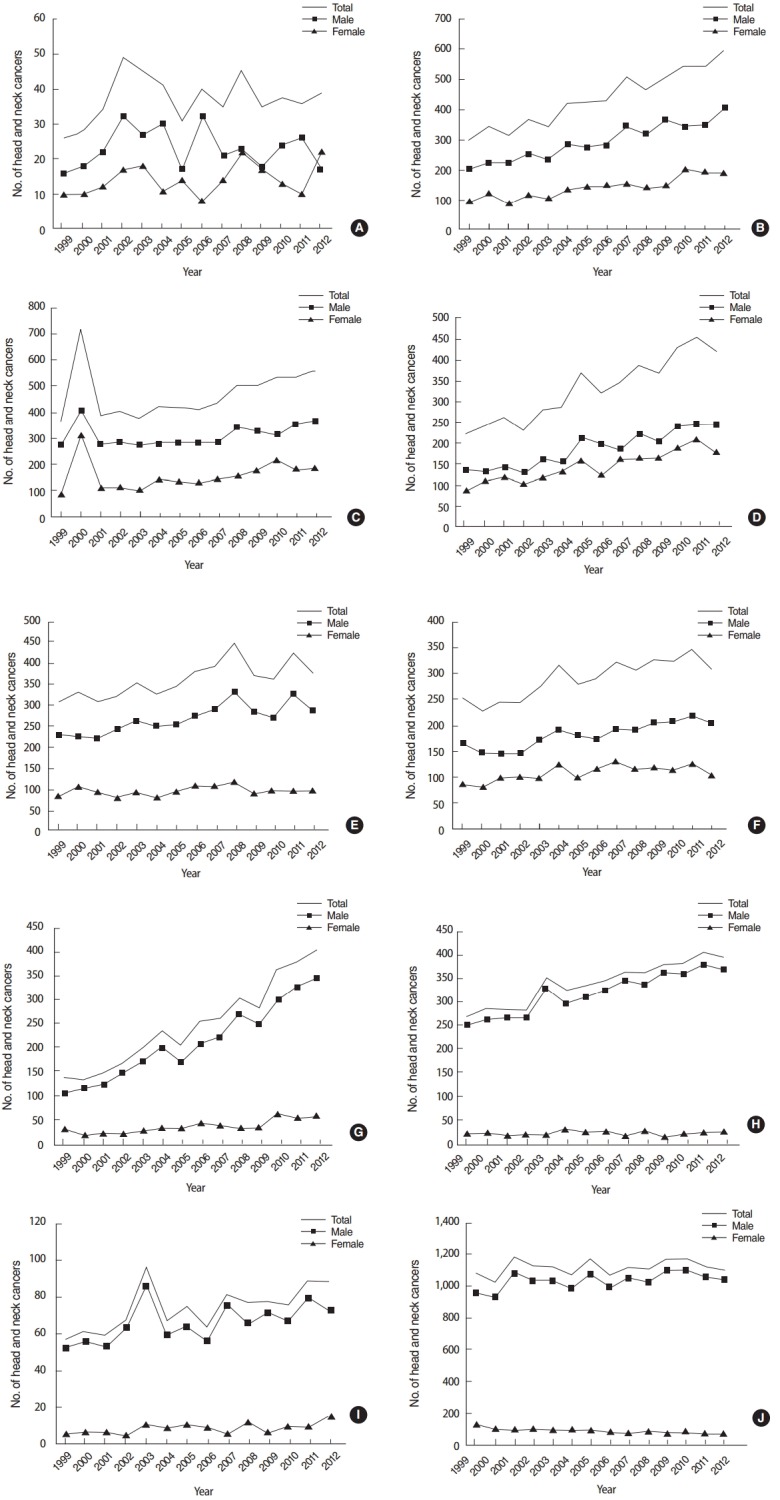
Objectives: The purpose is to provide detailed estimates of population-based incidences of head and neck cancers (HNCs) between 1999 and 2012 in South Korea and to evaluate trends.
Methods: Data was reviewed from the Korea National Cancer Incidence Database regarding the incidence of HNCs between 1999 and 2012. Locations that were surveyed included lip, oral tongue, oral cavity, major salivary gland, nasopharynx, nasal cavity and paranasal sinus, tonsil, hypopharynx, oropharynx, and larynx. Age-standardized incidence rates were calculated and provided with 95% confidence intervals. The increase ratio of HNCs for and male-to-female ratios were also calculated.
Results: The incidence of lip (0.07-0.10/100,000 people) and oropharyngeal cancer (0.09-0.12/100,000 people) remained low during the study period while laryngeal cancer (1.17-2.08/100,000 people) occurred most frequently. The incidence of oral tongue, major salivary gland, tonsil, and hypopharynx increased steeply compared to other HNCs between 1999 and 2012. Male-to-female ratio was over 1.0 for all HNCs, especially for those of tonsil, hypopharynx, oropharynx, and larynx cancer which were >5.0.
Conclusion: The incidence of all the HNCs except for laryngeal cancer has increased yearly in men and women in South Korea since 1998. Rates of oral tongue, major salivary gland, and tonsil cancer have increased the most rapidly during this time period.
Keywords: Head and Neck Neoplasms; Incidence; Republic of Korea.
Conflict of interest statement
No potential conflict of interest relevant to this article was reported.
Figures
References
-
- Simard EP, Torre LA, Jemal A. International trends in head and neck cancer incidence rates: differences by country, sex and anatomic site. Oral Oncol. 2014 May;50(5):387–403. - PubMed
-
- Van Nieuwenhuizen AJ, Buffart LM, Brug J, Leemans CR, Verdonckde Leeuw IM. The association between health related quality of life and survival in patients with head and neck cancer: a systematic review. Oral Oncol. 2015 Jan;51(1):1–11. - PubMed
-
- Hwang TZ, Hsiao JR, Tsai CR, Chang JS. Incidence trends of human papillomavirus-related head and neck cancer in Taiwan, 1995-2009. Int J Cancer. 2015 Jul;137(2):395–408. - PubMed
LinkOut - more resources
Full Text Sources
Other Literature Sources