Review
. 2013 Jun 25;2(3):396-415.
doi: 10.3390/plants2030396.

Understanding of Leaf Development-the Science of Complexity

Affiliations
Review

Understanding of Leaf Development-the Science of Complexity

Robert Malinowski. Plants (Basel). .

Abstract

The leaf is the major organ involved in light perception and conversion of solar energy into organic carbon. In order to adapt to different natural habitats, plants have developed a variety of leaf forms, ranging from simple to compound, with various forms of dissection. Due to the enormous cellular complexity of leaves, understanding the mechanisms regulating development of these organs is difficult. In recent years there has been a dramatic increase in the use of technically advanced imaging techniques and computational modeling in studies of leaf development. Additionally, molecular tools for manipulation of morphogenesis were successfully used for in planta verification of developmental models. Results of these interdisciplinary studies show that global growth patterns influencing final leaf form are generated by cooperative action of genetic, biochemical, and biomechanical inputs. This review summarizes recent progress in integrative studies on leaf development and illustrates how intrinsic features of leaves (including their cellular complexity) influence the choice of experimental approach.

Keywords: biophysical and cellular aspects of leaf development; leaf morphogenesis; leaf shape.


Figures
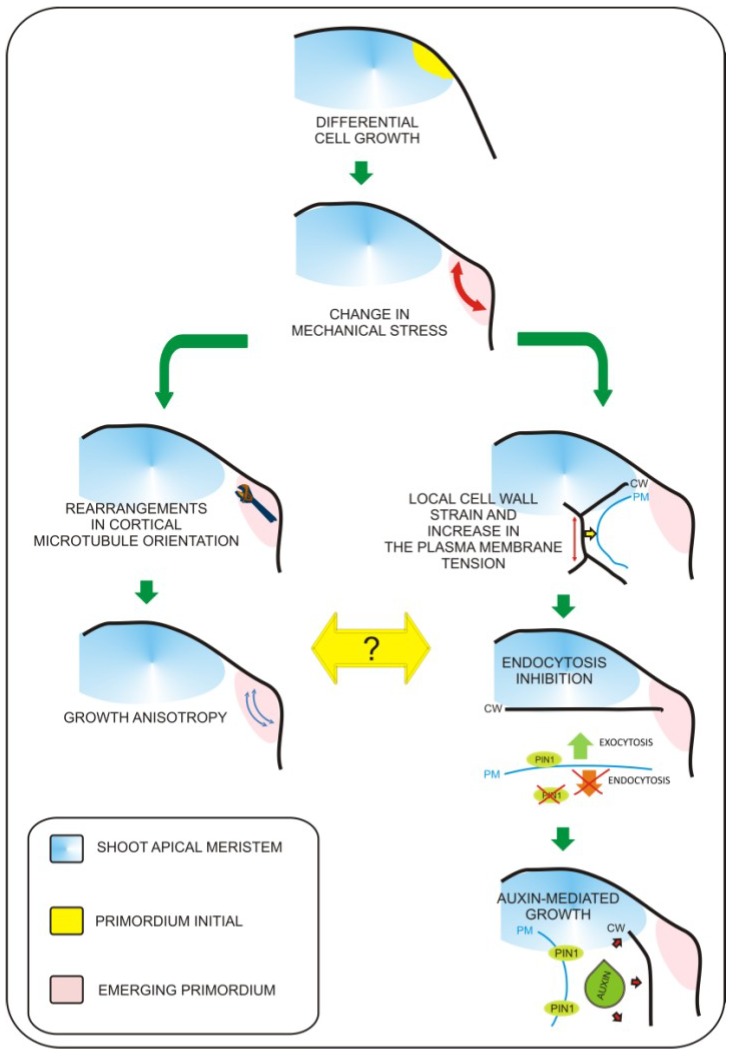
Figure 1
Figure 1
Mechanisms coordinating biomechanical signals with growth responses. Leaf primordium initiation involves local biomechanical changes. So far, two major pathways involved in this process were characterized. The first pathway involves microtubule rearrangements leading to growth anisotropy (left branch). The second is based on the impact of mechanical inputs on plasma-membrane protein trafficking (right branch). Mechanical stress leads to change in PIN1 auxin transporter distribution, this way increasing transport of auxin towards the apoplast. This leads to extracellular space acidification and cell wall loosening, which is required for turgor based growth of cells. So far everything shows that these two pathways are independent. Figure based on recent works of Uyttewaal et al. 2012 [14] and Nakayama et al., 2012 [15].
Figure 2
Figure 2
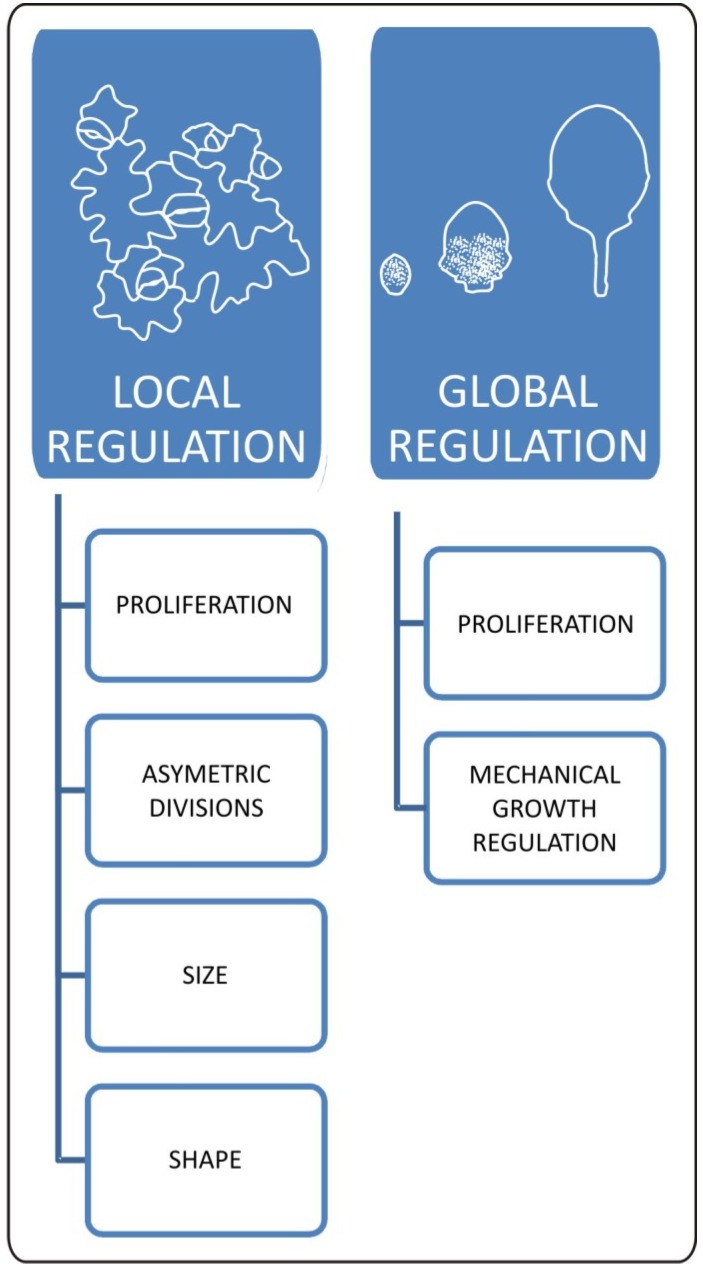
Local and global aspects of changes in epidermal properties during leaf development. Cellular changes within epidermis have a huge impact on final leaf form. Locally mechanisms regulating meristemoid cell fate influence distribution of stomata and pavement cells. This process has a huge impact on overall plant growth responses as well. Size and shape of pavement cells is the outcome of interaction between biomechanical and genetic factors. These local cellular changes are strictly connected with global effect of epidermis on leaf development. At the organ level, epidermis works as a mechanical growth rate-limiting factor. Epidermal growth and final leaf form is influenced by genetic and physiological inputs regulating patterns of cell proliferation.
Figure 3
Figure 3
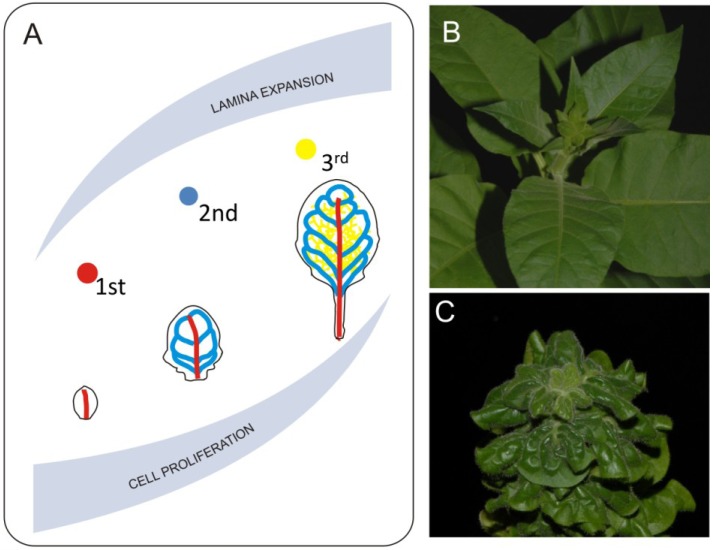
Mechanical effects of venation systems on leaf growth. Midvein and second degree veins differentiate during early stages of leaf development. This event overlaps with proliferative phase of leaf growth (A). Such situation has huge consequences on leaf morphology since 1st and 2nd degree veins reach they pattern at early stages of leaf development and will not accommodate it during further leaf expansion. Further degree veins differentiate during expansive phase of leaf development and they follow the lamina growth. Direct consequence of disturbed coordination between leaf blade expansion and growth of venation system is extreme 3-D deformation such as observed in the bri1 brassinosteroid mutant plants. Pictures show comparison between morphology of properly developing (B) and brassinosteroid insensitive (C) tobacco plants.
Figure 4
Figure 4
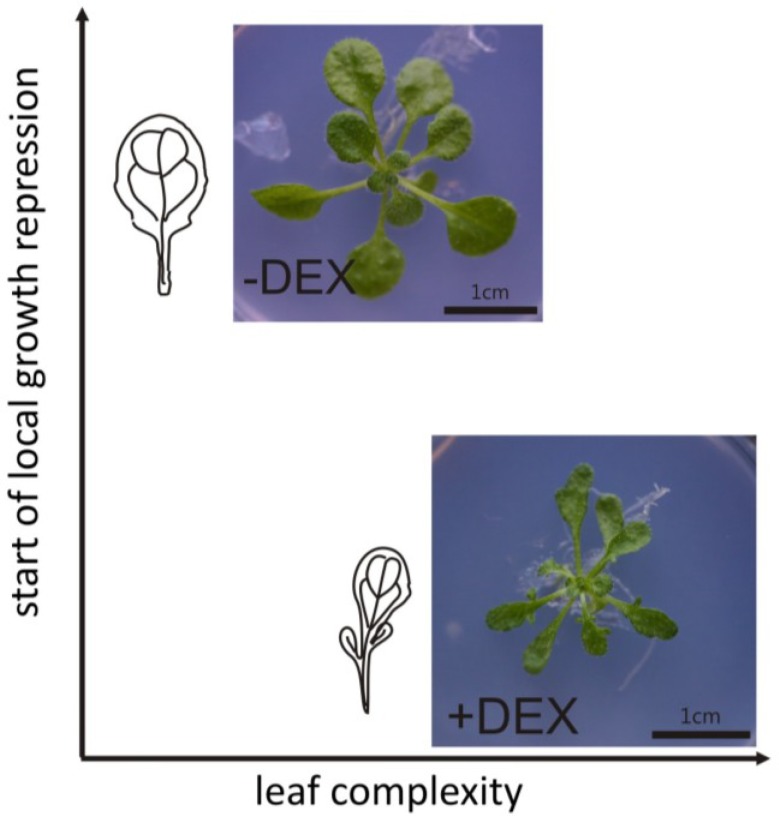
The effect of local growth repression on leaf complexityGeneration of local decrease in growth during early stages of leaf development results in increased leaf dissection. The pattern of these local gradients of growth distribution is established during proliferative phase of leaf growth and later manipulation does not result in any major change in leaf complexity. Figure shows effects of local growth arrest induced by chemical induction of the KRP1 gene within the CUC2 expressional domain in Arabidopsis thaliana plants (−DEX before and +DEX after induction). Figure based on Malinowski et al. [47].

References

    1. Beerling D. The Emerald Planet: How Plants Changed Earth’s History. Oxford University Press; New York, NY, USA: 2007.
    1. Boudaoud A. An introduction to the mechanics of morphogenesis for plant biologists. Trends Plant Sci. 2010;15:353–360. doi: 10.1016/j.tplants.2010.04.002. - DOI - PubMed
    1. Gonzalez N., Vanhaeren H., Inzé D. Leaf size control: Complex coordination of cell division and expansion. Trends Plant Sci. 2012;17:332–340. doi: 10.1016/j.tplants.2012.02.003. - DOI - PubMed
    1. Efroni I., Yuval E., Lifschitz E. Morphogenesis of simple and compound leaves: A critical review. Plant Cell. 2010;22:1019–1032. doi: 10.1105/tpc.109.073601. - DOI - PMC - PubMed
    1. Nakayama N., Kuhlemeier C. Leaf development: Untangling the spirals. Curr. Biol. 2009;2:R71–R74. doi: 10.1016/j.cub.2008.11.036. - DOI - PubMed

LinkOut - more resources