. 2016 Jul 1;291(27):13999-14011.
doi: 10.1074/jbc.M116.726596. Epub 2016 May 2.

Design of a Genetically Stable High Fidelity Coxsackievirus B3 Polymerase That Attenuates Virus Growth in Vivo

Affiliations

Design of a Genetically Stable High Fidelity Coxsackievirus B3 Polymerase That Attenuates Virus Growth in Vivo

Seth McDonald et al. J Biol Chem. .

Abstract

Positive strand RNA viruses replicate via a virally encoded RNA-dependent RNA polymerase (RdRP) that uses a unique palm domain active site closure mechanism to establish the canonical two-metal geometry needed for catalysis. This mechanism allows these viruses to evolutionarily fine-tune their replication fidelity to create an appropriate distribution of genetic variants known as a quasispecies. Prior work has shown that mutations in conserved motif A drastically alter RdRP fidelity, which can be either increased or decreased depending on the viral polymerase background. In the work presented here, we extend these studies to motif D, a region that forms the outer edge of the NTP entry channel where it may act as a nucleotide sensor to trigger active site closure. Crystallography, stopped-flow kinetics, quench-flow reactions, and infectious virus studies were used to characterize 15 engineered mutations in coxsackievirus B3 polymerase. Mutations that interfere with the transport of the metal A Mg(2+) ion into the active site had only minor effects on RdRP function, but the stacking interaction between Phe(364) and Pro(357), which is absolutely conserved in enteroviral polymerases, was found to be critical for processive elongation and virus growth. Mutating Phe(364) to tryptophan resulted in a genetically stable high fidelity virus variant with significantly reduced pathogenesis in mice. The data further illustrate the importance of the palm domain movement for RdRP active site closure and demonstrate that protein engineering can be used to alter viral polymerase function and attenuate virus growth and pathogenesis.

Keywords: plus-stranded RNA virus; polymerase fidelity; protein engineering; vaccine development; viral polymerase; virology.


Figures

FIGURE 1.
FIGURE 1.
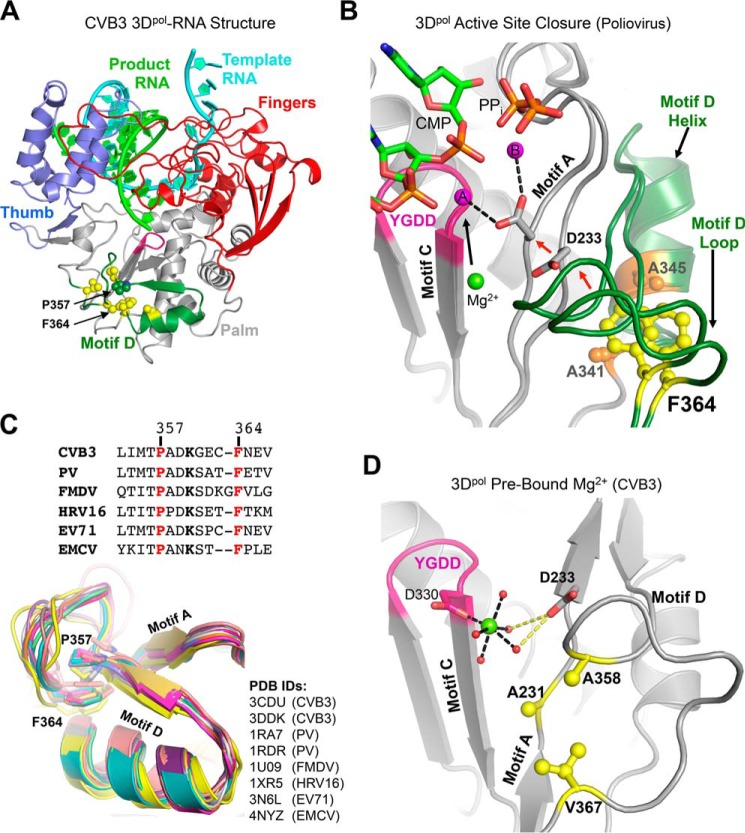
Structural overview of picornaviral RdRP active site movements and motif D conservation. A, coxsackievirus B3 3Dpol elongation complex structure (Protein Data Bank code 4K4X) highlighting the location of motif D (green) within the palm domain and residues targeted for mutation (yellow spheres). B, close-up view of two conformations of the poliovirus 3Dpol elongation complex active site (Protein Data Bank codes 3OL6 and 3OL7) showing the concerted movements of motifs A and D that close the active site and reposition Asp233 and the prebound metal A Mg2+ ion (green sphere) to yield the two-metal ion (magenta) coordination geometry required for catalysis. Note the sliding movement of Phe364 atop Ala341 and Ala345 that are located on the motif D helix (CVB3 numbering used). C, sequence and structure alignment of the motif D loop from multiple picornaviruses showing the conservation of residues Pro357 and Phe364 (CVB3 numbering) that likely stabilize the loop conformation. The maximum likelihood structural superpositioning (34, 35) emphasizes how the proline-phenylalanine interaction stabilizes the conserved architecture of the motif D loop. D, close-up view of the open conformation CVB3 3Dpol active site (Protein Data Bank 4K4Z) showing the hydration shell around the prebound Mg2+ ion (green). Mg2+ coordination by waters (red spheres) and Asp330 is indicated by black dashes; Asp233 hydrogen bonds to two of the coordinating waters are shown as yellow dashes. Residues framing this hydration network that were targeted for mutagenesis are shown as yellow sticks. PV, poliovirus; FMDV, foot-and-mouth disease virus; EMCV, encephalomyocarditis virus; HRV, human rhinovirus; EV, enterovirus.
FIGURE 2.
FIGURE 2.
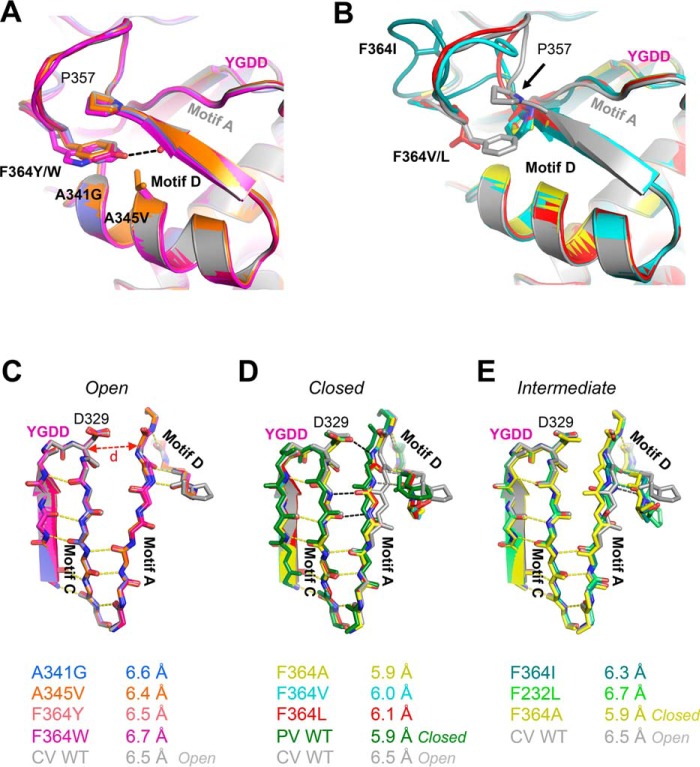
Crystal structures of CVB3 3Dpol motif D mutants. A, mutations that do not alter the wild type conformation of the motif D loop include A341G (blue), A345V (orange), F364Y (pink), and F364W (magenta). The F364Y mutation may stabilize this conformation via a new hydrogen bond to the backbone carbonyl of Met355 (black dashed line), and F364W may reinforce the interaction with Pro357 by providing a larger aromatic surface area. YGDD marks the active site β-turn within motif C. B, mutation of Phe364 to small hydrophobic and β-branched residues precludes the stacking interaction with Pro357, inducing a downward movement of Pro357. F364A is shown in yellow, F364V is in cyan, F364L is in red, and F364I is in teal. C–E, mutations to Phe364 result in a closing of the active site in the absence of RNA and NTPs as shown in these top views of the active site motifs. C, the open conformation seen with A341G, A345V, and the aromatic F364Y and F364W mutations matches the structure of the wild type 3Dpol (gray). The open conformation is characterized by partial hydrogen bonding (yellow dashes) between motifs A and C and an ≈6.5-Å distance between Asp329 Cα in Motif C and Tyr234 Cα in motif A. D, The F364A, F364L, and F364V mutant structures show closed active sites characterized by an ≈0.5-Å movement of motif A toward motif C that is stabilized by the formation of three new hydrogen bonds (black dashes). The hydrogen bonds between motifs A and D are maintained (gray dashes), demonstrating the concerted movement of motifs A and D to close the active site. The open wild type CVB3 (gray) and closed poliovirus (PV) (green) conformation structures are shown for comparison. E, the F364I mutant (teal with nitrogen atoms in blue and oxygen atoms in red) is in a partially closed state where the hydrogen bonding network of the closed active site has not fully formed. The open wild type (gray), closed F364A (yellow), and F232L (green) structures are shown for comparison.
FIGURE 3.
FIGURE 3.
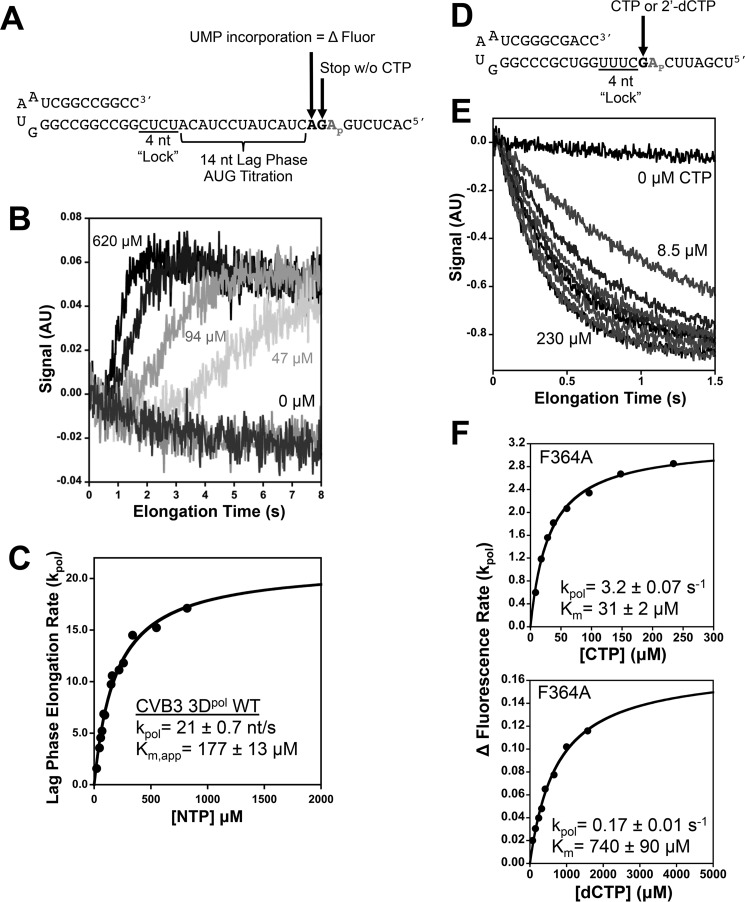
Processive elongation and single nucleotide incorporation measured by stopped-flow 2-aminopurine fluorescence. A, hairpin primer-template RNA on which preinitiated elongation complexes are assembled by only supplying GTP and ATP in the reaction, causing them to stall at a +4 product. Stopped-flow addition of ATP + GTP + UTP then results in rapid elongation to the +18 product where the complex stalls because CTP is not present. This translocates a unique 2-aminopurine base analog (Ap) into the +2 binding pocket on the polymerase where its fluorescence increases because it is fully unstacked from both neighboring bases. B, stopped-flow traces showing the shortening of the lag phase that reflects faster processive elongation as the NTP concentration is increased. C, curve fitting of the rates extracted from the lag phase versus NTP concentration allows the determination of processive elongation rates and Km values. D, structure of the hairpin primer-template RNA used for single nucleotide incorporation assays where preinitiation with ATP and GTP result in stalled elongation complexes with the template strand 2-aminopurine in the +2 position. E, stopped-flow traces demonstrating the single step quenching of fluorescence as 2-aminopurine is translocated from the +2 position to the +1 position. F, analysis of CVB3 3Dpol F364A single nucleotide turnover rates as a function of CTP (top) and 2′-dCTP (bottom) concentrations. AU, arbitrary units; nt, nucleotide(s).
FIGURE 4.
FIGURE 4.
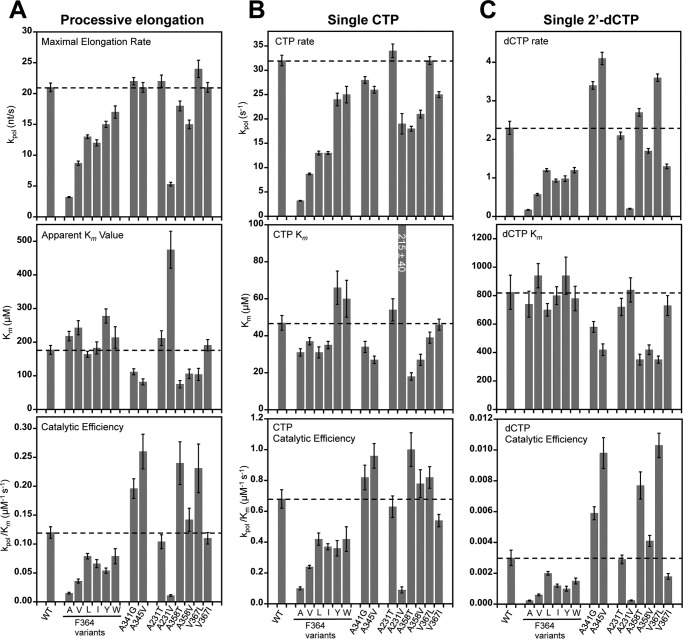
Summary of processive and single nucleotide elongation data. A, plots of processive elongation rates (kpol; top), Km values (middle), and catalytic efficiencies (kpol/Km; bottom) for all mutations in this study. Dashed horizontal lines indicate WT values, and error bars reflect the S.E. obtained from curve fitting the data. For the catalytic efficiencies, these errors are propagated as root mean square fractional errors. B and C, analogous plots for single nucleotide turnover rates with CTP and 2′-dCTP substrates. nt, nucleotides.
FIGURE 5.
FIGURE 5.
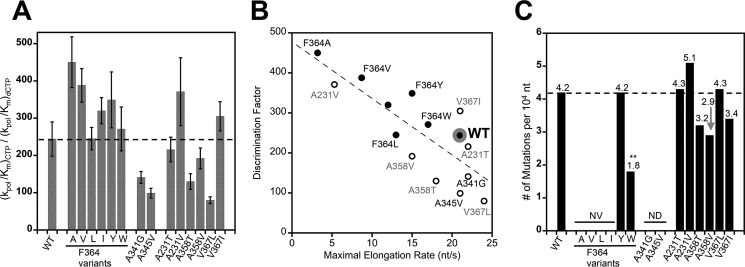
Nucleotide discrimination and deep sequencing-based fidelity of 3Dpol variants. A, CTP versus 2′-dCTP discrimination factors calculated as the ratio of their catalytic efficiencies. Error bars reflect root mean square propagation of experimental errors from Fig. 4. B, correlation plot of maximal elongation rates based on processive elongation (Fig. 4A) versus the nucleotide discrimination factors. Phe364 mutations are shown as closed symbols, and wild type is marked with a large gray ring. C, mutation frequencies of the variant polymerases based on molecular clone sequencing of progeny virus genomes following infection in tissue culture. Between 81 and 96 clones (94,000 and 112,000 nucleotides) were sequenced per population. **, p < 0.01 by two-tailed Mann-Whitney U test; n = 165; all other values not significant, p > 0.05. NV denotes non-viable viruses, and ND denotes not determined. nt, nucleotides.
FIGURE 6.
FIGURE 6.
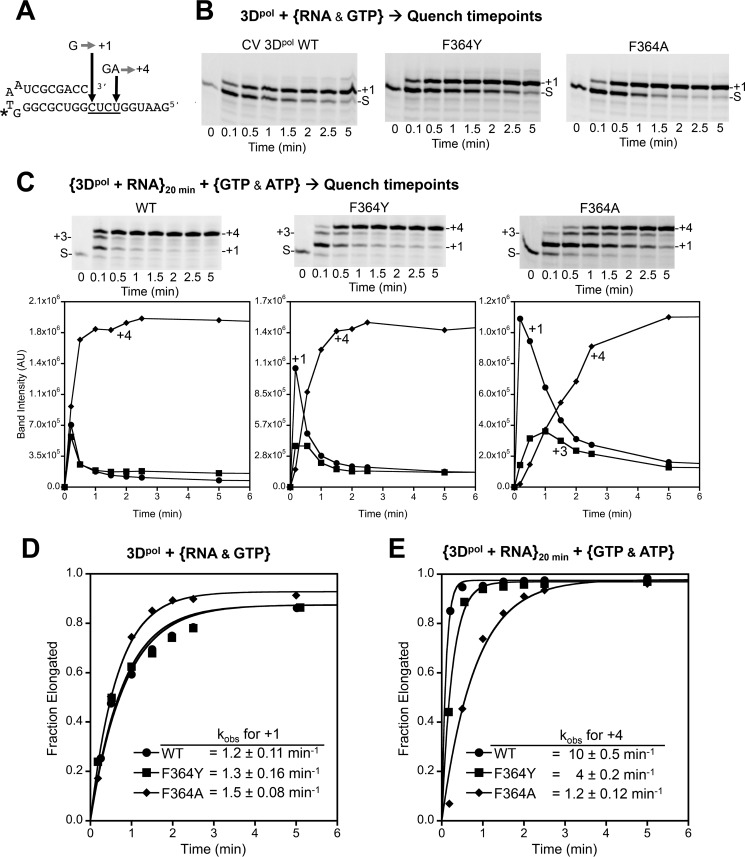
Perturbing the Pro357-Phe364 interaction affects both pre- and postcatalysis active site motions. A, sequence of the hairpin primer-template RNA used in elongation reactions where incubation with only GTP results in formation of a +1 product, whereas incubation with GTP and ATP will yield a +4 product. * denotes location of LI-COR Biosciences IRDye800 attachment. B, +1 product formation by wild type and mutant polymerases observed by denaturing PAGE followed by infrared imaging of the IRDye label. S marks starting RNA material position. C, +4 product formation in a reaction where 3Dpol and RNAwere preincubated to minimize effects from the slow RNA binding step prior to initiation. The plots of band intensities underscore the processive elongation defects of the F364A mutant where there is significant buildup of the intermediate +1 product as compared with wild type. D and E, single exponential rates for +1 and +4 product formation reactions shown in B and C. AU, arbitrary units.
FIGURE 7.
FIGURE 7.
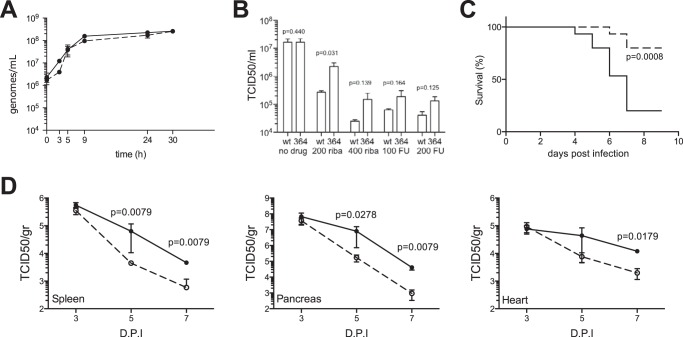
F364W increases resistance to RNA mutagens and is attenuated in vivo. A, one-step replication curves of wild type (solid line) and F364W (dashed line) viruses. HeLa cells were infected at a multiplicity of infection of 10, and at the times indicated the total viral RNA genomes were quantified by quantitative RT-PCR. B, the F364W virus exhibits resistance to nucleoside analogs in Vero cells treated with either ribavirin or 5-fluorouracil. Histograms represent mean values and S.E.; p values based on unpaired, two-tailed t test are indicated; n = 3. C, survival curve of mice (15 per group) infected with either wild type (solid line) or F364W (dashed line) virus monitored over 14 days, the first 9 days of which are shown. p value is indicated based on log rank Mantel-Cox test. D, tissue-specific viral titers (TCID50/g of organ) in mice infected with either wild type (solid line) or F364W (dashed line) virus harvested at 3, 5, and 7 days postinfection. Mean values with error bars reflecting the standard error of the mean are shown; p values determined by two-tailed Mann-Whitney U test are indicated; n = 5.

References

    1. Gong P., and Peersen O. B. (2010) Structural basis for active site closure by the poliovirus RNA-dependent RNA polymerase. Proc. Natl. Acad. Sci. U.S.A. 107, 22505–22510 - PMC - PubMed
    1. Kornberg R. D. (2007) The molecular basis of eukaryotic transcription. Proc. Natl. Acad. Sci. U.S.A. 104, 12955–12961 - PMC - PubMed
    1. Steitz T. A. (2009) The structural changes of T7 RNA polymerase from transcription initiation to elongation. Curr. Opin. Struct. Biol. 19, 683–690 - PMC - PubMed
    1. Steitz T. A. (1998) A mechanism for all polymerases. Nature 391, 231–232 - PubMed
    1. Ferrer-Orta C., Ferrero D., and Verdaguer N. (2015) RNA-dependent RNA polymerases of picornaviruses: from the structure to regulatory mechanisms. Viruses 7, 4438–4460 - PMC - PubMed

Publication types

Substances