


Physical Activity and Sedentary Behavior in Metabolically Healthy versus Unhealthy Obese and Non-Obese Individuals - The Maastricht Study
- PMID: 27138596
- PMCID: PMC4854448
- DOI: 10.1371/journal.pone.0154358
Physical Activity and Sedentary Behavior in Metabolically Healthy versus Unhealthy Obese and Non-Obese Individuals - The Maastricht Study
Abstract
Background: Both obesity and the metabolic syndrome are associated with increased risk of cardiovascular diseases and type 2 diabetes. Although both frequently occur together in the same individual, obesity and the metabolic syndrome can also develop independently from each other. The (patho)physiology of "metabolically healthy obese" (i.e. obese without metabolic syndrome) and "metabolically unhealthy non-obese" phenotypes (i.e. non-obese with metabolic syndrome) is not fully understood, but physical activity and sedentary behavior may play a role.
Objective: To examine objectively measured physical activity and sedentary behavior across four groups: I) "metabolically healthy obese" (MHO); II) "metabolically unhealthy obese" (MUO); III)"metabolically healthy non-obese" (MHNO); and IV) "metabolically unhealthy non-obese" (MUNO).
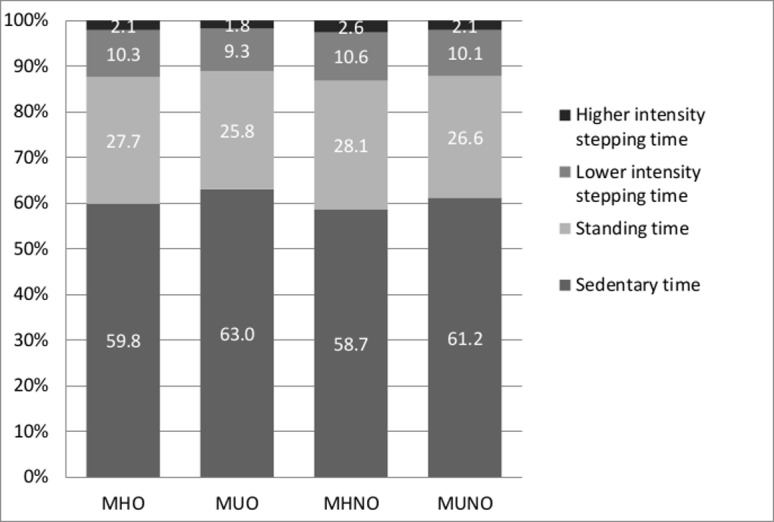
Methods: Data were available from 2,449 men and women aged 40-75 years who participated in The Maastricht Study from 2010 to 2013. Participants were classified into the four groups according to obesity (BMI≥30kg/m2) and metabolic syndrome (ATPIII definition). Daily activity was measured for 7 days with the activPAL physical activity monitor and classified as time spent sitting, standing, and stepping.
Results: In our study population, 562 individuals were obese. 19.4% of the obese individuals and 72.7% of the non-obese individuals was metabolically healthy. After adjustments for age, sex, educational level, smoking, alcohol use, waking time, T2DM, history of CVD and mobility limitation, MHO (n = 107) spent, per day, more time stepping (118.2 versus 105.2 min; p<0.01) and less time sedentary (563.5 versus 593.0 min., p = 0.02) than MUO (n = 440). In parallel, MHNO (n = 1384) spent more time stepping (125.0 versus 115.4 min; p<0.01) and less time sedentary (553.3 versus 576.6 min., p<0.01) than MUNO (n = 518).
Conclusion: Overall, the metabolically healthy groups were less sedentary and more physically active than the metabolically unhealthy groups. Therefore, physical activity and sedentary time may partly explain the presence of the metabolic syndrome in obese as well as non-obese individuals.
Conflict of interest statement
Figures
References
-
- WHO (2014) Obesity and overweight. In: N°311 Fs, editor. Fact Sheets: World Health Organization.
-
- Grundy SM, Brewer HB Jr, Cleeman JI, Smith SC Jr, Lenfant C (2004) Definition of metabolic syndrome: report of the National Heart, Lung, and Blood Institute/American Heart Association conference on scientific issues related to definition. Arterioscler Thromb Vasc Biol 24: e13–18. - PubMed
-
- Wildman RP, Muntner P, Reynolds K, McGinn AP, Rajpathak S, et al. (2008) The obese without cardiometabolic risk factor clustering and the normal weight with cardiometabolic risk factor clustering: prevalence and correlates of 2 phenotypes among the US population (NHANES 1999–2004). Arch Intern Med 168: 1617–1624. 10.1001/archinte.168.15.1617 - DOI - PubMed
MeSH terms
LinkOut - more resources
Full Text Sources
Other Literature Sources
Medical
