


Mode of action uncovered for the specific reduction of methane emissions from ruminants by the small molecule 3-nitrooxypropanol
- PMID: 27140643
- PMCID: PMC4896709
- DOI: 10.1073/pnas.1600298113
Mode of action uncovered for the specific reduction of methane emissions from ruminants by the small molecule 3-nitrooxypropanol
Erratum in
-
Correction for Duin et al., Mode of action uncovered for the specific reduction of methane emissions from ruminants by the small molecule 3-nitrooxypropanol.Proc Natl Acad Sci U S A. 2016 May 31;113(22):E3185. doi: 10.1073/pnas.1607088113. Epub 2016 May 23. Proc Natl Acad Sci U S A. 2016. PMID: 27217557 Free PMC article. No abstract available.
Abstract
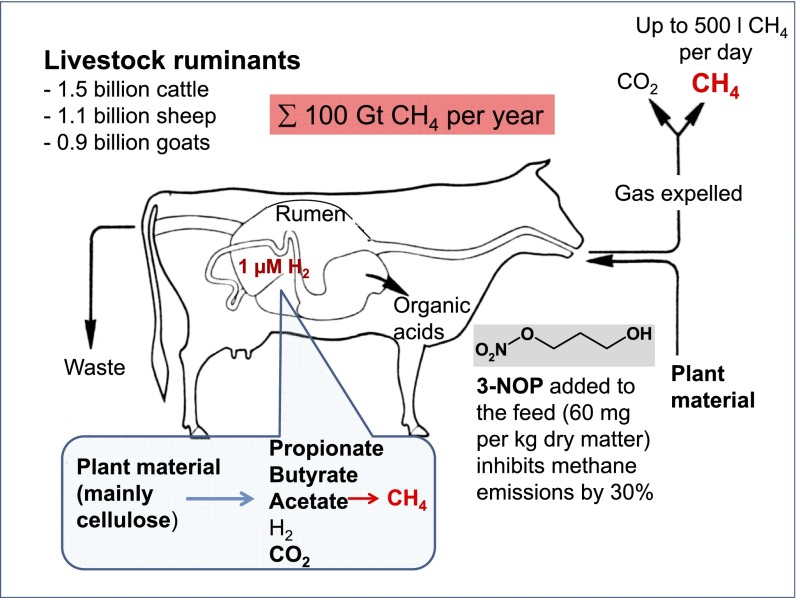
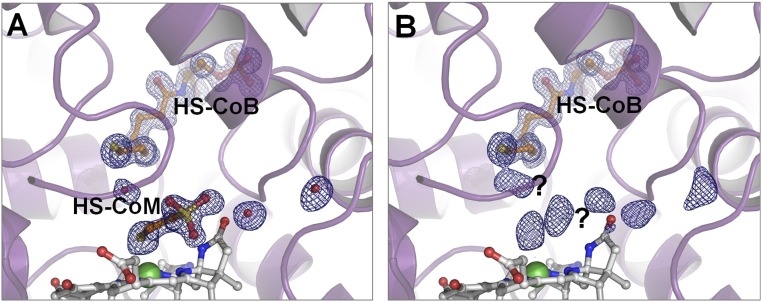
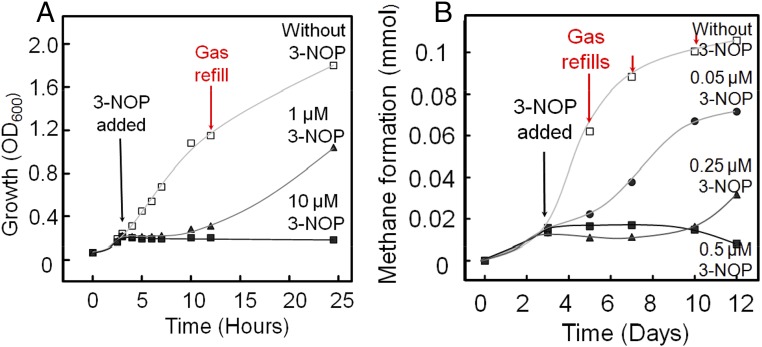
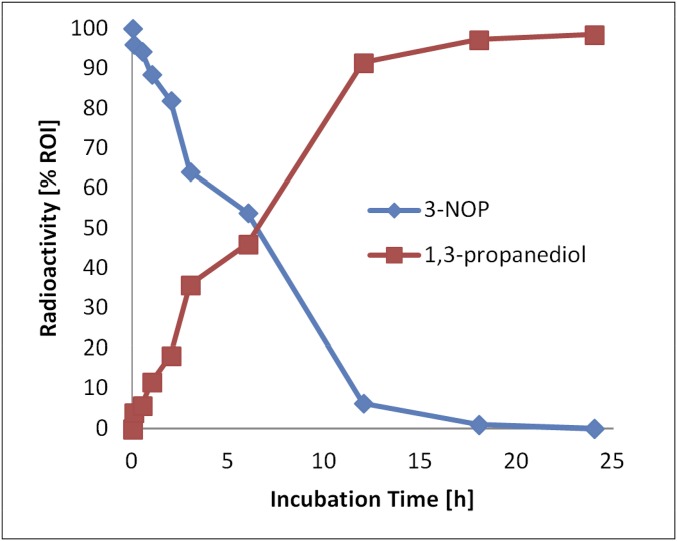
Ruminants, such as cows, sheep, and goats, predominantly ferment in their rumen plant material to acetate, propionate, butyrate, CO2, and methane. Whereas the short fatty acids are absorbed and metabolized by the animals, the greenhouse gas methane escapes via eructation and breathing of the animals into the atmosphere. Along with the methane, up to 12% of the gross energy content of the feedstock is lost. Therefore, our recent report has raised interest in 3-nitrooxypropanol (3-NOP), which when added to the feed of ruminants in milligram amounts persistently reduces enteric methane emissions from livestock without apparent negative side effects [Hristov AN, et al. (2015) Proc Natl Acad Sci USA 112(34):10663-10668]. We now show with the aid of in silico, in vitro, and in vivo experiments that 3-NOP specifically targets methyl-coenzyme M reductase (MCR). The nickel enzyme, which is only active when its Ni ion is in the +1 oxidation state, catalyzes the methane-forming step in the rumen fermentation. Molecular docking suggested that 3-NOP preferably binds into the active site of MCR in a pose that places its reducible nitrate group in electron transfer distance to Ni(I). With purified MCR, we found that 3-NOP indeed inactivates MCR at micromolar concentrations by oxidation of its active site Ni(I). Concomitantly, the nitrate ester is reduced to nitrite, which also inactivates MCR at micromolar concentrations by oxidation of Ni(I). Using pure cultures, 3-NOP is demonstrated to inhibit growth of methanogenic archaea at concentrations that do not affect the growth of nonmethanogenic bacteria in the rumen.
Keywords: climate change; enteric methane; greenhouse gas; methanogenesis; methyl-coenzyme M reductase.
Conflict of interest statement
Conflict of interest statement: The authors working at Auburn University and at the Max Planck Institute in Marburg (E.C.D., T.W., S.S., D.P., B.C., and R.K.T.) declare no competing financial interests. The authors affiliated with Estation Experimental del Zaidin (D.R.Y.-R.) or DSM Nutritional Products (S.D., R.R., R.T.S., and M.K.) have filed patent applications for nitrate esters as inhibitors of rumen methanogenesis.
Figures


Comment in
-
Targeting methanogenesis with a nitrooxypropanol bullet.Proc Natl Acad Sci U S A. 2016 May 31;113(22):6100-1. doi: 10.1073/pnas.1606107113. Epub 2016 May 13. Proc Natl Acad Sci U S A. 2016. PMID: 27179005 Free PMC article. No abstract available.
Comment on
-
Targeting methanogenesis with a nitrooxypropanol bullet.Proc Natl Acad Sci U S A. 2016 May 31;113(22):6100-1. doi: 10.1073/pnas.1606107113. Epub 2016 May 13. Proc Natl Acad Sci U S A. 2016. PMID: 27179005 Free PMC article. No abstract available.
References
-
- Myhre G, et al. Anthropogenic and natural radiative forcing. In: Stocker TF, et al., editors. Climate Change 2013: The Physical Science Basis. Contribution of Working Group I to the Fifth Assessment Report of the Intergovernmental Panel on Climate Change. Cambridge Univ Press; Cambridge, UK: 2013. pp. 659–740.
-
- Shindell D, et al. Simultaneously mitigating near-term climate change and improving human health and food security. Science. 2012;335(6065):183–189. - PubMed
-
- Conrad R. The global methane cycle: Recent advances in understanding the microbial processes involved. Environ Microbiol Rep. 2009;1(5):285–292. - PubMed
-
- Wolin MJ. Fermentation in the rumen and human large intestine. Science. 1981;213(4515):1463–1468. - PubMed
Publication types
MeSH terms
Substances
Associated data
- Actions
LinkOut - more resources
Full Text Sources
Other Literature Sources
Molecular Biology Databases
