Review
doi: 10.1101/cshperspect.a021873.
TGF-β and the TGF-β Family: Context-Dependent Roles in Cell and Tissue Physiology
Affiliations
- PMID: 27141051
- PMCID: PMC4852809
- DOI: 10.1101/cshperspect.a021873
Item in Clipboard
Review
TGF-β and the TGF-β Family: Context-Dependent Roles in Cell and Tissue Physiology
Cold Spring Harb Perspect Biol.
.
Abstract
The transforming growth factor-β (TGF-β) is the prototype of the TGF-β family of growth and differentiation factors, which is encoded by 33 genes in mammals and comprises homo- and heterodimers. This review introduces the reader to the TGF-β family with its complexity of names and biological activities. It also introduces TGF-β as the best-studied factor among the TGF-β family proteins, with its diversity of roles in the control of cell proliferation and differentiation, wound healing and immune system, and its key roles in pathology, for example, skeletal diseases, fibrosis, and cancer.
Copyright © 2016 Cold Spring Harbor Laboratory Press; all rights reserved.
Figures
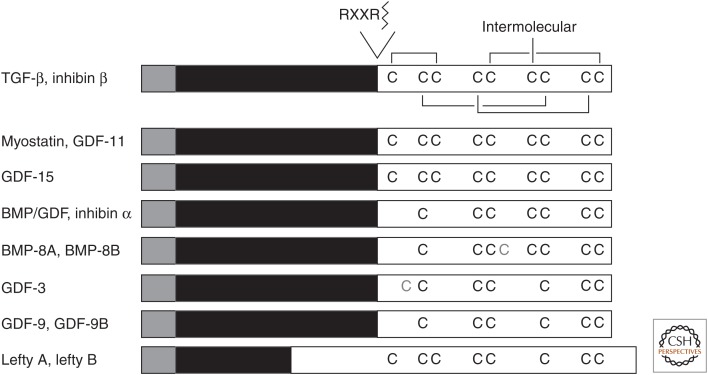
Comparison of the polypeptide organization of TGF-β family proteins. The precursor protein is cleaved by a furin protein convertase, which mainly recognizes the Arg-X-X-Arg (RXXR) motif, but also the Arg-X-Lys/Arg-Arg (RXK/RR) motif. The mature polypeptides (white) contain seven or nine cysteines conserved in most TGF-β family members. These cysteines engage in inter- and intramolecular disulfide bonds. Human BMP-8A, BMP-8B, and GDF-3 have an additional cysteine residue, which is shown in gray, whereas five members lack the cysteine that mediates the disulfide bond in ligand dimerization. Signal peptide, gray; prosegment, black; mature polypeptide, white; TGF-β, transforming growth factor β; BMP, bone morphogenetic protein; GDF, growth and differentiation factor.
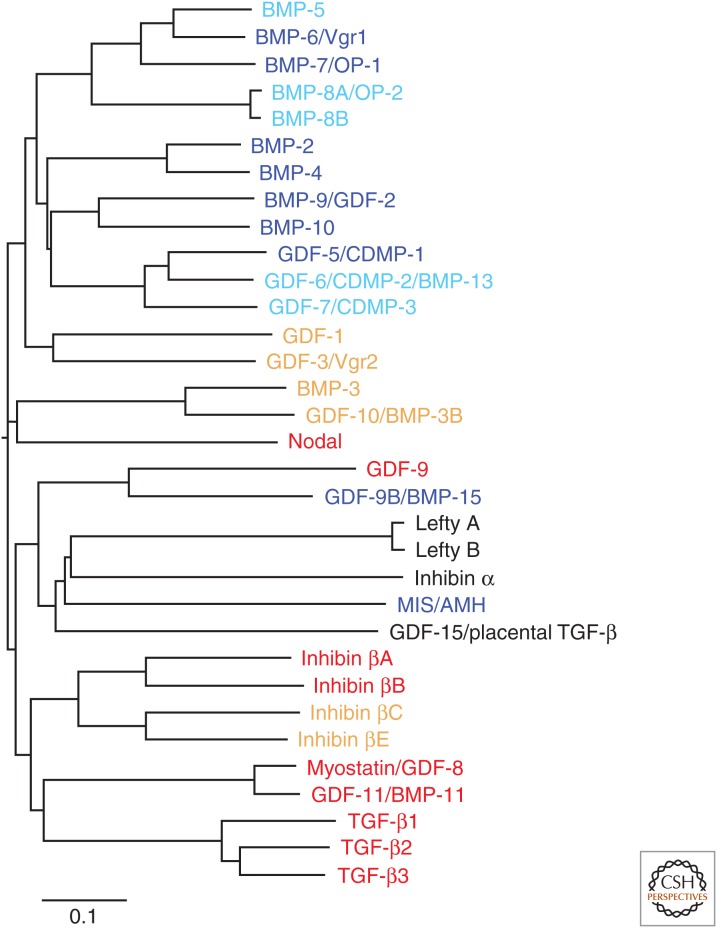
Phylogenetic tree of the 33 TGF-β family polypeptides in human. The amino acid sequences of 33 TGF-β family polypeptides, encoded by their corresponding human genes, were obtained from NCBI’s protein database (www.ncbi.nlm.nih.gov ), and the carboxy-terminal mature polypeptides were assigned based on validated or predicted furin cleavage sites. The sequences were aligned by Clustal Omega (www.clustal.org/omega ) (Sievers et al. 2011) and the phylogenetic tree was illustrated using FigTree v1.4.2 (tree.bio.ed.ac.uk/software/figtree ). Ligands that signal through activin- or TGF-β-activated R-Smads or BMP-activated R-Smads are shown in red or blue, respectively. Ligands that may activate these two types of R-Smads, but whose receptors and Smad-signaling pathways have not been fully determined, are shown in orange or light blue, respectively. BMP, Bone morphogenetic protein; OP, osteogenic protein; GDF, growth and differentiation factor; CDMP, cartilage-derived morphogenetic protein; MIS/AMH, Müllerian-inhibiting substance/anti-Müllerian hormone; TGF-β, transforming growth factor β.
References
-
- Amendt C, Mann A, Schirmacher P, Blessing M. 2002. Resistance of keratinocytes to TGFβ-mediated growth restriction and apoptosis induction accelerates re-epithelialization in skin wounds. J Cell Sci 115: 2189–2198. - PubMed
-
- Anido J, Saez-Borderias A, Gonzalez-Junca A, Rodon L, Folch G, Carmona MA, Prieto-Sanchez RM, Barba I, Martinez-Saez E, Prudkin L, et al. 2010. TGF-β receptor inhibitors target the CD44high/Id1high glioma-initiating cell population in human glioblastoma. Cancer Cell 18: 655–668. - PubMed
Publication types
MeSH terms
Substances
LinkOut - more resources
Full Text Sources
Other Literature Sources
Medical