Review
. 2016 Jun 1;6(6):a022814.
doi: 10.1101/cshperspect.a022814.

Role of Sodium Channels in Epilepsy

Affiliations
Review

Role of Sodium Channels in Epilepsy

David I Kaplan et al. Cold Spring Harb Perspect Med. .

Abstract

Voltage-gated sodium channels (VGSCs) are fundamentally important for the generation and coordinated transmission of action potentials throughout the nervous system. It is, therefore, unsurprising that they have been shown to play a central role in the genesis and alleviation of epilepsy. Genetic studies on patients with epilepsy have identified more than 700 mutations among the genes that encode for VGSCs attesting to their role in pathogenesis. Further, many common antiepileptic drugs act on VGSCs to suppress seizure activity. Here, we present an account of the role of VGSCs in epilepsy, both through their pathogenic dysfunction and as targets for pharmacotherapy.


Figures

Figure 1.
Figure 1.
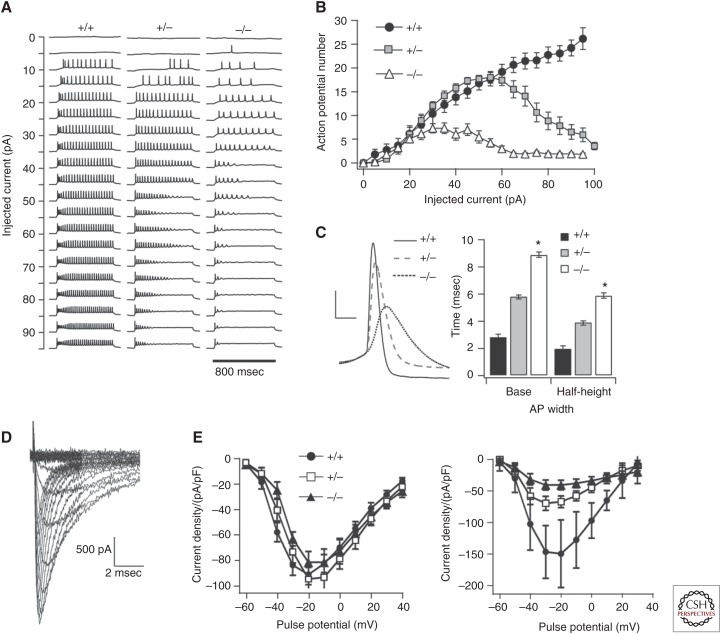
Scn1a knockout and heterozygous mice show a reduction of sodium currents localized to inhibitory interneurons (Yu et al. 2006). (A) Sample voltage traces from current clamp recordings of mouse γ-aminobutyric acid (GABA)ergic interneurons in the wild-type (WT) (left), heterozygous (middle), and null (right) Scn1a mice, showing a marked reduction in cell excitability in the heterozygous and null mice, summarized in B. (C) The size of action potentials (APs) was also reduced with the mutation, whereas the width of APs increased. (D) Voltage-clamp recordings of isolated sodium currents. (E) I–V curves showing that the mutation does not affect current density in pyramidal neurons (left), whereas it does cause a reduction in current in GABAergic neurons (right) (figure created from data in Yu et al. 2003, 2006).
Figure 2.
Figure 2.
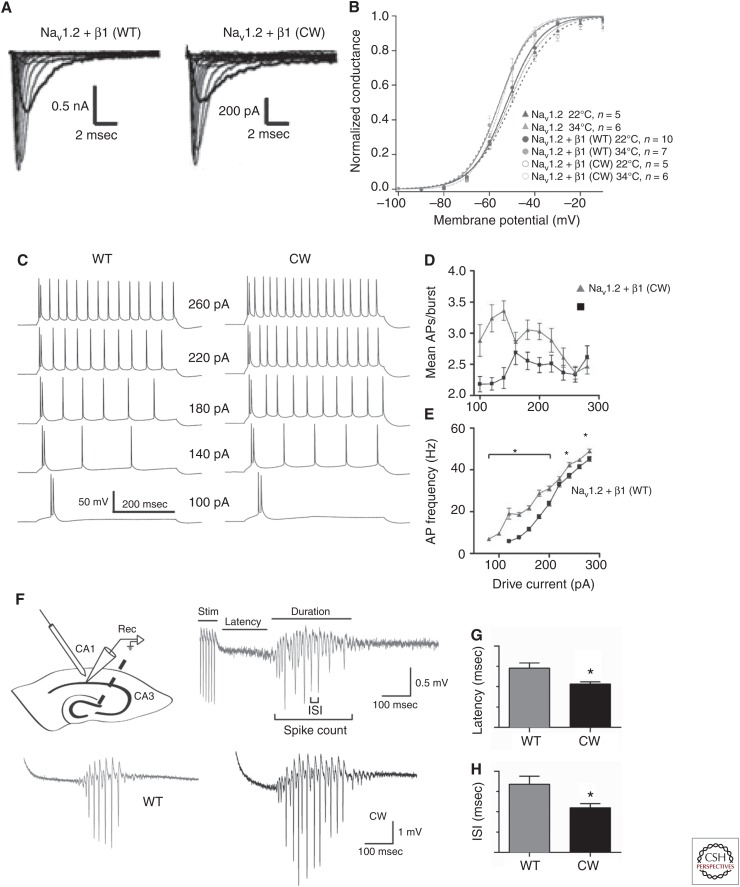
The functional consequences of channel mutations can be analyzed on different spatial scales (Wimmer et al. 2010; Egri et al. 2012; Hatch et al. 2014). (A) Current traces from voltage-clamp analysis of NaV1.2 VGSC α-subunits coexpressed with either the wild-type (WT) β1-subunit (left) or the GEFS+ mutation C121W (right) in Chinese hamster ovary (CHO) cells. (B) Voltage dependence of activation for the NaV1.2, NaV1.2 + β1 (WT), and NaV1.2 + β1 (CW) at 22°C and 34°C. Increasing temperature results in a shift of the voltage of half activation, which is most significant in the NaV1.2 + β1 (CW). (C) Current clamp recordings showing the voltage response of mouse subicular neurons to current injections in WT (left) and C121W heterozygous (right) mice. (D) For most current injections, the C121W mouse showed an increase in action potentials (APs) frequency (E) and the average number of APs per burst. (F) Through tetanic stimulation, network oscillations could be induced in the mouse hippocampus. (G) The latency and (H) interspike interval of these oscillations was reduced in the C121W mouse (figure created from data in Wimmer et al. 2010, Egri et al. 2012, and Hatch et al. 2014). ISI, Interspike interval.

References

    1. Adler EM, Yaari Y, David G, Selzer ME. 1986. Frequency-dependent action of phenytoin on lamprey spinal axons. Brain Res 362: 271–280. - PubMed
    1. Allen AS, Berkovic SF, Cossette P, Delanty N, Dlugos D, Eichler EE, Epstein MP, Glauser T, Goldstein DB, Han Y, et al. 2013. De novo mutations in epileptic encephalopathies. Nature 501: 217–221. - PMC - PubMed
    1. Baasch AL, Huning I, Gilissen C, Klepper J, Veltman JA, Gillessen-Kaesbach G, Hoischen A, Lohmann K. 2014. Exome sequencing identifies a de novo SCN2A mutation in a patient with intractable seizures, severe intellectual disability, optic atrophy, muscular hypotonia, and brain abnormalities. Epilepsia 55: e25–e29. - PubMed
    1. Baraban SC, Dinday MT, Hortopan GA. 2013. Drug screening in Scn1a zebrafish mutant identifies clemizole as a potential Dravet syndrome treatment. Nat Commun 4: 2410. - PMC - PubMed
    1. Brackenbury WJ, Isom LL. 2011. Na channel β subunits: Overachievers of the ion channel family. Front Pharmacol 2: 53. - PMC - PubMed

Substances