


doi: 10.1155/2016/8961486.
Epub 2016 Apr 6.
A Rare Case of Primary Anterior Mediastinal Yolk Sac Tumor in an Elderly Adult Male
Affiliations
- PMID: 27144043
- PMCID: PMC4837257
- DOI: 10.1155/2016/8961486
Item in Clipboard
A Rare Case of Primary Anterior Mediastinal Yolk Sac Tumor in an Elderly Adult Male
Case Rep Oncol Med.
2016.
Abstract
Mediastinal germ cell tumors are extragonadal germ cell tumors (EGGCTs) commonly seen in children and young adults. They are more common in men. Clinically they are classified as teratomas, seminomas, and nonseminomatous germ cell tumors. Primary mediastinal yolk sac neoplasm is an extremely rare tumor. We present here a very rare case of primary yolk sac tumor of the anterior mediastinum in a 73-year-old male. Mediastinal germ cell tumors have a worse prognosis than gonadal germ cell tumors. Chemotherapy followed by adjuvant surgery improves overall response in EGGCTs. However, comorbidities can render treatment with chemotherapy and surgery challenging in elderly patients.
Figures
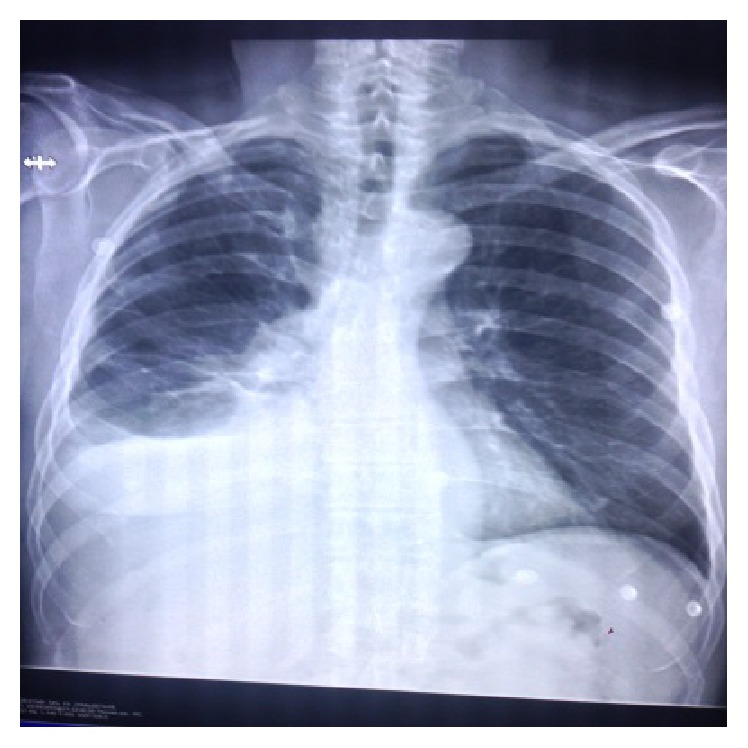
Chest X-ray of 73-year-old male revealing large right unilateral pleural effusion.
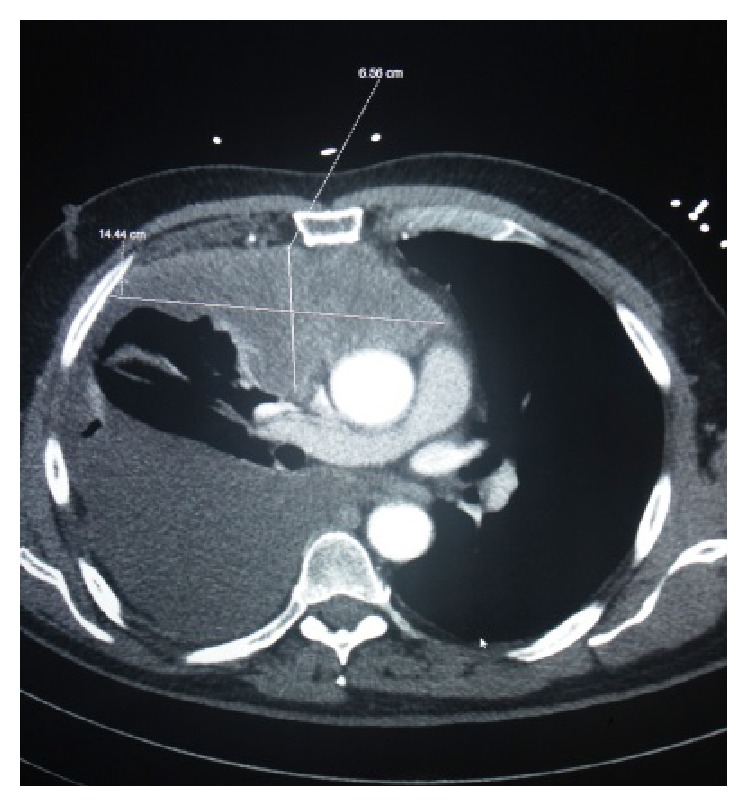
Computerized tomography (CT) scans of chest revealed a large mass/conglomerate lymphadenopathy measuring 6.6 cm × 14.5 cm × 7 cm in the anterior inferior mediastinum extending to involve the anterior right hemithorax, along the pleural surface, associated with a very large right-sided pleural effusion, causing partial collapse of the right inferior and middle lobes.
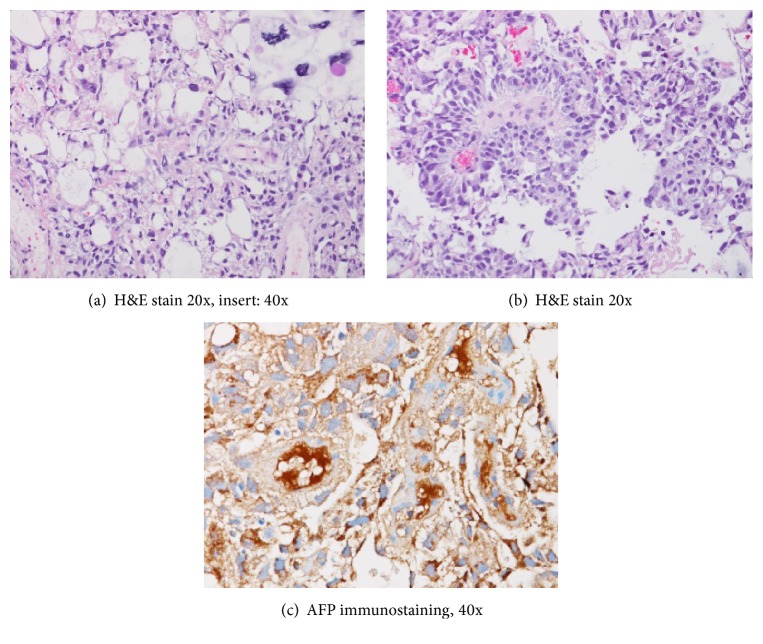
The fine needle aspiration/core biopsy revealed abundant tumor cells that were pleomorphic with reticular growth pattern. The tumor showed focal reactivity with AFP and CDX2 and focal weak reactivity with TTF-1 and is nonreactive with CK7, CK20, Napsin A, p63, calretinin, CK5/6, D2-40, CD31, PSA, PSAP, synaptophysin, chromogranin, CD56, hepar, CD45, CD5, CD10, and CD30.
References
-
- Papaioannou A., Porpodis K., Spyratos D., Zarogoulidis K. Yolk sac tumour in the anterior mediastinum. Pneumon. 2013;26(4):361–365.
-
- Nichols C. R. Mediastinal germ cell tumors. Seminars in Thoracic and Cardiovascular Surgery. 1992;4(1):45–50. - PubMed
-
- Necchi A., Giannatempo P., Lo Vullo S., et al. A prognostic model including pre- and postsurgical variables to enhance risk stratification of primary mediastinal nonseminomatous germ cell tumors: the 27-year experience of a referral center. Clinical Genitourinary Cancer. 2015;13(1):87.e1–93.e1. doi: 10.1016/j.clgc.2014.06.014. - DOI - PubMed
-
- Rodney A. J., Tannir N. M., Siefker-Radtke A. O., et al. Survival outcomes for men with mediastinal germ-cell tumors: the University of Texas M. D. Anderson Cancer Center experience. Urologic Oncology: Seminars and Original Investigations. 2012;30(6):879–885. doi: 10.1016/j.urolonc.2010.08.005. - DOI - PMC - PubMed
LinkOut - more resources
Full Text Sources
Other Literature Sources
